


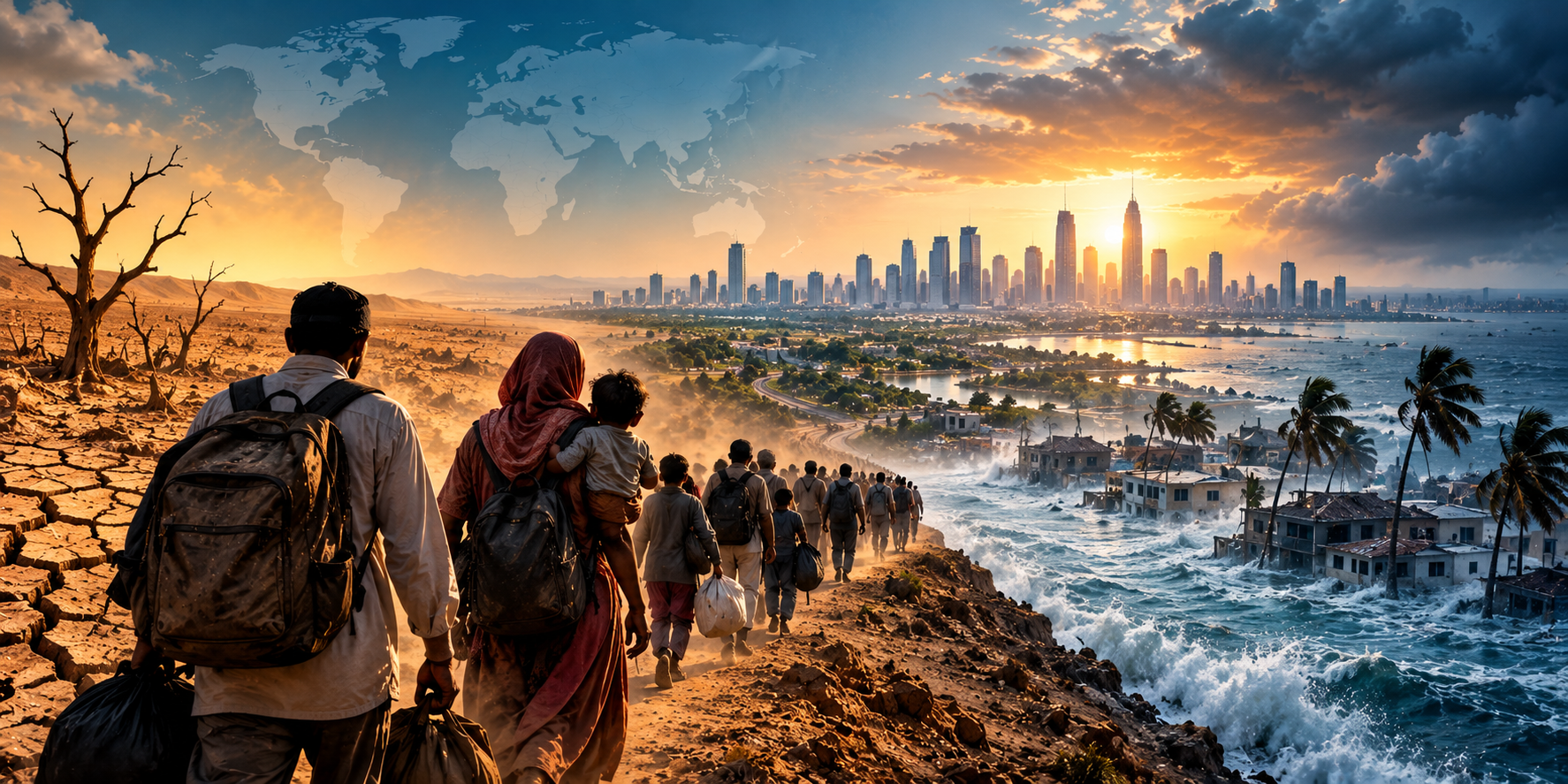
The next great migration of the 21st century may not be driven by war or economic collapse. It may be driven by a quieter force: the growing difficulty of living in places where heat, water, floods, storms and rising seas are changing the basic conditions of life.
For most of human history, migration has been shaped by a familiar set of forces.
People moved because of war.
They moved because of famine.
They moved for jobs.
They moved because of political persecution.
They moved toward cities, ports, fertile land and economic opportunity.
Climate change is beginning to add another force to that equation.
It does not operate alone. Climate change interacts with poverty, food insecurity, conflict, weak infrastructure, population growth and economic inequality. The International Organization for Migration emphasizes that the relationship between climate change and human mobility is complex rather than a simple chain in which rising temperatures automatically produce migration.
But the direction is becoming increasingly clear.
As some places become harder to live in, migration will increasingly become an adaptation strategy.
The consequences could reshape cities, labor markets, national politics, borders and the geopolitical balance of entire regions.
The Migration Crisis May Begin Inside Countries
The most important misconception about climate migration is that it will necessarily mean millions of people crossing international borders.
Most movement is likely to happen much closer to home.
The World Bank’s Groundswell analysis estimates that, without strong climate and development action, climate change could drive 216 million people to move within their own countries by 2050 across six regions.
The projected numbers are striking:
- Sub-Saharan Africa: up to 86 million
- East Asia and the Pacific: 49 million
- South Asia: 40 million
- North Africa: 19 million
- Latin America: 17 million
- Eastern Europe and Central Asia: 5 million
These are not predictions that 216 million people will suddenly leave their homes.
They represent modeled scenarios of internal migration driven by climate-related changes in water availability, agricultural productivity and sea-level rise, alongside demographic and development conditions.
The distinction matters.
Climate migration is likely to be gradual, uneven and deeply interconnected with economics.
A farmer may first move seasonally.
Then a family member may move permanently to a city.
Then the entire household may follow.
Eventually, an entire region can begin losing population.
That is how demographic transformation happens.
The First Climate Migrants Are Already Moving
Climate migration is not simply a story about 2050.
Disaster displacement is already occurring on a massive scale.
According to the Internal Displacement Monitoring Centre, 45.8 million internal displacements associated with disasters were recorded in 2024, the highest annual figure since IDMC began monitoring the phenomenon in 2008. Weather-related hazards, particularly storms and floods, accounted for the overwhelming majority.
The number of “displacements” is not the same as the number of unique people.
One person can be displaced multiple times.
Some evacuations are temporary and lifesaving, with people returning home after a storm or flood.
Others become permanent.
That distinction will become increasingly important as climate shocks become more frequent and expensive to recover from.
The question will increasingly be:
How many times can a community rebuild before rebuilding stops making economic sense?
1. Heat Could Become a Migration Force
Floods and hurricanes are visually dramatic.
Heat is different.
It can transform a region without destroying a single building.
Extreme heat affects outdoor workers.
It reduces agricultural productivity.
It increases cooling costs.
It stresses electricity systems.
It damages infrastructure.
It worsens health risks.
And over time, it can make certain livelihoods increasingly difficult.
The IPCC finds that climate-related migration can result from both sudden events and slow-onset changes, with heat stress and changes to resource-dependent livelihoods contributing to migration in some regions.
This creates a different type of migration pressure.
People may not flee a heatwave.
They may simply decide that their economic future lies somewhere else.
A young person leaves a rural region for a cooler city.
A farming household sends one worker to another part of the country.
A business relocates its operations.
A construction company changes its labor supply.
Over several decades, these individual decisions can completely alter the demographic map.
2. Water May Become One of the World’s Biggest Migration Drivers
Water could become an even more powerful driver.
Climate change is altering rainfall patterns, increasing drought risk in some regions and intensifying water stress.
The World Bank’s climate migration modeling specifically identifies water scarcity as one of the major mechanisms through which climate change can drive internal migration.
This creates a particularly dangerous cycle.
Less water affects agriculture.
Lower agricultural productivity reduces income.
Lower income reduces people’s ability to adapt.
Households then become more likely to migrate.
The destination city receives more people.
Housing demand increases.
Infrastructure comes under pressure.
Water demand rises again.
Climate change therefore does not simply move people.
It can move economic pressure from one location to another.
3. The Great Rural-to-Urban Migration Could Accelerate
The world’s cities may become the primary destination for climate migrants.
That would accelerate an existing historical trend.
People are already moving from rural areas toward cities because cities offer jobs, education, healthcare and infrastructure.
Climate change could reinforce that movement.
A farmer facing declining crop yields may not move to another farm.
They may move to a city.
A fishing community affected by changing marine conditions may move inland.
A flood-prone village may gradually lose residents to a nearby urban center.
The result could be a new generation of climate-driven urbanization.
This presents both an opportunity and a risk.
If cities are prepared, migration can provide workers, entrepreneurs and consumers.
If cities are unprepared, it can produce informal settlements, housing shortages, unemployment, infrastructure stress and political instability.
The difference between the two outcomes may depend less on whether migration occurs than on how governments plan for it.
4. The Global South Will Face the Greatest Pressure
The geography of climate migration will not be evenly distributed.
The poorest and most climate-exposed populations generally have fewer resources to adapt.
They may lack:
- Insurance
- Savings
- Reliable infrastructure
- Air conditioning
- Irrigation
- Disaster-resistant housing
- Access to credit
- Political influence
This creates a paradox.
Those with the fewest resources may face the greatest climate pressures — but may also be the least able to move.
The World Bank warns that climate migration will disproportionately affect poorer and more vulnerable regions.
This produces a concept that deserves more attention:
trapped populations.
A family may live in a place where farming is becoming increasingly difficult.
But moving requires money.
So they stay.
Climate change does not always create migration.
Sometimes it creates involuntary immobility.
5. The People Who Move May Not Be the Poorest
There is another important paradox.
Migration itself costs money.
A household needs transportation, accommodation, documentation, job networks and sometimes education.
As a result, the most severely affected communities may not necessarily produce the largest migrant flows.
People with some resources may be the first to leave.
They can afford to move.
Those with nothing may remain behind.
This means climate migration could initially become a story of unequal mobility.
Some people will adapt by moving.
Others will be forced to remain in increasingly vulnerable locations.
That difference could become one of the defining inequalities of the climate era.
6. Coastal Cities Face a Different Future
Some of the world’s most important cities were built near water.
That was historically an enormous economic advantage.
Ports enabled trade.
Rivers enabled agriculture.
Coasts enabled shipping.
Today, those same geographic advantages are becoming sources of climate risk.
Sea-level rise, coastal flooding, storm surges and saltwater intrusion can threaten homes, infrastructure and freshwater supplies.
The World Bank identifies sea-level rise as one of the key climate mechanisms that could generate future internal migration.
The consequences could be enormous.
Think about cities such as:
Mumbai.
Dhaka.
Jakarta.
Alexandria.
Shanghai.
Miami.
Lagos.
Manila.
Their futures will depend partly on how effectively they can protect themselves.
But protection has limits.
At some point, governments may have to make a difficult decision:
Defend the city, redesign the city, or move people away from the most vulnerable areas.
7. Planned Relocation Could Become a Normal Government Policy
For much of modern history, governments treated relocation as something that happened after disasters.
That approach may change.
Governments could increasingly decide in advance that certain communities should move.
This is known as planned relocation.
It could involve:
- Moving coastal communities
- Relocating villages exposed to repeated flooding
- Resettling populations affected by erosion
- Moving infrastructure away from high-risk areas
- Creating new urban settlements
- Offering financial incentives to relocate
The challenge is political.
People do not always want to leave ancestral land.
Communities have cultural identities.
Land ownership is emotionally and politically sensitive.
A technically sensible relocation plan can therefore become socially explosive.
Climate adaptation will increasingly require governments to answer not only:
Where can people safely live?
but also:
Who gets to decide where they live?
8. Small Island States Face the Most Difficult Question
For some island nations, the problem is existential.
If sea-level rise, coastal erosion, saltwater intrusion and extreme weather make parts of an island increasingly difficult to inhabit, migration may eventually become unavoidable.
This raises questions that traditional migration law was not designed to answer.
What happens when an entire community needs to relocate?
What happens to national identity?
What happens to property?
What happens if people move permanently to another country?
What happens to sovereignty if the physical territory becomes difficult to inhabit?
These are not theoretical questions.
They could become major issues of international law and diplomacy during the coming decades.
The World Bank has warned that small island and atoll communities face particularly severe challenges from rising seas and climate-related displacement.
9. Africa Could Become the Epicenter of Climate Migration
Sub-Saharan Africa stands out in almost every major climate-migration scenario.
The World Bank’s Groundswell modeling projects up to 86 million internal climate migrants in Sub-Saharan Africa by 2050 under a scenario of significant climate and development pressures.
Several factors overlap:
- Rapid population growth
- Dependence on agriculture
- Water stress
- Extreme heat
- Conflict
- Poverty
- Limited infrastructure
- Rapid urbanization
Climate change therefore becomes a multiplier.
A drought does not simply create a drought problem.
It can become a food problem.
Then an employment problem.
Then a migration problem.
Then an urbanization problem.
Then potentially a political problem.
This is why climate migration cannot be separated from development policy.
10. South Asia May Become One of the World’s Most Important Migration Zones
South Asia presents another major challenge.
The region combines:
Huge populations + climate exposure + dense cities + agricultural dependence + major river systems.
The World Bank estimates that South Asia could account for up to 40 million internal climate migrants by 2050 under its adverse scenario.
India, Bangladesh, Pakistan and other countries could face multiple simultaneous pressures.
Heat.
Flooding.
Water stress.
Agricultural disruption.
Cyclones.
Coastal risks.
These forces will not necessarily produce one giant cross-border migration wave.
Instead, the region could experience millions of smaller movements:
Village → town
Town → city
Coast → inland
Rural → urban
Small city → megacity
And occasionally:
One country → another
The cumulative effect could be enormous.
11. Climate Change Could Redraw Labor Markets
Migration is not only about humanitarian movement.
It is also about labor.
As climate conditions change, the location of economic activity may change.
Some agricultural regions may become less productive.
Some cities may become too hot for certain forms of outdoor work during parts of the year.
Some coastal industrial zones may face higher insurance and infrastructure costs.
Other regions could become relatively more attractive.
This could create a new geography of labor.
Workers may move toward:
- Cooler regions
- Better-watered regions
- Higher-elevation cities
- Resilient urban centers
- Industrial zones with strong infrastructure
Companies may follow.
Investment may follow.
Governments may then redirect infrastructure spending.
Climate change could therefore influence not only where people live but where economic growth happens.
12. The Next Megacities May Be Climate Cities
Today’s largest cities grew around trade, rivers, industry and finance.
Tomorrow’s successful cities may increasingly be judged by something else:
resilience.
A climate-resilient city will need:
- Reliable water
- Efficient drainage
- Heat-resistant infrastructure
- Affordable housing
- Public transport
- Cooling systems
- Renewable energy
- Emergency services
- Green spaces
- Strong healthcare
- Disaster-response capabilities
This could create a new competitive advantage.
Cities that successfully absorb climate migration could become economic winners.
Cities that fail to adapt could lose both residents and investment.
Climate resilience could become a form of economic infrastructure.
13. Migration Could Become an Adaptation Strategy
Migration is often discussed as a failure.
But it can also be an adaptation mechanism.
The IOM emphasizes that human mobility can be part of adaptation when it occurs under safe and informed conditions and is supported by appropriate policy.
A worker moving from a drought-prone agricultural region to a city may gain a more stable income.
A household relocating before repeated floods destroy its assets may reduce long-term vulnerability.
Seasonal migration can diversify income.
Remittances can help families invest in resilient housing, education and livelihoods.
The problem is not migration itself.
The problem is forced, unmanaged and unequal migration.
14. The Phrase “Climate Refugee” Is More Complicated Than It Sounds
The term “climate refugee” has become common in public discussion.
But legally, it is problematic.
UNHCR states that “climate refugee” is not a recognized category under international law. Most climate-related displacement occurs within national borders, while the legal definition of a refugee generally concerns people who cross an international border because of persecution or other circumstances specified under applicable refugee frameworks.
That does not mean people displaced across borders by climate-related conditions lack all forms of protection.
Climate change can interact with conflict, persecution and serious disturbances of public order in ways that bring existing international protection frameworks into play.
But the terminology matters because the legal question will become increasingly important.
If a person cannot safely return home because climate change has destroyed the conditions necessary for life, what obligations does another country have?
There is no simple global answer.
And the number of such cases could grow.
15. Climate Migration Could Reshape Immigration Politics
Migration is already one of the most politically sensitive issues in the world.
Climate change could intensify those debates.
Countries receiving migrants may face pressure over:
- Border controls
- Housing
- Employment
- Public services
- National identity
- Security
- Citizenship
Political movements may use climate migration to argue for either more restrictive or more generous immigration policies.
This could create a new political divide.
One side may argue:
Climate change creates a humanitarian obligation to accept migrants.
Another may argue:
Every country must prioritize adaptation and controlled migration within its own borders.
A third approach may focus on legal labor mobility:
Create safe pathways for people whose regions are becoming economically or physically unviable.
The politics will vary by country.
But climate migration is likely to become part of the immigration debate whether governments are prepared for it or not.
16. The Biggest Migration Crisis May Not Be a Border Crisis
This distinction is crucial.
Imagine a country where 20 million people gradually relocate from vulnerable rural areas into cities.
There may be no dramatic border crossing.
No refugee camp.
No international emergency.
Yet the country could experience an enormous transformation.
Housing markets change.
Election maps change.
Infrastructure requirements change.
Labor markets change.
Water demand changes.
Political power shifts.
That may be the real climate-migration story.
Not millions crossing borders at once, but millions gradually changing the geography of their own countries.
17. Climate and Conflict Can Create a Dangerous Feedback Loop
Climate change does not automatically cause war.
But it can increase pressure in already fragile societies.
UNHCR describes climate change as a “risk multiplier” that can interact with conflict, poverty and displacement.
Consider the chain:
Drought reduces agricultural income.
Food prices increase.
Competition over resources intensifies.
People move.
Host communities face additional pressure.
Political tensions rise.
Violence may increase.
More people flee.
Climate change has not “caused” the conflict in a simple sense.
But it has changed the environment in which conflict occurs.
This is why future migration policy cannot be separated from peacebuilding and development.
18. Countries That Attract Migrants Could Gain Economically
There is another side to the story.
Migration does not necessarily weaken receiving countries.
If managed effectively, migrants can expand:
- Labor supply
- Consumer demand
- Entrepreneurship
- Tax revenues
- Innovation
- Skills
The United States, Canada, Australia and many European economies have historically benefited from immigration.
Climate change could reinforce this dynamic.
Some countries with aging populations may actually need migrants.
This creates a potential strategic alignment:
Climate-vulnerable countries need pathways for mobility.
Aging economies need workers.
The challenge is designing systems that connect the two.
19. The Gulf Could Become a Major Climate Migration Destination
The Gulf presents an unusual case.
Countries such as Saudi Arabia and the UAE are investing heavily in infrastructure designed to withstand extreme heat while also building diversified economies that require large workforces.
But the Gulf itself faces severe heat and water constraints.
This creates a complicated future.
The region may simultaneously be:
A climate-vulnerable region and a destination for workers displaced by climate stress elsewhere.
That could make Gulf migration policy increasingly important.
Saudi Arabia, the UAE and other Gulf economies may have to balance domestic workforce policies, expatriate labor needs, climate resilience and regional migration pressures.
The result could be a very different Gulf labor market by 2040.
20. India Could Become Both a Source and Destination of Climate Migration
India is particularly important because of its scale.
Climate stress could push people away from some rural, agricultural and coastal regions.
At the same time, India’s rapidly expanding cities and industrial corridors could attract workers.
This creates an internal redistribution of population.
Mumbai, Delhi, Bengaluru, Hyderabad, Chennai, Pune and other urban centers could see growing demand for housing and infrastructure.
But new economic centers may also emerge.
If climate conditions make some traditional economic zones increasingly difficult, investment could shift toward regions with better water availability, infrastructure and resilience.
India’s climate-migration challenge may therefore become a question of where the next 100 million people live and work.
21. Governments Need to Plan for Migration Before It Happens
The biggest mistake would be treating climate migration as an emergency that begins only after people have moved.
Planning needs to happen earlier.
Governments can:
- Invest in climate-resilient cities
- Improve water management
- Protect agricultural livelihoods
- Build early-warning systems
- Expand social protection
- Create affordable housing
- Develop new economic centers
- Establish planned relocation frameworks
- Create legal mobility pathways
- Invest in skills and employment
The World Bank estimates that strong climate action and inclusive development could reduce projected internal climate migration by as much as 80%.
That is perhaps the most important number in the entire climate-migration debate.
The future is not predetermined.
Climate policy is migration policy.
And development policy is climate policy.
22. The Future Could Produce Three Types of Climate Mobility
The world is likely to see three broad categories.
1. Adaptive Migration
People move voluntarily toward better economic and environmental opportunities.
This can be beneficial.
2. Managed Relocation
Governments move communities away from areas that are becoming increasingly dangerous.
This is difficult but potentially necessary.
3. Forced Displacement
People are suddenly forced to leave because of floods, storms, drought, fires, conflict or the collapse of livelihoods.
This is the most humanitarian form of climate mobility.
The policy objective should be to maximize the first category, carefully manage the second and minimize the third.
23. The New Geography of Opportunity
Climate change will not make every vulnerable place uninhabitable.
Nor will it make every cooler region prosperous.
But it could change relative attractiveness.
Some places may gain advantages because they have:
- More water
- Better infrastructure
- Lower heat exposure
- Strong institutions
- Economic opportunity
- Affordable housing
- Reliable energy
Others may become increasingly expensive to defend.
This could create a new geography of investment.
Investors may begin asking questions that would have sounded unusual twenty years ago:
How much water does this city have?
How hot will it be in 2040?
How vulnerable is the coastline?
Can the electricity grid withstand extreme heat?
What happens if thousands of people migrate here?
Climate risk is becoming demographic risk.
Demographic risk is becoming economic risk.
24. Climate Migration Could Become One of the Defining Geopolitical Issues of 2050
The geopolitical consequences could be profound.
Imagine several decades from now:
Large populations have moved toward major cities.
Some coastal communities have relocated.
Water-stressed regions have lost agricultural workers.
New economic centers have emerged.
Countries are competing for migrants with valuable skills.
Other countries are trying to prevent uncontrolled inflows.
Borders have become more politically important.
International organizations are negotiating new protection mechanisms.
And governments are investing billions in climate-resilient urban infrastructure.
At that point, climate migration will no longer be considered an environmental issue.
It will be:
an economic issue.
A security issue.
A demographic issue.
A development issue.
A foreign-policy issue.
The Countries That Prepare Will Have an Advantage
Climate migration does not have to become a global catastrophe.
Migration itself is not the enemy.
Unplanned migration is.
The countries that recognize demographic changes early will have enormous advantages.
They can build housing before populations arrive.
They can expand transport networks.
They can create jobs.
They can protect water supplies.
They can redesign cities.
They can develop legal migration channels.
They can invest in vulnerable communities before people are forced to leave.
The greatest climate-migration policy may therefore be one that allows people to move before they are forced to flee.
The World Needs a New Migration Framework
The international migration system was largely designed around economic migration, persecution, conflict and conventional refugee movements.
Climate change complicates those categories.
A person may leave because a drought destroyed their livelihood.
Another may leave because repeated floods destroyed their home.
Another may leave because climate stress intensified an existing conflict.
Another may relocate voluntarily because their children will have better opportunities elsewhere.
These cases cannot all be treated the same.
The world will need more nuanced frameworks covering:
- Temporary protection
- Planned relocation
- Disaster displacement
- Labor mobility
- Regional migration agreements
- Remittance systems
- Adaptation finance
- Cross-border humanitarian assistance
The legal architecture will have to catch up with the physical reality.
Frequently Asked Questions
Will climate change create millions of refugees?
It could contribute to more cross-border displacement, but most climate-related movement currently occurs within countries. The World Bank’s major 2050 estimate concerns 216 million potential internal climate migrants, not international refugees.
Which regions are most vulnerable?
Sub-Saharan Africa, South Asia, East Asia and the Pacific, North Africa, parts of Latin America and low-lying coastal and island communities face significant risks. The scale varies greatly depending on emissions, development, adaptation and migration policies.
Is “climate refugee” a legal term?
No. UNHCR does not endorse the term as a formal legal category. Most people displaced by climate-related hazards remain within their own countries and are therefore internally displaced rather than refugees under the 1951 Refugee Convention.
Will climate migrants mainly move from poor countries to rich countries?
Not necessarily. Much climate-related migration is expected to occur within countries or between neighboring countries. People generally prefer to remain relatively close to their homes when possible, and the cost of long-distance migration can itself be a barrier.
Could climate migration benefit some countries?
Yes. Countries with aging populations, labor shortages and strong economies could potentially benefit from well-managed migration. The challenge will be creating legal and social systems that allow migration to be orderly and economically productive.
Can climate adaptation prevent migration?
It can reduce forced migration, but not necessarily eliminate movement. The World Bank estimates that strong climate and development action could reduce projected internal climate migration by as much as 80%.
Conclusion
The defining migration story of the 21st century may not be a single mass exodus.
It may be millions of individual decisions.
A farmer leaves a village.
A family moves away from a floodplain.
A young worker leaves a drought-stricken region.
A coastal community relocates inland.
A company moves to a city with better water security.
A government builds a new urban center to accommodate people arriving from elsewhere.
One decision becomes thousands.
Thousands become millions.
And eventually, the map changes.
That is what makes climate migration different from a conventional refugee crisis.
It will not necessarily arrive as one dramatic wave.
It may unfold gradually — almost invisibly — until countries realize that their populations, cities, economies and political landscapes have already changed.
The great climate migration of the future may therefore not be defined by people crossing borders.
It may be defined by where the world’s next generation chooses — or is forced — to live.
And the countries that understand that transformation early will have an enormous advantage.
Climate change will reshape the planet.
But it may be the movement of people that reshapes the world.


