


The International Wire | Climate & Global Affairs
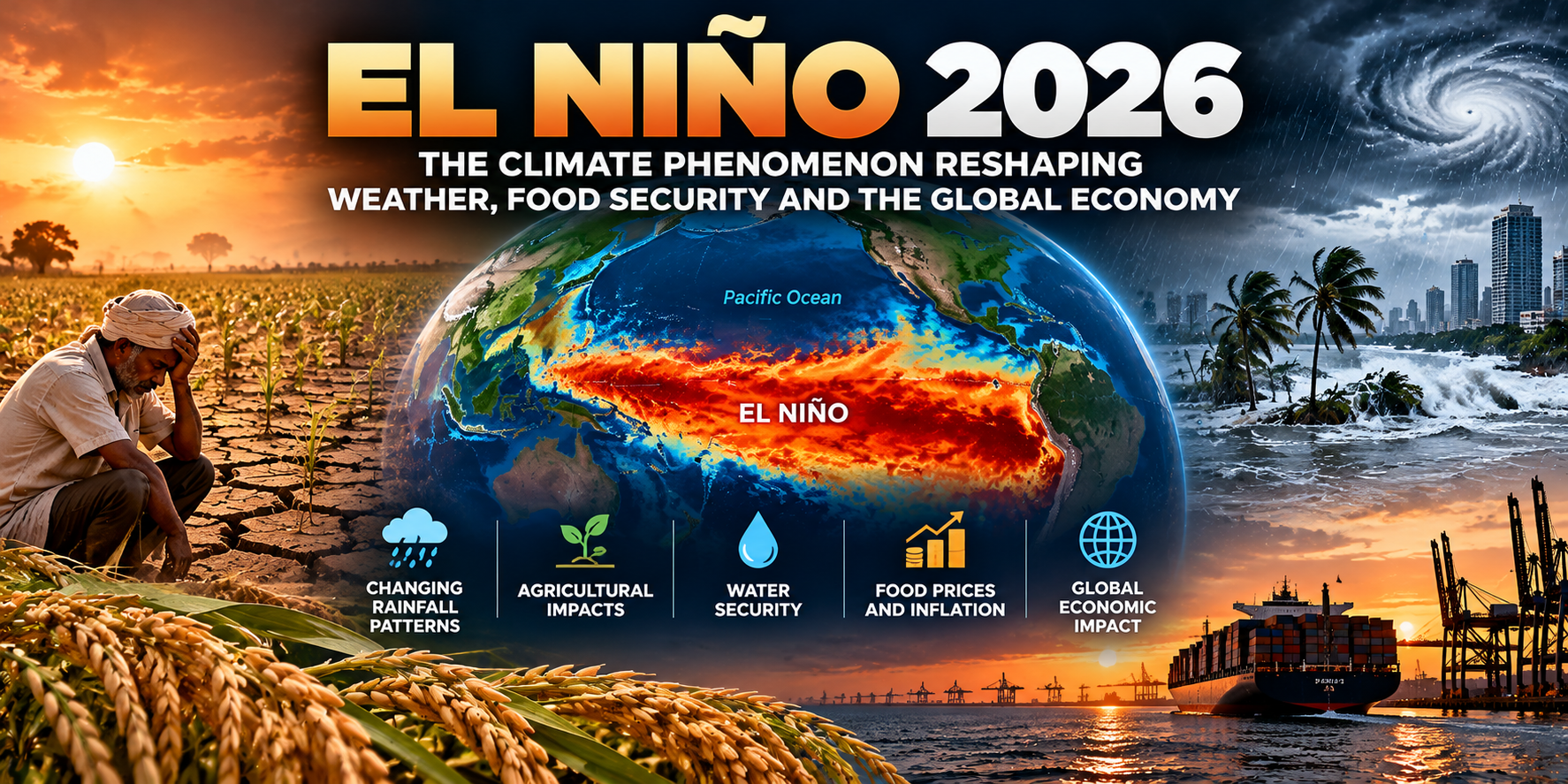
The strengthening El Niño is raising the risk of extreme heat, disrupted rainfall, agricultural losses and water stress. With India emerging from a deficient monsoon and global temperatures remaining exceptionally high, the consequences are extending beyond weather into food prices, economic stability and geopolitical risk.
Introduction: When the Pacific Ocean Changes the World
A change in ocean temperatures thousands of kilometres from India can influence the rainfall that sustains its farmers, the water available to its cities, the price of food in its markets and the economic calculations of governments around the world.
That is the significance of El Niño.
The climate phenomenon, which originates in the tropical Pacific Ocean, is strengthening in 2026. On 8 October, the World Meteorological Organization warned that sea-surface temperatures in the central and eastern tropical Pacific were forecast to reach exceptional levels during October–December. The event is expected to influence weather patterns, economies and ecosystems around the world. The US National Oceanic and Atmospheric Administration (NOAA) also reported that a strong-to-very-strong El Niño was likely to persist through January–March 2027. <Cite refs={[“turn122005search1″,”turn122005search3”]}/>
The implications are already becoming visible. India has experienced a deficient 2026 southwest monsoon, with drought concerns affecting agricultural regions. Water availability is under pressure in parts of the country, while businesses and policymakers are preparing for the possibility of further rainfall disruption. Internationally, the event is increasing the risk of extreme heat, drought in some regions and excessive rainfall in others.
Yet El Niño is more than a meteorological story. It is an economic and strategic challenge because modern societies depend on predictable water supplies, stable agricultural production and reliable infrastructure.
The central question is no longer simply how strong El Niño will become. It is how effectively governments, businesses and communities can manage the consequences of a climate system that is becoming increasingly difficult to predict.
1. What Is El Niño—and Why Does It Matter?
El Niño is the warm phase of the El Niño–Southern Oscillation, or ENSO, a natural climate pattern involving changes in ocean temperatures and atmospheric circulation across the tropical Pacific.
Under normal conditions, trade winds push warm surface water towards the western Pacific, while cooler water rises in parts of the eastern Pacific. During El Niño, these winds weaken or change, allowing unusually warm water to spread across the central and eastern equatorial Pacific.
That ocean warming alters atmospheric circulation, shifting the location and intensity of rainfall, storms and large-scale weather systems.
The consequences differ by region. El Niño can increase drought risk in parts of South and Southeast Asia and Australia, while raising the likelihood of wetter conditions in some parts of the Americas and eastern Africa. These are broad climate tendencies, not guarantees of specific local weather events. <Cite refs={[“turn122005search1″,”turn122005search2”]}/>
El Niño also tends to increase global average temperatures. Its effects interact with long-term human-driven climate change, which has already raised the baseline temperature of the atmosphere and oceans.
This interaction matters. When an El Niño event develops in an already warming climate, its contribution to global heat can increase the likelihood of dangerous temperature extremes. The precise effect on any individual heatwave, flood or drought depends on several factors, including local geography, atmospheric circulation and other ocean conditions.
El Niño is therefore not the sole cause of extreme weather. It is a major climate driver that can make certain outcomes more likely and intensify existing vulnerabilities.
2. El Niño 2026: A Powerful Event Still Developing
The current event has strengthened rapidly.
In its 8 October diagnostic update, NOAA reported that sea-surface temperature anomalies had exceeded 4°C above average in parts of the eastern equatorial Pacific. Its Niño 3.4 index, a key measure used to monitor El Niño, had reached +2.1°C. NOAA assessed that there was more than an 83% chance of strong-to-very-strong conditions persisting through January–March 2027. <Cite refs={[“turn122005search3″,”turn122005search5”]}/>
These measurements indicate substantial ocean warming. However, the precise peak intensity and the resulting regional impacts remain uncertain.
The WMO’s October outlook expects the event to continue intensifying ahead of a likely peak in December. Its seasonal forecast points to above-average temperatures across much of the world, alongside significant shifts in rainfall patterns. Wetter-than-normal conditions are favoured in parts of the Greater Horn of Africa, northern Arabia, Central Asia and coastal East Asia. Drier-than-normal conditions are favoured across the Indian subcontinent and several other regions. <Cite refs={[“turn122005search1”]}/>
The term “super El Niño” has appeared in public discussion of the event. It is an informal description rather than a separate, universally standardised scientific classification. The more useful questions are how ocean temperatures evolve, how atmospheric circulation responds and which communities face the greatest exposure.
The developing event also coincides with exceptionally warm global oceans and a forecast positive Indian Ocean Dipole. The interaction between these climate drivers can influence rainfall patterns around the Indian Ocean, making regional forecasting particularly important. <Cite refs={[“turn122005search2″,”turn122005search0”]}/>
The emerging picture is one of elevated risk rather than a predetermined global disaster. Forecasts identify where preparations may be most valuable; they do not establish that every anticipated impact will occur.
3. India’s Monsoon: The First Major Test
For India, the monsoon is not simply a seasonal weather event. It is a foundation of agricultural production, rural employment, reservoir replenishment and water security.
The 2026 southwest monsoon ended with a reported rainfall deficit of approximately 13%, according to reporting on the India Meteorological Department’s seasonal assessment. In April, the IMD had forecast seasonal rainfall at 92% of the long-period average, with a model error of plus or minus five percentage points. The eventual shortfall has reinforced concerns about water availability and agricultural output. <Cite refs={[“turn122005search9″,”turn122005search10”]}/>
El Niño is an important factor in this picture. Historically, the phenomenon has often been associated with weaker Indian summer monsoons, particularly during the latter part of the season. But the relationship is not automatic: some El Niño years have still recorded normal or above-normal rainfall because other climate drivers can offset its influence.
India’s immediate challenge is to manage the consequences of the rainfall deficit already recorded while preparing for the next agricultural and water-management cycle.
Agricultural losses and rural livelihoods
Rain-fed agriculture is particularly vulnerable when rainfall is deficient or poorly distributed. A delayed onset, a prolonged dry spell or insufficient rain during a critical crop-growth stage can reduce yields even if other periods receive substantial rainfall.
Rice, pulses, oilseeds, cotton and other crops can be affected differently depending on their location, irrigation access and stage of development. Reduced production can weaken farm incomes, increase the need for relief measures and place pressure on agricultural supply chains.
The effects can extend beyond farmers. Food processors, traders, transport operators and rural retailers may all be affected when production falls or procurement becomes more expensive.
Drought risks across states
The effects are not uniform across India. Several regions have reported severe rainfall shortages and agricultural distress.
Andhra Pradesh has declared drought conditions in 21 districts for the 2026 kharif season, with hundreds of administrative blocks classified as severely or moderately affected. Reporting on the state’s assessment cited a substantial rainfall deficit during the June–August period. <Cite refs={[“turn122005news44”]}/>
In Maharashtra, water-supply restrictions have been announced in response to drought concerns and expectations that El Niño conditions may persist into the following year. Such measures illustrate how the impact of a weak monsoon can extend from farms to towns and cities. <Cite refs={[“turn122005news43”]}/>
These developments should not be attributed to El Niño alone. Local rainfall patterns, groundwater depletion, reservoir levels, irrigation systems and water-management decisions also influence the severity of drought.
The immediate priority is to direct water and agricultural support towards the places where the risk is greatest.
4. Water Security: The Crisis Beyond the Fields
A deficient monsoon can leave consequences long after the rainy season ends.
Reservoirs may receive less inflow, groundwater recharge can weaken and communities may become more dependent on stored water or alternative supplies. These pressures can affect drinking water, irrigation, electricity generation and industrial operations.
For cities, water shortages can lead to restrictions, increased costs and pressure on local authorities to prioritise essential uses. For industries, unreliable water supplies can interrupt production in sectors ranging from food processing to manufacturing.
The challenge is particularly acute where population growth, urban expansion and intensive agriculture have already placed pressure on available resources.
A strong El Niño lasting into early 2027 would increase the importance of careful reservoir management, groundwater monitoring and demand reduction. It would not, by itself, determine whether a particular city experiences a shortage. Local storage, infrastructure and policy decisions remain critical.
India’s response should therefore focus on resilience rather than waiting for the next monsoon to resolve every problem.
Measures include repairing distribution leaks, improving irrigation efficiency, restoring local water bodies, expanding rainwater harvesting and encouraging crop choices that are better suited to local water availability.
In water-stressed areas, the economic value of a crop must be considered alongside the water required to produce it. This is especially relevant where water-intensive crops compete with drinking-water needs and other essential uses.
5. Food Prices and Inflation: How Climate Becomes an Economic Problem
When rainfall affects crop production, the consequences can move quickly from farms into food markets.
Lower yields can tighten supply, while farmers and distributors may face higher costs for irrigation, electricity, transport and other inputs. If shortages coincide with strong demand, prices can rise. The extent of the increase depends on the crop, the size of the production shortfall, government stocks, imports and the ability of supply chains to adjust.
India’s September 2026 retail inflation rose to 5.54%, according to Reuters reporting on 12 October. Food inflation reached 7.74%, with rising prices for essential items contributing to the increase. The report also cited poor monsoon conditions and higher global energy and transport costs among the pressures affecting the inflation outlook. <Cite refs={[“turn122005news36″,”turn122005news39”]}/>
These figures do not establish that El Niño alone caused the rise in inflation. Food prices are influenced by multiple factors, including harvest conditions, seasonal supply, storage, distribution, fuel costs and policy decisions. Nevertheless, a weak monsoon can increase the risk of further price pressure if it reduces production or leaves supplies tighter than expected.
The implications extend beyond India. When major agricultural producers experience adverse weather, global markets can become more volatile. Export restrictions, changes in import demand and higher freight costs can amplify the impact on countries that rely heavily on imported food.
For low-income households, food inflation is especially damaging because essential purchases consume a large share of their budgets. Governments may then face difficult choices between supporting consumers, protecting farmer incomes and maintaining fiscal discipline.
Climate resilience is consequently part of economic policy. Better weather forecasts, reliable crop data, effective storage and targeted support can reduce the likelihood that a rainfall shock becomes a broader inflation crisis.
6. Global Agriculture: Different Regions, Different Risks
El Niño does not produce the same outcome everywhere. Its effects depend on regional climate patterns, the season, local infrastructure and the crops being grown.
In parts of South and Southeast Asia, the event can increase the likelihood of rainfall deficits and heat stress. In Australia, it can raise drought and wildfire risks. In parts of the Americas, it can alter rainfall patterns in ways that affect agriculture, water supplies and ecosystems.
Elsewhere, El Niño can increase the likelihood of excessive rainfall. The WMO’s October outlook identifies wetter-than-normal conditions in parts of the Greater Horn of Africa, northern Arabia, Central Asia and coastal East Asia, while drier conditions are favoured across the Indian subcontinent and several other regions. <Cite refs={[“turn122005search1”]}/>
These patterns can have significant economic consequences.
Drought can reduce crop yields, increase irrigation demand and affect livestock. Excessive rainfall can damage crops, flood farmland, disrupt transport and delay harvests. In both cases, the timing of the event matters: rainfall arriving at the wrong stage of a crop’s development can be as damaging as a seasonal shortfall.
Global food markets can therefore experience simultaneous pressures in different regions. A surplus in one country may partly offset a shortage elsewhere, but this depends on trade capacity, export policies, transport availability and the types of crops affected.
The lesson is that governments should not plan for a single global El Niño outcome. They need regional forecasts and sector-specific contingency plans.
7. Extreme Heat and Public Health
One of the most consequential effects of El Niño is its contribution to higher global temperatures.
The WMO expects above-average temperatures across much of the world during the current event. Combined with long-term global warming, this raises concerns about heat exposure, energy demand, labour productivity and public health. <Cite refs={[“turn122005search1″,”turn122005search2”]}/>
Heatwaves can increase the risk of dehydration, heat exhaustion and heatstroke, particularly among older people, outdoor workers, people with existing health vulnerabilities and those without access to reliable cooling.
The economic effects can be substantial. Construction, agriculture, transport and other outdoor activities may become more difficult or require changes to working hours. Higher temperatures can increase electricity demand for cooling, putting pressure on power grids during peak periods.
Cities face additional challenges because built-up areas often retain heat. Limited tree cover, dense construction and inadequate access to cooling can make exposure more severe.
Preparedness measures include early-warning systems, public communication, access to drinking water, shaded public spaces and workplace heat-safety plans. Electricity providers also need to plan for periods of unusually high demand.
El Niño does not create every heatwave, and its effects vary by location. But it can add to the heat burden in a world where average temperatures are already elevated.
8. Why the Global Economy Is Exposed
The economic impact of El Niño reaches beyond agriculture and public health. Weather-sensitive industries are connected through energy markets, transport networks, manufacturing and international trade.
Agricultural losses can increase food prices. Drought can affect hydropower generation and industrial water supplies. Extreme heat can raise electricity demand and reduce outdoor productivity. Flooding can damage roads, ports and warehouses, disrupting deliveries.
These pressures can reinforce one another.
For example, a crop shortfall may increase demand for imports just as extreme weather disrupts transport in another region. Higher fuel prices can raise the cost of moving replacement supplies. Food processors and retailers may face higher procurement costs, while households have less money available for discretionary spending.
Insurers may also face greater claims when extreme weather damages homes, infrastructure and commercial property. In areas with repeated losses, coverage may become more expensive or difficult to obtain.
The impact on economic growth is not predetermined. Countries with diversified agricultural production, adequate reserves, flexible supply chains and effective public institutions are better positioned to absorb weather shocks. Those with limited fiscal capacity or heavy dependence on rain-fed agriculture may face more severe consequences.
El Niño is therefore a test of economic resilience as much as a test of climate forecasting.
9. El Niño, Climate Change and the Limits of Prediction
A critical distinction is needed between El Niño and human-driven climate change.
El Niño is a naturally occurring climate pattern. Climate change is primarily the result of long-term greenhouse-gas emissions, which have raised global temperatures and altered the background conditions in which natural climate variability operates.
The two can interact. An El Niño event can temporarily add to global warming, while the warmer baseline increases the risks associated with extreme heat and some forms of heavy rainfall. But not every drought, flood or heatwave during El Niño can be attributed to the phenomenon.
Nor can forecasts of a strong El Niño establish exactly what will happen in every country. Seasonal outlooks describe probabilities and broad regional tendencies. Local outcomes depend on additional atmospheric patterns, ocean conditions and land characteristics.
This uncertainty should not be mistaken for a lack of useful information. Forecasts can still help governments plan reservoir releases, prepare emergency services, advise farmers and protect vulnerable communities.
The most effective approach is to combine global climate information with national and local weather forecasts, water data and agricultural assessments.
10. What Governments and Businesses Should Do Now
With El Niño expected to remain influential into early 2027, preparation should move from general warnings to practical action.
For governments:
- Strengthen drought monitoring and update district-level water assessments.
- Provide farmers with timely crop advisories and locally appropriate contingency plans.
- Improve the management of reservoirs and groundwater resources.
- Monitor food stocks and price movements without imposing unnecessary restrictions that could worsen supply shortages.
- Expand heat-health alerts and protect outdoor workers.
- Coordinate disaster planning across agriculture, water, energy, health and transport agencies.
For businesses:
- Assess exposure to water shortages, extreme heat and weather-related logistics disruptions.
- Diversify suppliers where dependence on one region creates significant risk.
- Review water and energy efficiency across operations.
- Prepare contingency plans for agricultural inputs and temperature-sensitive supply chains.
- Use credible seasonal forecasts alongside short-term operational weather information.
For communities and households:
- Use water carefully and follow local restrictions.
- Pay attention to official weather and heat advisories.
- Support water conservation and local watershed protection.
- Avoid assuming that a forecast of El Niño means a particular local disaster is inevitable.
The central objective is to reduce avoidable losses before the most difficult conditions arrive.
Conclusion: El Niño Is a Warning About Global Vulnerability
El Niño 2026 is developing into a major climate event, with unusually warm Pacific waters, elevated global temperature risks and shifting rainfall patterns. India’s deficient monsoon and growing drought concerns illustrate how these large-scale climate changes can translate into immediate pressure on agriculture, water resources and economic stability.
The consequences will not be identical everywhere. Some regions may experience drought and heat, while others face a greater likelihood of excessive rainfall. The economic impact will depend on how these risks interact with local vulnerabilities, global supply chains and government preparedness.
For India, the immediate priorities are water security, agricultural resilience and careful management of food-price pressures. For the wider world, the challenge is to prepare for weather shocks that can affect food production, electricity demand, public health and trade at the same time.
The deeper lesson is that climate risk is no longer confined to environmental policy. It is directly connected to economic planning, public health, infrastructure and national resilience.
El Niño cannot be prevented, and its precise local effects cannot be forecast with certainty months in advance. But its risks can be managed more intelligently.
The defining question is not whether El Niño will disrupt the world. It is how much damage societies can prevent through timely information, resilient infrastructure and decisions made before the crisis peaks.


