


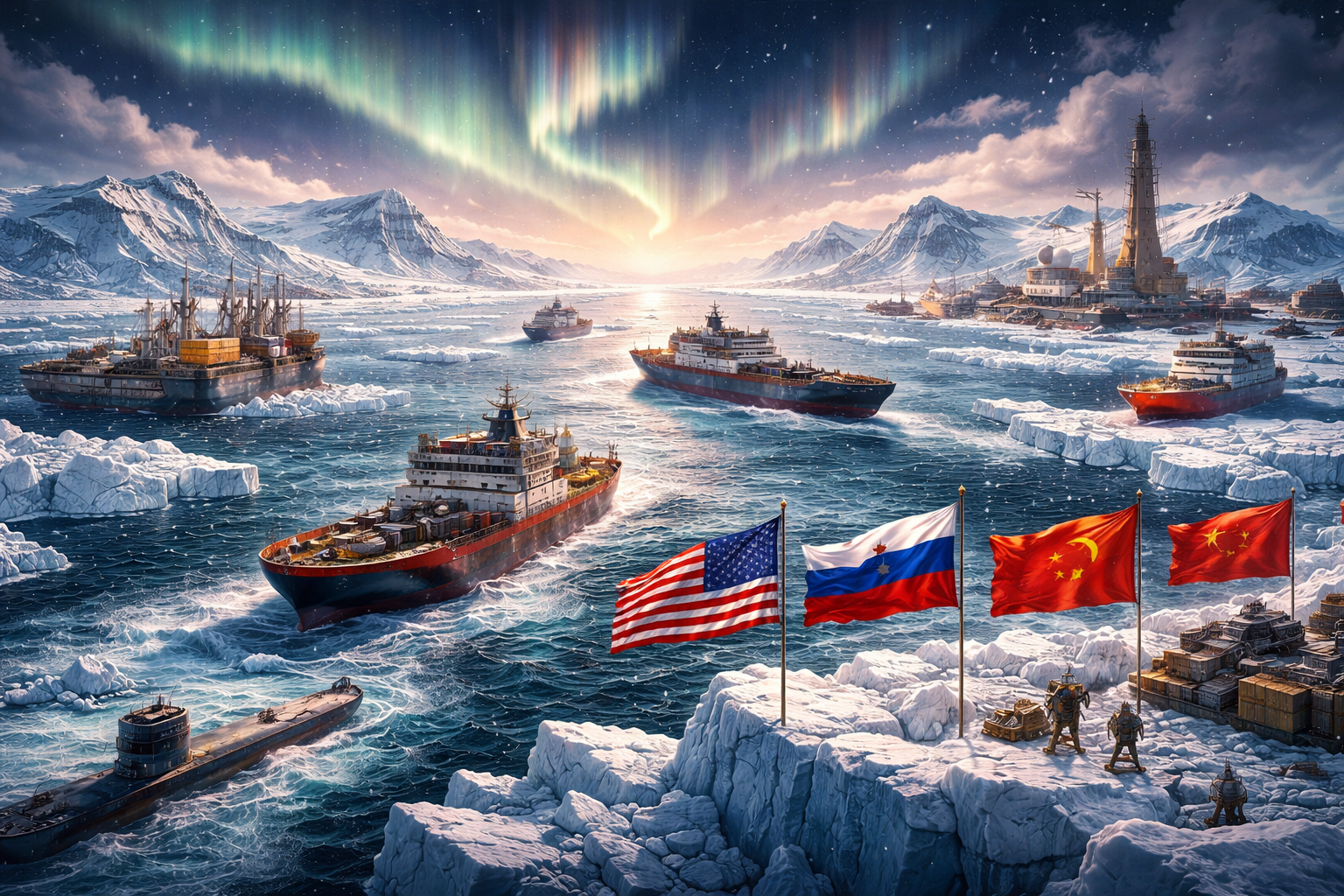
As Arctic ice recedes, a new geopolitical competition is opening for shipping routes, energy resources, and strategic dominance
Introduction: The Ocean Opening
For most of human history, the Arctic has been defined by inaccessibility. Vast ice sheets covering the Arctic Ocean, year-round darkness, extreme cold, and the absence of infrastructure made the region one of the least economically and strategically significant on earth — important primarily to the indigenous peoples who had learned over millennia to live within its constraints, and to the strategists who recognised its significance as a transit zone for ballistic missiles flying polar trajectories between superpowers.
That definition is changing. The Arctic is warming approximately four times faster than the global average — the most dramatic manifestation of climate change on any region on earth. The minimum summer sea ice extent has declined dramatically over the past four decades, and projections from the scientific community suggest that the Arctic Ocean could experience ice-free summers by the middle of this century, perhaps earlier. This melting is creating navigable shipping routes that did not previously exist for commercial shipping, opening access to energy and mineral resources that were inaccessible under permanent ice, and transforming a geopolitically dormant region into an arena of intense and growing competition among the Arctic states and China.
Section I: The Economic Opportunities
New Shipping Routes
The Northern Sea Route — following Russia’s Arctic coastline from Murmansk to the Bering Strait — is already commercially navigable for an extended summer season, and that season is lengthening each year as Arctic sea ice recedes. For container ships and bulk carriers moving goods between Asia and Europe, the Northern Sea Route offers a potential shortcut compared to both the Suez Canal route and the Cape of Good Hope route — saving approximately 30 to 40 percent of the distance of the Suez route on the most favourable comparisons, though the comparison depends significantly on the specific ports of origin and destination.
The Northwest Passage — the route through the Canadian Arctic Archipelago connecting the Atlantic and Pacific — is opening more slowly than the Russian route but is progressing toward commercial navigability for specially reinforced vessels during the summer months. Canada regards the Northwest Passage as internal Canadian waters subject to Canadian jurisdiction; the United States and most maritime nations regard it as an international strait through which all vessels have a right of transit passage. This legal dispute has not been resolved and is becoming more practically significant as traffic increases.
Energy and Mineral Resources
The Arctic contains an estimated 13 percent of the world’s undiscovered conventional oil resources and 30 percent of undiscovered conventional natural gas resources, according to US Geological Survey assessments, as well as significant deposits of rare earth metals, nickel, cobalt, and other materials central to the clean energy transition. These resources have been technically inaccessible under the ice cover that has historically prevailed. As that cover recedes and as extraction technology improves, previously uneconomic resources are becoming developable — though environmental sensitivities, extreme operational conditions, and infrastructure challenges continue to affect project economics.
| ~13% of world’s undiscovered conventional oil and 30% of undiscovered gas estimated in Arctic Per US Geological Survey assessment. Combined with the strategic value of new shipping routes and the growing economic significance of rare earth and mineral resources, the opening Arctic represents one of the most significant resource geography shifts in the global economy since the development of deep-water oil technology. |
Section II: The Geopolitical Competition
Russia’s Arctic Strategy
Russia has the longest Arctic coastline, the most extensive Arctic infrastructure, and the largest icebreaker fleet of any country — including the only nuclear-powered icebreakers in the world. The Northern Sea Route runs primarily through Russia’s exclusive economic zone, and Russia has been assertive in claiming jurisdiction over the route and requiring vessels to use Russian icebreaker escorts. Russia has also rebuilt and expanded its Soviet-era Arctic military infrastructure, reopening and modernising bases, deploying Arctic-capable weapons systems, and establishing the Northern Fleet — one of its four main naval fleets — as the primary military force for Arctic operations.
NATO’s Arctic Members and the Security Dimension
The accession of Finland and Sweden to NATO has significantly increased the alliance’s Arctic presence and coherence. Norway, Denmark (via Greenland), Iceland, Canada, and the United States are all Arctic NATO members. The combined NATO Arctic coastline and military capability substantially exceeds Russia’s, but the alliance’s degree of coordination on Arctic-specific challenges has varied. American strategic interest in the Arctic has increased significantly, with the US government designating the Arctic as a strategic priority and investing in icebreaker capability that had been allowed to decline.
China’s Arctic Ambitions
China describes itself as a ‘near-Arctic state’ — a formulation not recognised in international law but reflective of its strategic interest in Arctic shipping routes and resources. China has established a research presence in the region, operates icebreaking research vessels, and has invested in Arctic infrastructure and resource projects where opportunities have been available. Chinese shipping companies are monitoring the development of Arctic commercial routes with significant interest. The geopolitical implication of Chinese Arctic engagement — a non-Arctic state seeking influence in a region where all the adjacent states are members of NATO or close American partners — is a source of ongoing strategic concern among Western Arctic nations.
Conclusion: The Arctic as a Twenty-First Century Arena
The opening Arctic is not primarily a crisis — it is an opportunity, a challenge, and a competition simultaneously. The opportunity is real: new shipping routes, accessible energy resources, and the possibility of sustainable development in one of the world’s last major frontier regions. The challenge is also real: the environmental fragility of the Arctic ecosystem, the rights and interests of indigenous peoples whose homelands are being transformed by forces entirely outside their control, and the governance gaps in a region whose legal frameworks were developed before its commercial and strategic significance was apparent.
The competition is intensifying. The combination of energy resources, strategic shipping routes, military geography, and rare earth minerals in a region experiencing the world’s fastest climate change is drawing the sustained strategic attention of every major power. Managing that competition — preserving the cooperative frameworks that have functioned in the Arctic Council while accommodating the increasing assertiveness of all Arctic actors and the interest of non-Arctic powers — is a governance challenge that will become increasingly pressing as the ice continues to retreat.
Who Profited From the Iraq War?


