


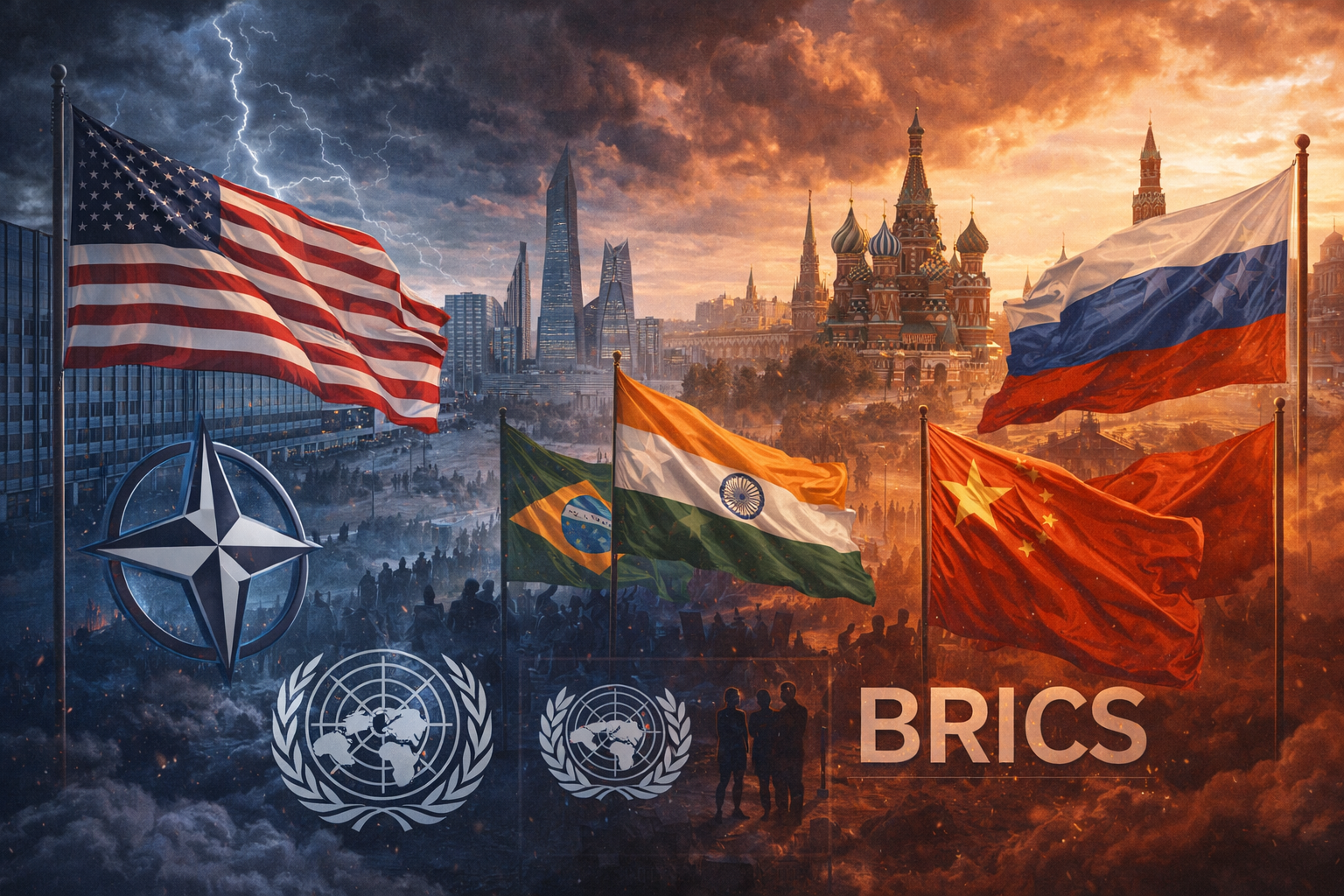
The international system built after the Cold War is fracturing into competing blocs and the rules-based order is straining under pressures it was not designed to manage
Introduction: The System Under Stress
The international order that emerged from the Cold War‘s end rested on a set of interlocking assumptions: that the spread of market economies and democratic governance was broadly advancing; that international institutions — the UN, the World Trade Organization, the International Monetary Fund, the World Bank — provided a framework for managing disputes and collective challenges; that military force between major powers was increasingly constrained by economic interdependence and nuclear deterrence; and that the United States, as the world’s dominant power, would sustain the rules and institutions of this order as a foundation for its own security and prosperity.
Each of these assumptions is now under significant strain. The democratic backsliding documented across multiple regions, the paralysis of the UN Security Council on multiple major conflicts, the erosion of WTO dispute resolution mechanisms, the weaponisation of trade and finance as instruments of geopolitical competition, and the fundamental challenge posed by China’s rise to American primacy have collectively produced a system under stresses its designers did not anticipate and its institutions were not built to manage.
Section I: The Emerging Blocs
The Western Alliance
The United States and its treaty allies — the European members of NATO, Japan, South Korea, Australia — remain the most powerful alignment in the current international system, collectively accounting for the majority of global GDP and military capability. But this alliance faces internal stresses: divergent approaches to China policy between the US and major European economies deeply embedded in Chinese supply chains; questions about the reliability of American commitments in an era of domestic political polarisation; and the challenge of extending alliance frameworks designed for a bipolar Cold War to a multipolar environment requiring more complex coordination.
The China-Russia Strategic Alignment
China and Russia have moved toward what their February 2022 joint statement described as a ‘no limits’ strategic partnership — a relationship of tactical coordination against American-led order whose depth and durability are subject to significant analytical debate. The relationship is real and consequential: Russian energy at discounted prices flows to China; China provides Russia with dual-use technology and diplomatic cover during the Ukraine conflict; both coordinate at the UN Security Council to block Western-led resolutions. But the relationship also has structural limits — China and Russia have competing interests in Central Asia, and Russia’s weakening by the Ukraine war potentially shifts the relationship toward greater Chinese dominance.
The Non-Aligned Middle
Perhaps the most significant structural development in the current international order is the emergence of a large and assertive group of states that resist alignment with either the Western or the China-Russia bloc and are actively cultivating relationships with multiple great powers simultaneously. India is the paradigmatic example: a member of the Quad, a strategic partner of the United States, a major purchaser of Russian energy and weapons, a partner with China in multiple multilateral formats, and a consistent advocate for an international order that reflects non-Western interests. Brazil, South Africa, Indonesia, Turkey, Saudi Arabia, and the UAE exhibit variants of the same multi-alignment strategy.
| “The most significant development in international relations is not the US-China competition itself — it is the growing number of consequential states that refuse to choose sides in that competition. The unipolar moment is over, and the majority of the world’s population lives in countries that are actively cultivating strategic autonomy.” — Dr. Shivshankar Menon Former National Security Advisor of India; Distinguished Fellow, Brookings India |
Section II: The Institutional Dimension
The multilateral institutions through which the post-Cold War order managed international affairs are experiencing significant stress. The UN Security Council is paralysed on major conflicts by the veto of permanent members directly involved in or supporting the parties to those conflicts. The WTO’s appellate body — the dispute resolution mechanism at the heart of rules-based international trade — has been effectively disabled by the US refusal to approve new appellate body appointments, reflecting American frustration with rulings it regards as unfavourable.
In response to the perceived limitations of Western-dominated institutions, alternative frameworks have gained momentum. The BRICS grouping — Brazil, Russia, India, China, South Africa — expanded in 2024 to include Saudi Arabia, Iran, Ethiopia, Egypt, Argentina (which subsequently withdrew), and the UAE, creating a forum that collectively represents a substantial share of global GDP and population. The Shanghai Cooperation Organisation has expanded its membership to include most of Central Asia and South Asia. The New Development Bank provides an alternative to IMF and World Bank financing for members seeking development capital without the policy conditionality attached to Western-backed institutions.
Section III: What Fragmentation Means Practically
The fragmentation of the international order does not mean that international cooperation has ceased or that the institutions of the post-Cold War system have collapsed. The WTO still operates; most international trade still follows agreed rules; the IMF still provides emergency financing; the UN General Assembly still meets. What fragmentation means, in practice, is that the consensus underlying these institutions has fractured — that an increasing number of consequential states regard the rules and institutions of the post-Cold War order as reflecting specific interests rather than universal principles, and are therefore less willing to treat those rules as binding constraints on their own behaviour.
The practical consequences include reduced effectiveness of international sanctions (as alternative payment systems and supply chains allow sanctioned states to maintain economic activity), the development of parallel multilateral institutions that compete with Western-led frameworks for legitimacy and membership, and a progressive reduction in the scope of issues on which genuine multilateral cooperation is achievable.
Conclusion: Managing a Fragmented Order
The post-Cold War international order is not collapsing — it is fragmenting. The institutions remain; the rules are still invoked; the language of international law and multilateralism is still deployed. But the system beneath the surface is changing in ways that the institutions themselves have not fully accommodated: more competitive, more multipolar, less consensual, and increasingly characterised by the pursuit of strategic autonomy by a growing number of states that regard the rules-based order as something to be engaged with selectively rather than deferred to comprehensively. Managing that fragmentation — preserving enough international cooperation to address the genuinely global challenges that no state can address alone, while adapting to the reality that the post-Cold War consensus has dissolved — is the central challenge of international relations in the current era.
Who Profited From the Iraq War?


