


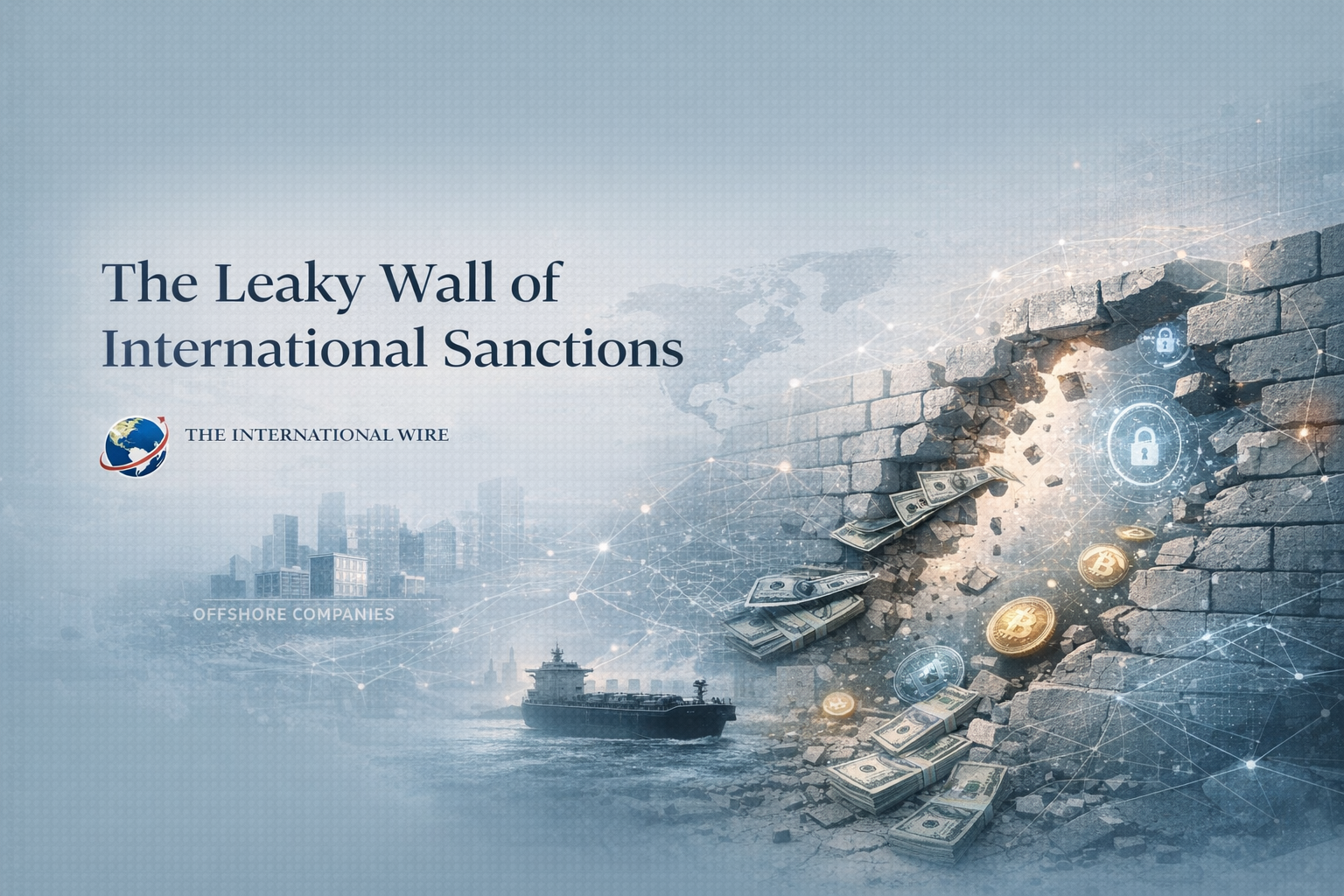
Sanctioned states continue to move billions through the global financial system and the networks enabling them are more sophisticated than ever
Introduction: The Leaky Wall of International Sanctions
International sanctions — the restriction of trade, financial transactions, and economic relationships with targeted countries or individuals — are one of the primary instruments of coercive foreign policy available to major powers and multilateral institutions. They are designed to impose economic costs severe enough to alter the behaviour of sanctioned parties: to compel the abandonment of prohibited weapons programmes, to punish violations of international law, to deny revenue that funds military operations or human rights abuses.
The effectiveness of sanctions as a policy instrument depends critically on their comprehensiveness and enforcement. A sanction that can be circumvented reduces the economic cost on the target, reduces the credibility of the sanctioning authority, and potentially provides commercially significant incentives for third-party actors to develop the circumvention infrastructure. The history of major sanctions regimes — against Iran, Russia, North Korea, and others — shows that the circumvention infrastructure is not merely a marginal phenomenon but a substantial, sophisticated, and increasingly well-resourced industry in its own right.
Section I: How Sanctions Evasion Works
Front Companies and Shell Structures
The foundational technique of sanctions evasion is the use of front companies — entities that do not appear on sanctions lists and have no obvious connection to the sanctioned party — to conduct transactions on behalf of the target. A sanctioned Iranian oil company cannot sell oil through its own accounts; but it can establish or work through a chain of apparently independent companies in jurisdictions with limited transparency requirements — free trade zones, offshore financial centres, countries that do not enforce Western sanctions — to move oil to buyers who prefer not to attract scrutiny.
The complexity of corporate structures used for sanctions evasion has grown significantly as enforcement capabilities have improved. Multi-layered ownership chains across multiple jurisdictions, with beneficial ownership obscured through nominee arrangements and trust structures, make the identification of ultimate beneficial ownership extremely resource-intensive for investigators. Jurisdictions with company registration requirements that do not require disclosure of real owners — or that do not enforce disclosure requirements — are essential enabling infrastructure for sanctions evasion.
The Shadow Fleet
One of the most visible manifestations of sanctions circumvention in the current period is the ‘shadow fleet’ — the collection of oil tankers operating outside the normal Western-insured, transparently-tracked commercial shipping infrastructure to move Russian oil in circumvention of the price cap imposed by Western countries following the Ukraine invasion. Estimates of the shadow fleet’s size range from several hundred to over a thousand vessels — older tankers purchased by opaque entities and operating without Western insurance or classification, tracked irregularly, and moving Russian oil to markets in Asia, the Middle East, and elsewhere. The fleet has been effective: Russia’s oil export revenues, while affected by the price cap, have not been reduced to the levels that Western sanctions designers projected.
| “The shadow fleet demonstrates that sanctions on major commodity exporters face a fundamental challenge: if the commodity is valuable enough, the market will find a way to route it to buyers who want it. The question is whether the sanctions impose sufficient cost on the seller to change behaviour — which is a much higher bar than simply blocking some sales.” — Richard Bronze Head of Geopolitics, Energy Aspects (commodity intelligence consultancy) |
Section II: Cryptocurrency and Alternative Financial Systems
Crypto as a Sanctions Evasion Tool
Cryptocurrencies have attracted significant attention as potential sanctions evasion tools, and North Korea has demonstrated their utility at scale. The Lazarus Group — a cyber unit linked to North Korean intelligence — has stolen an estimated $3 billion in cryptocurrency from exchanges and DeFi protocols since 2016, according to various assessments, using these funds to finance weapons development programmes outside the formal financial system. The pseudonymous nature of cryptocurrency transactions, the absence of central counterparties that can be pressed to comply with sanctions, and the technical sophistication required for effective blockchain forensics have made cryptocurrency a genuine challenge for sanctions enforcement.
Alternative Payment and Banking Systems
Russia’s exclusion from the SWIFT international banking messaging system in 2022 — one of the most dramatic financial sanctions measures applied in recent history — accelerated the development of alternative payment infrastructure designed to function outside Western-controlled financial channels. China’s Cross-Border Interbank Payment System (CIPS), Russia’s System for Transfer of Financial Messages (SPFS), and various bilateral payment arrangements have expanded in usage as a result of sanctions pressure. While none of these systems approaches SWIFT’s scale or global coverage, their development creates infrastructure for financial transactions between sanctioned states and willing trading partners that sanctions enforcers cannot easily reach.
Section III: The Enforcement Challenge
Sanctions enforcement relies on the willingness of third-country banks, businesses, and governments to comply with sanctions regimes that may not be their own. The United States’ secondary sanctions — measures that threaten to penalise non-American entities doing business with sanctioned parties — are the most powerful enforcement tool available, using the centrality of the US dollar in global finance to extend American sanctions jurisdiction extraterritorially. But even secondary sanctions face limits: they require the sanctioning authority to be willing to impose costs on third-country economic actors, creating diplomatic friction with allies and partners; and they drive sanctioned parties and their business networks toward financial channels — local currency trade, cryptocurrency, barter — that are harder to reach.
Conclusion: The Limits and Possibilities of Financial Coercion
Sanctions are a genuine instrument of statecraft — they impose real economic costs on targeted states, constrain their access to certain technologies and markets, and signal international opprobrium in ways that matter politically. But the evidence of their effectiveness in compelling specific behavioural changes — as opposed to imposing general economic pain — is more mixed than their proponents often acknowledge.
The dark market of sanctions evasion is not a story about criminal activity at the margins of the international economy. It is a story about the limits of coercive financial statecraft in a world where the sanctioned parties have strong incentives to develop circumvention infrastructure, where the economic interests of third-country actors provide willing participation in that infrastructure, and where the technical and organisational sophistication of evasion networks continues to evolve in response to enforcement innovations. Understanding those limits is essential to designing sanctions regimes with realistic objectives — and to avoiding the mistake of treating economic pressure as a substitute for the diplomatic and strategic engagement that is ultimately necessary to resolve the underlying disputes that sanctions are designed to address.


