


The Rise of the Countries in Between
For much of modern history, international politics has been defined by great powers.
The British Empire shaped the nineteenth century. The United States and the Soviet Union dominated the Cold War. After the collapse of the Soviet Union, the United States emerged as the world’s sole superpower.
The prevailing assumption was that global politics would continue to revolve around major powers and their rivalries.
That assumption is increasingly outdated.
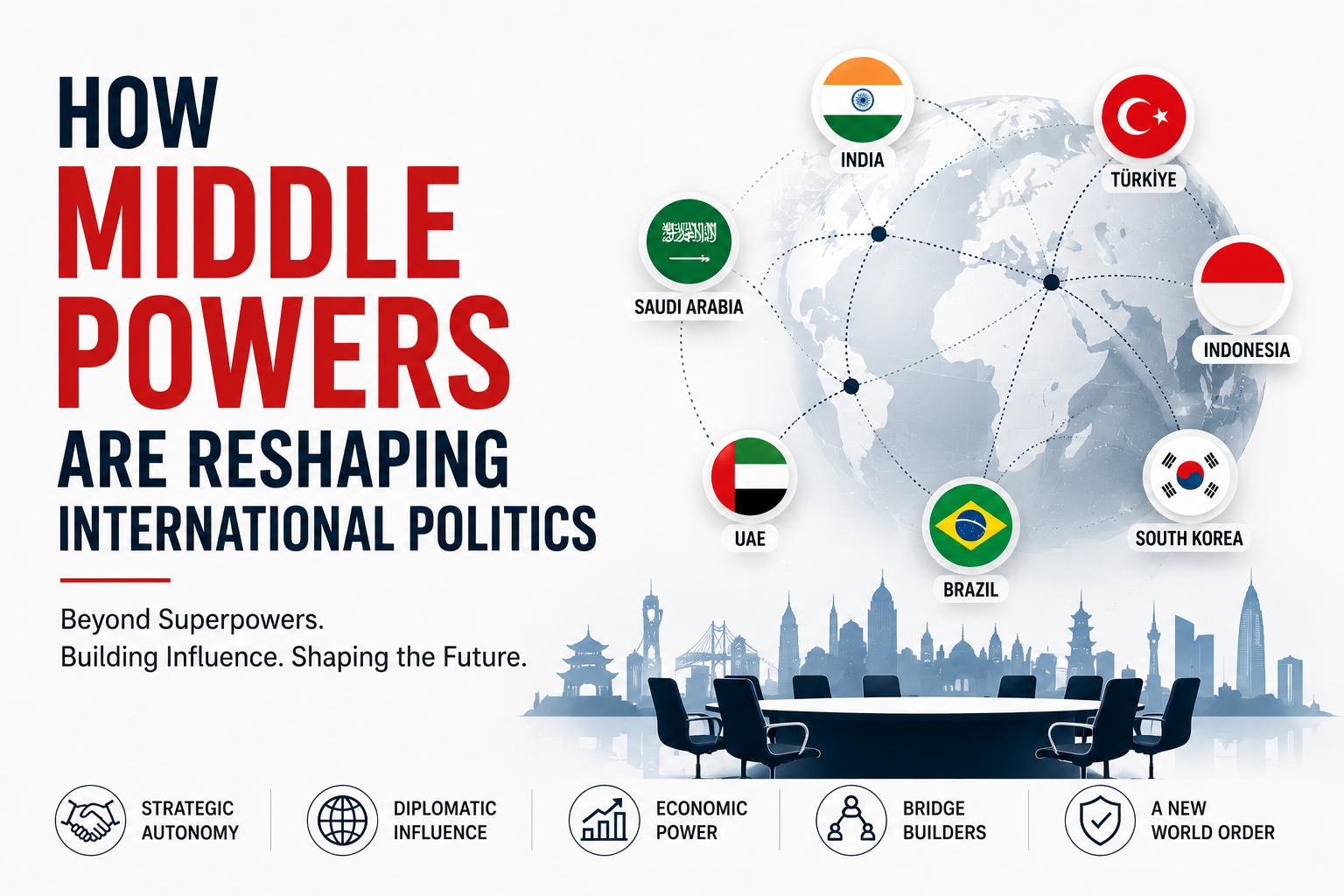
The twenty-first century is witnessing the rise of middle powers—countries that may not possess the economic size, military capabilities, or global influence of superpowers but have developed the ability to shape regional and even international outcomes.
India.
Saudi Arabia.
Türkiye.
Indonesia.
Brazil.
The United Arab Emirates.
South Korea.
Australia.
These countries are increasingly exercising strategic autonomy, influencing global agendas, and positioning themselves as indispensable players in a more fragmented and multipolar world.
The future of international politics may not be decided solely in Washington, Beijing, or Moscow.
It may increasingly be shaped by the countries in between.
What Is a Middle Power?
A middle power is not defined solely by economic size or military strength.
It is defined by influence.
Middle powers possess sufficient economic, diplomatic, technological, or strategic capabilities to shape regional developments and contribute meaningfully to global governance, even if they cannot dominate the international system on their own.
Historically, middle powers often aligned themselves closely with larger powers.
Today, many are pursuing something different.
Strategic autonomy.
They seek partnerships without dependence.
Cooperation without alignment.
Influence without hegemony.
This approach is fundamentally changing international politics.
Why Middle Powers Are Rising
The rise of middle powers is not accidental.
Several structural changes are creating opportunities for them.
The first is the diffusion of economic power.
Economic growth is increasingly distributed across Asia, the Middle East, and parts of Africa and Latin America.
The second is technological democratization.
Advanced technologies that were once available only to great powers are becoming more accessible.
The third is the fragmentation of global politics.
The intensifying rivalry between the United States and China has created diplomatic space for countries that can engage both sides simultaneously.
The fourth is the decline of unipolarity.
No single country today possesses the capacity to shape every major global outcome alone.
This has increased the importance of coalition-building and regional influence.
Middle powers thrive in such environments.
The Age of Strategic Autonomy
Perhaps the defining characteristic of modern middle powers is their pursuit of strategic autonomy.
During the Cold War, many countries faced binary choices.
Align with Washington.
Or align with Moscow.
Today’s international environment is more flexible.
India purchases military equipment from multiple partners while deepening relations with the United States and maintaining economic engagement with China.
Saudi Arabia cooperates closely with Washington while simultaneously expanding relations with China and Russia.
Türkiye balances its commitments within NATO while pursuing independent regional policies.
The United Arab Emirates engages with both Western and Asian partners while positioning itself as a global investment and logistics hub.
These countries increasingly reject zero-sum choices.
Instead, they seek maximum flexibility.
Middle Powers as Global Mediators
Middle powers are increasingly becoming diplomatic intermediaries.
Their ability to maintain relationships across competing blocs gives them unique advantages.
They can communicate with actors that larger powers sometimes cannot.
They can host negotiations.
Facilitate dialogue.
Provide neutral diplomatic platforms.
As geopolitical fragmentation increases, the value of trusted intermediaries is growing.
The future international system may depend increasingly on countries capable of bridging political divides.
Diplomatic influence is becoming as important as military power.
The New Energy and Investment Powers
The rise of middle powers is also reshaping global economics.
Several middle powers now control assets that are strategically indispensable.
Energy resources.
Critical minerals.
Investment capital.
Logistics infrastructure.
Advanced manufacturing capabilities.
The Gulf states illustrate this transformation particularly clearly.
Rather than remaining solely hydrocarbon producers, countries such as Saudi Arabia and the UAE are positioning themselves as investment hubs, technology investors, logistics platforms, and renewable energy leaders.
Indonesia’s critical mineral reserves have made it central to the global energy transition.
South Korea has become indispensable to advanced manufacturing and semiconductor supply chains.
India’s vast market and demographic advantages are making it increasingly influential in global trade and technology ecosystems.
Economic influence is becoming more distributed.
So is geopolitical power.
The Rise of Minilateral Diplomacy
International politics is increasingly moving away from universal solutions and toward smaller, flexible coalitions.
These arrangements are often referred to as minilateralism.
Countries cooperate on specific issues without requiring comprehensive alignment.
The Quad.
I2U2.
Regional infrastructure initiatives.
Energy partnerships.
Technology alliances.
Investment corridors.
Middle powers are frequently the architects of these arrangements.
They understand that solving complex challenges increasingly requires pragmatic partnerships rather than rigid alliances.
The future international system may consist less of competing blocs and more of overlapping networks of cooperation.
Middle powers are particularly well suited to operate in such environments.
Why Superpowers Need Middle Powers
Even the world’s largest powers increasingly depend on middle powers.
The United States requires partners to secure supply chains, strengthen regional alliances, and manage global challenges.
China depends on relationships across the Global South to sustain trade networks and expand its economic influence.
Europe increasingly seeks partnerships with middle powers on energy security, critical minerals, and climate cooperation.
No major power today can achieve its strategic objectives entirely on its own.
Influence increasingly depends on networks.
And middle powers often occupy critical positions within those networks.
Their importance is growing precisely because global politics is becoming more interconnected and more fragmented simultaneously.
The Limits of Middle Power Influence
The rise of middle powers should not be exaggerated.
Most still lack the military capabilities and economic scale necessary to fundamentally reorder the international system independently.
Many face domestic challenges.
Political transitions.
Economic vulnerabilities.
Security threats.
Institutional limitations.
Their influence often depends on maintaining strategic flexibility.
As competition between major powers intensifies, preserving that flexibility may become increasingly difficult.
Middle powers must continually balance opportunities against risks.
Strategic autonomy requires careful diplomacy.
It is an advantage, but also a challenge.
Frequently Asked Questions
What is a middle power?
A middle power is a country that possesses sufficient economic, diplomatic, technological, or strategic capabilities to influence regional and international affairs despite lacking superpower status.
Which countries are considered middle powers?
Examples include India, Saudi Arabia, the United Arab Emirates, Türkiye, Indonesia, Brazil, South Korea, Australia, and several European and Southeast Asian states.
Why are middle powers becoming more influential?
Economic growth, technological diffusion, geopolitical fragmentation, and the decline of unipolarity have created opportunities for countries capable of pursuing strategic autonomy and coalition-building.
What is strategic autonomy?
Strategic autonomy refers to a country’s ability to pursue independent foreign policies and maintain relationships with multiple powers without becoming overly dependent on any single partner.
Why do major powers need middle powers?
Major powers increasingly rely on middle powers for supply chains, regional influence, energy security, investment partnerships, diplomatic mediation, and coalition-building.
The Multipolar Century Belongs to the Network Builders
International politics is entering a new phase.
Power is becoming more distributed.
Influence is becoming more networked.
Diplomacy is becoming more flexible.
The countries that thrive in this environment will not necessarily be those with the largest militaries or economies.
They will be the countries capable of building partnerships across competing blocs, connecting regions, facilitating cooperation, and exercising strategic autonomy.
Middle powers are uniquely positioned to perform these roles.
They are becoming investors, mediators, logistics hubs, technology partners, and diplomatic bridge-builders.
The twenty-first century may still witness intense competition among superpowers.
But the outcomes of that competition will increasingly be shaped by countries that are neither superpowers nor bystanders.
The emerging international order is not simply becoming multipolar.
It is becoming networked.
And in a networked world, the countries in between often become the ones that matter most.


