


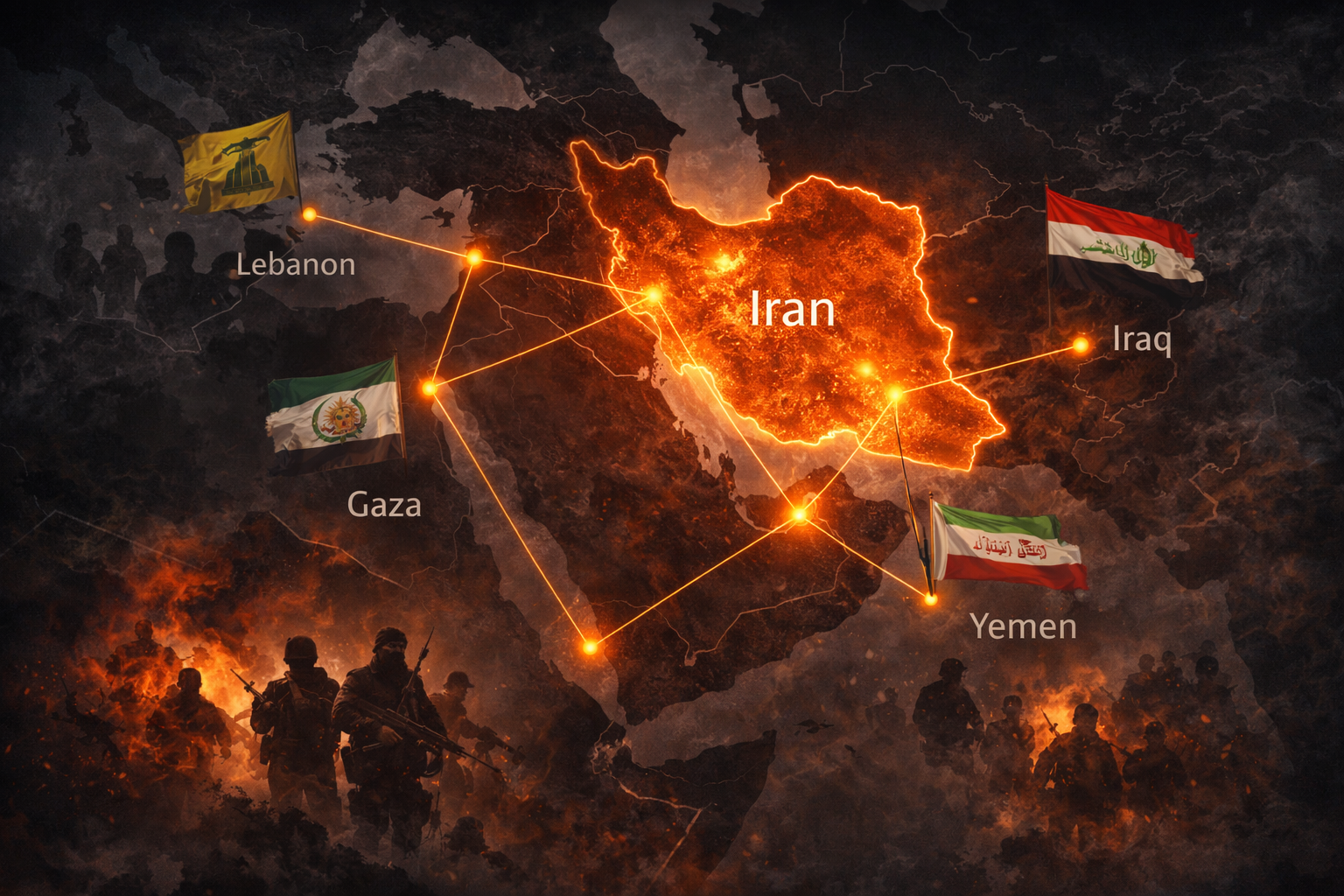
A timeline and analysis of the month that pushed the region from shadow war to open conflict
Introduction
March 2026 may come to be seen as the moment when long-contained tensions in the Middle East crossed a decisive threshold. What had, for years, remained a shadow conflict—defined by covert operations, cyberattacks, and proxy warfare—evolved into a more direct and sustained confrontation involving Iran, Israel, and the United States, with the Gulf states drawn in by proximity and vulnerability.
This was not a sudden rupture. Rather, it was the culmination of layered mistrust, strategic signalling, and incremental escalation. Yet the events of March compressed these dynamics into a single, volatile sequence—one that has altered the region’s security architecture and injected new uncertainty into global energy markets.
Timeline: March 2026
Week 1: Escalation Becomes Overt
The opening days of March saw a sharp intensification of hostilities. Israeli strikes on Iranian-linked targets expanded in scope, moving beyond proxy networks to include infrastructure assessed to be tied to Iran’s strategic capabilities. The United States, while initially cautious, provided logistical and intelligence support, signalling alignment without full operational exposure.
Iran’s response marked a shift in doctrine. Rather than relying solely on regional proxies, Tehran launched direct missile and drone attacks targeting Israeli territory and US-linked installations. This signalled both capability and intent: Iran was prepared to absorb escalation while demonstrating reach.
The significance of this phase lay in its visibility. What had previously been deniable became explicit.
Week 2: Regionalisation of the Conflict
By the second week, the conflict had begun to spill across borders. Iranian-linked actors, including groups in Lebanon and Yemen, intensified their activities. Missile launches and drone incursions widened the theatre, stretching Israel’s defensive systems and complicating response calculations.
The Gulf states, particularly Saudi Arabia and the United Arab Emirates, entered a period of heightened alert. While not direct participants, they faced growing risks as potential targets of Iranian retaliation or spillover effects.
Diplomatic channels remained active but ineffective. Intermediaries attempted to establish de-escalation mechanisms, yet neither side appeared willing to concede strategic ground.
Week 3: Energy Infrastructure Enters the Battlefield
The third week marked a critical turning point: energy assets became direct targets.
Strikes on Iranian gas infrastructure and retaliatory threats to Gulf energy facilities introduced a new dimension—economic warfare. Disruptions to shipping routes and heightened risks in the Strait of Hormuz triggered volatility in global energy markets.
For the Gulf Cooperation Council (GCC), this phase underscored a structural vulnerability. Their economic model—anchored in energy exports—was now directly exposed to geopolitical conflict.
At the same time, the United States increased its military footprint, deploying additional naval assets to secure shipping lanes and deter further escalation.
Week 4: Managed De-escalation, Unresolved Tensions
In the final week of March, signs of cautious de-escalation emerged. Backchannel negotiations, reportedly involving European and regional intermediaries, explored frameworks for limiting further escalation.
However, the underlying dynamics remained unresolved. Iran retained significant military capability; Israel continued to assert its red lines; and the United States faced the dual challenge of managing conflict while avoiding deeper entanglement.
Rather than resolution, the month ended with a fragile equilibrium—one sustained by deterrence rather than agreement.
Explainer: What Changed in March 2026?
1. The End of the Shadow War
For over a decade, Iran and Israel engaged in what analysts termed a “shadow war”—covert, deniable, and geographically diffuse. March 2026 marked a transition to direct confrontation.
This shift carries structural implications:
- Reduced space for plausible deniability
- Increased risk of rapid escalation
- Greater involvement of state militaries rather than proxies
The threshold for conflict has, in effect, been lowered.
2. Iran’s Strategic Doctrine: Deterrence Through Escalation
Iran’s actions reflected a calibrated approach rather than impulsive escalation.
Key elements include:
- Direct retaliation to signal credibility
- Geographic expansion of the conflict to complicate adversary responses
- Economic leverage, particularly through energy chokepoints
By targeting both military and economic assets, Iran demonstrated an ability to impose costs beyond the battlefield.
Importantly, Tehran’s posture suggests that deterrence is no longer defensive but actively constructed through controlled escalation.
3. Israel’s Strategy: Forward Defence
Israel’s response has been characterised by a willingness to strike beyond immediate threats.
This approach rests on three pillars:
- Pre-emption of perceived strategic threats
- Operational reach into adversary territory
- Integration of defence systems to manage multi-front attacks
However, this strategy carries inherent risks. Expanding the scope of operations increases exposure to retaliation and complicates escalation control.
4. The United States: Between Leadership and Restraint
The United States remains the central external actor, yet its role is increasingly complex.
Washington’s objectives appear to include:
- Supporting Israeli security
- Maintaining freedom of navigation in critical waterways
- Preventing broader regional destabilisation
Yet these goals are not always aligned. Increased military involvement risks escalation, while restraint may undermine deterrence.
Domestic considerations—including economic pressures linked to energy prices—further constrain policy choices.
5. The GCC: Strategic Exposure Without Strategic Control
For the Gulf states, March 2026 underscored a fundamental dilemma: proximity without control.
Despite significant investments in defence and diplomacy, GCC countries remain vulnerable to:
- Missile and drone attacks
- Disruptions to energy infrastructure
- Spillover from regional conflicts
At the same time, internal divergences complicate collective action. While some states favour de-escalation, others see strategic value in weakening Iran’s capabilities.
This divergence limits the effectiveness of a unified Gulf response.
6. Energy as a Strategic Weapon
Perhaps the most consequential development was the integration of energy into the conflict dynamic.
The Strait of Hormuz—through which a significant share of global oil and gas flows—became a focal point of strategic calculation. Even limited disruptions had outsized global effects.
This marks a shift toward economic statecraft through coercion, where:
- Infrastructure becomes a target
- Markets become a battleground
- Global consumers become indirect stakeholders
Broader Implications
A More Volatile Regional Order
The events of March suggest a transition from a relatively contained regional order to one characterised by:
- Higher baseline tensions
- More frequent direct engagements
- Reduced predictability
This environment increases the likelihood of miscalculation.
Global Economic Spillovers
Energy market disruptions have already demonstrated their global reach. Sustained instability could:
- Drive inflationary pressures
- Disrupt supply chains
- Complicate monetary policy decisions
In this sense, the conflict is not regionally contained—it is globally consequential.
Diplomacy Under Strain
While diplomatic channels remain active, their effectiveness is constrained by:
- Deep strategic mistrust
- Divergent objectives among key actors
- Domestic political pressures
Any durable resolution would require addressing underlying security concerns—an outcome that remains distant.
Conclusion
March 2026 did not produce a decisive outcome, but it altered the trajectory of Middle Eastern geopolitics.
The transition from shadow conflict to open confrontation, the exposure of Gulf vulnerabilities, and the weaponisation of energy infrastructure collectively signal a more complex and unstable regional order.
For now, the system is held together by deterrence and cautious signalling. Whether this balance can be sustained—or whether it gives way to further escalation—will define not only the region’s future but also its impact on the global system.


