


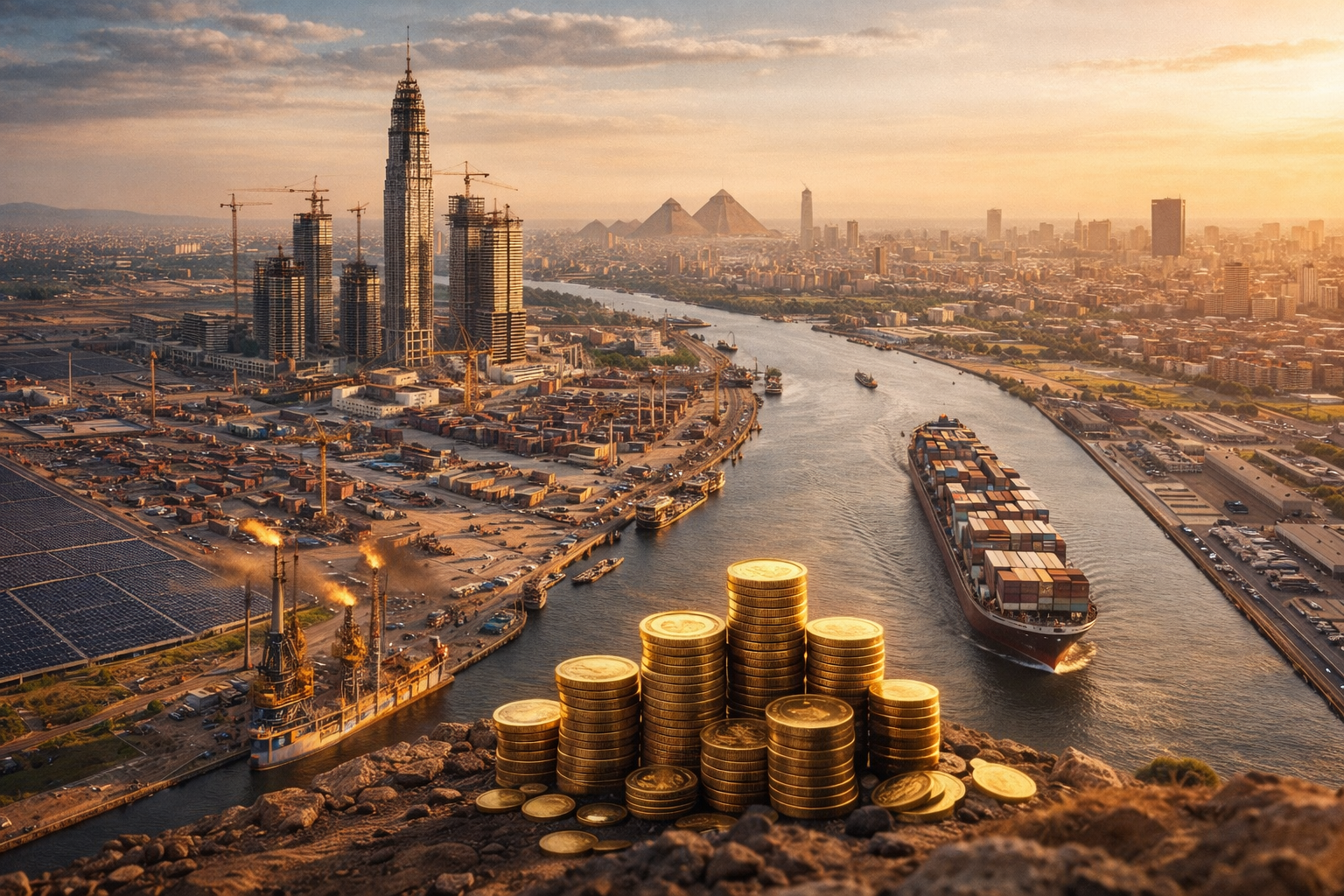
Why Global Capital Keeps Flowing Into Egypt
In a continent where investment flows are often volatile and uneven, Egypt stands out for one defining reason: scale. By volume, no African country consistently attracts more headline investment than Egypt. While not always the easiest or fastest market, Egypt has positioned itself as the continent’s most significant destination for large, state-backed, and geopolitically aligned capital.
Its appeal is not driven by startup dynamism or niche efficiency, but by something more fundamental: a vast domestic market, strategic geography, and a government willing to deploy the state as the primary investment catalyst.
A Market Defined by Demographic Gravity
Large Population, Enduring Demand
With a population exceeding 100 million, Egypt offers something few African economies can match: immediate domestic scale.
- Large consumer base supporting demand for housing, energy, transport, and food
- Deep labour pool for construction, manufacturing, and services
- Urbanisation driving long-term infrastructure and real estate demand
For investors—particularly sovereign funds and state-linked capital—Egypt’s demographics provide predictability. Even when growth slows, demand rarely disappears.
State-Led Infrastructure as Investment Strategy
Building First, Attracting Capital Later
Egypt’s investment model is unapologetically state-driven. Over the past decade, the government has launched some of the largest infrastructure programmes in the developing world:
- New Administrative Capital east of Cairo
- Nationwide road and rail expansion
- Port modernisation along the Mediterranean and Red Sea
- Large-scale housing and urban development
These projects are not merely domestic initiatives; they function as investment platforms, designed to absorb foreign capital at scale.
For global investors seeking large-ticket deployment rather than incremental exposure, Egypt offers rare capacity.
Geography as Geoeconomic Leverage
Linking Three Regions at Once
Egypt’s strategic location remains one of its most powerful advantages.
- Control of the Suez Canal, a critical artery of global trade
- Direct access to African, Middle Eastern, and European markets
- Proximity to Gulf capital and European supply chains
This positioning makes Egypt not just a national market, but a regional logistics and transit node—a factor increasingly valued as global trade routes face disruption.
Gulf Sovereign Wealth: The Decisive Force
Capital With Strategic Alignment
A defining feature of Egypt’s investment story is the role of Gulf sovereign wealth funds, particularly from Saudi Arabia, the UAE, and Qatar.
These inflows are characterised by:
- Long-term horizons
- State-to-state alignment
- Focus on infrastructure, energy, ports, and strategic assets
This capital is less sensitive to short-term volatility and more responsive to geopolitical stability and regional partnerships. As a result, Egypt continues to attract large inflows even during periods of macroeconomic stress.
Where the Money Goes: Key Investment Sectors
1. Infrastructure and Construction
Infrastructure absorbs the largest share of investment:
- Roads, bridges, railways
- New cities and housing
- Ports and logistics corridors
These projects generate employment, anchor supply chains, and create follow-on opportunities for private capital.
2. Energy: Gas and Renewables
Egypt has emerged as a regional energy hub.
- Offshore gas discoveries supporting exports
- Large-scale solar and wind projects
- Grid expansion and energy interconnection
Energy investments are favoured by both Western and Gulf investors due to their strategic and revenue-generating nature.
3. Manufacturing and Logistics
As global firms look to diversify supply chains, Egypt has positioned itself as:
- A manufacturing base serving Europe and Africa
- A logistics hub linked to maritime trade routes
Industrial zones near ports and transport corridors are central to this strategy.
4. State-Backed Mega-Projects
Perhaps uniquely, Egypt continues to attract capital into mega-projects that rely on state guarantees, long timelines, and political backing. These projects inflate headline investment figures—but also anchor Egypt’s position at the top of Africa’s investment rankings.
The Investment Trade-Offs
Egypt’s dominance by volume does not imply frictionless investing.
Challenges include:
- Currency volatility
- Heavy state involvement limiting private-sector autonomy
- Regulatory complexity
- Dependence on external financing
Yet for investors prioritising scale over speed, these constraints are often acceptable.
Editorial Takeaway: Scale Over Subtlety
Egypt attracts the largest investment flows in Africa not because it is the easiest market, but because it is the biggest platform. Its model relies on state leadership, demographic gravity, and strategic alliances—particularly with Gulf capital—to sustain investment momentum.
In an African investment landscape defined by fragmentation, Egypt offers something increasingly rare: the ability to absorb capital at scale.
That is why, by volume and visibility, Egypt remains Africa’s top investment magnet.


