


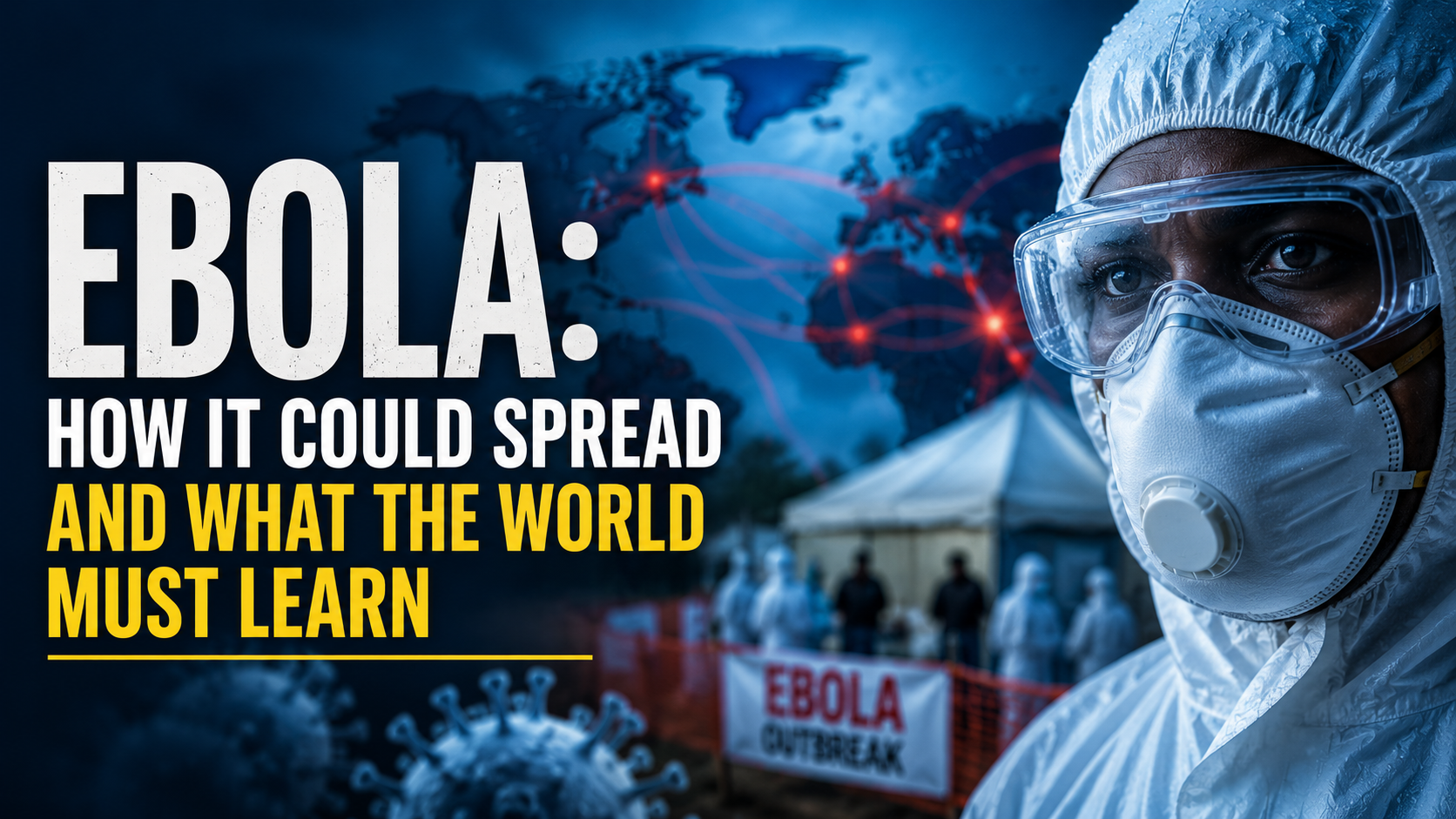
The world remains vulnerable to another Ebola crisis — not because Ebola is unstoppable, but because the global systems designed to detect, contain, and respond to outbreaks remain uneven, reactive, politically fragmented, and dangerously dependent on emergency improvisation rather than permanent preparedness.
Ebola is one of the deadliest viral diseases known to humanity. Since its discovery in 1976, outbreaks across Central and West Africa have repeatedly demonstrated how rapidly weak healthcare systems can become overwhelmed once transmission accelerates. Fatality rates in some Ebola outbreaks have exceeded 50%, while social panic, economic disruption, and political instability have often spread faster than the virus itself.
Unlike airborne pandemics such as COVID-19, Ebola primarily spreads through direct contact with bodily fluids of infected individuals. In theory, this makes Ebola easier to contain through isolation, tracing, and protective protocols. In practice, however, containment becomes extremely difficult in regions affected by:
- Fragile healthcare infrastructure
- Conflict and displacement
- Limited medical staffing
- Poor sanitation systems
- Weak border controls
- Public distrust of authorities
The lesson of Ebola is not that the virus is invincible.
The lesson is that modern globalization allows localized outbreaks to become international crises far faster than many governments are prepared to manage.
Where Does the Ebola Threat Stand in 2026?
Ebola remains one of the world’s most closely monitored epidemic threats, yet the structural conditions that allow outbreaks to emerge remain largely unresolved.
The African continent has made major progress in:
- Disease surveillance
- Vaccine deployment
- Regional coordination
- Laboratory capacity
- Emergency response systems
However, vulnerabilities persist in several high-risk regions where:
- Civil conflict disrupts healthcare delivery
- Refugee movements complicate tracing
- Rural outbreaks go undetected
- Urban overcrowding accelerates transmission risk
At the same time, international fatigue following COVID-19 has weakened political urgency around epidemic preparedness in many countries.
This creates a dangerous contradiction:
The world possesses more scientific capability than ever before — but political attention and institutional readiness remain inconsistent.
The greatest modern Ebola risk is not necessarily mutation into an uncontrollable airborne virus.
The greater risk is delayed detection combined with dense urban transmission and weak public health coordination.
Section I: The Historical Record — What Ebola Has Already Taught the World
Ebola’s modern history is defined by repeated warnings that the international system only partially absorbed.
The first recorded Ebola outbreaks occurred in 1976 in Sudan and what is now the Democratic Republic of Congo. For decades, outbreaks remained relatively localized due to limited transport infrastructure and lower population density.
The situation changed dramatically in the 21st century.
The 2014–2016 West African Ebola outbreak became the largest Ebola epidemic in history, spreading across:
- Guinea
- Liberia
- Sierra Leone
The outbreak eventually caused more than 11,000 deaths and exposed severe weaknesses in:
- International coordination
- Emergency medical deployment
- Public communication systems
- Border health monitoring
- Protective equipment supply chains
The outbreak also demonstrated how fear itself can destabilize economies and governments.
Airlines suspended routes.
Trade slowed.
Hospitals became overwhelmed.
Healthcare workers died in large numbers.
Misinformation spread internationally.
The epidemic was eventually controlled through:
- Massive international intervention
- Local community engagement
- Quarantine enforcement
- Contact tracing
- Experimental vaccine deployment
But the response came late.
The Democratic Republic of Congo later experienced additional Ebola outbreaks that highlighted another major challenge: conflict zones.
Armed violence complicated medical access, while distrust toward governments and international organizations undermined containment efforts.
Ebola repeatedly exposed a central weakness of the modern international system:
global health preparedness is often strongest where outbreak risk is lowest and weakest where outbreak risk is highest.
“The danger of Ebola is not only the mortality rate. It is the speed at which fragile systems collapse once fear, displacement, and institutional overload combine.”
— Global Health Crisis Researcher
Section II: The Current Reality — How Ebola Could Spread Internationally Today
Modern globalization fundamentally changes the risk profile of epidemic diseases.
In previous decades, remote outbreaks could remain geographically isolated for longer periods. Today, international mobility compresses time and distance dramatically.
An infected traveler can move between continents within hours.
This does not mean Ebola spreads as easily as airborne respiratory viruses. It does mean that delayed detection can allow infected individuals to cross borders before containment systems activate.
Several modern conditions increase the risk of rapid escalation.
International Air Travel
Major international transport networks create potential transmission corridors between:
- African urban centers
- Gulf transit hubs
- European cities
- Asian megacities
While airport screening reduces some risk, early-stage symptoms can resemble common illnesses, complicating detection.
Urban Population Density
Historically, some Ebola outbreaks occurred in relatively isolated rural regions.
Future outbreaks near:
- Major urban centers
- Informal settlements
- Refugee camps
- Dense slum environments
…would be significantly harder to contain.
Large-scale population density increases:
- Human contact rates
- Hospital overload risk
- Community transmission speed
- Sanitation challenges
Fragile Healthcare Systems
Weak healthcare systems create multiple cascading risks:
- Delayed diagnosis
- Lack of protective equipment
- Hospital-based transmission
- Healthcare worker fatalities
- Reduced public trust
In some outbreaks, hospitals themselves became transmission hubs due to insufficient infection control.
Conflict Zones and Refugee Corridors
Conflict significantly worsens epidemic conditions.
War zones often involve:
- Population displacement
- Collapsed sanitation systems
- Limited medical access
- Distrust toward authorities
- Restricted humanitarian access
Refugee movements across porous borders complicate tracing and isolation efforts.
The Information Crisis
Modern outbreaks now spread through two parallel systems:
- Biological transmission
- Information transmission
Misinformation can:
- Undermine vaccination campaigns
- Trigger panic
- Encourage concealment of infections
- Fuel conspiracy theories
- Reduce trust in healthcare workers
In several past outbreaks, medical teams themselves became targets of hostility because local populations viewed them with suspicion.
Section III: Lessons from COVID-19 — What the World Still Has Not Fixed
COVID-19 exposed systemic weaknesses across global governance and public health systems.
Many governments:
- Delayed early response
- Minimized risks publicly
- Failed to coordinate internationally
- Allowed supply chain breakdowns
- Lost public trust through inconsistent communication
Ebola requires the opposite response structure.
Successful Ebola containment depends on:
- Rapid isolation
- Immediate tracing
- Transparent reporting
- Community-level cooperation
- Cross-border coordination
- Fast deployment of protective infrastructure
Delay is especially dangerous because Ebola’s fatality rate can overwhelm already weak healthcare systems very quickly.
COVID also demonstrated how modern crises rapidly become interconnected:
- Public health crises become economic crises
- Economic crises become political crises
- Political crises become security crises
Future Ebola outbreaks would likely trigger:
- Border restrictions
- Airline disruptions
- Supply chain interruptions
- Financial market anxiety
- Humanitarian emergencies
Especially if outbreaks occur near major commercial or geopolitical corridors.
Section IV: Future Scenarios — What Could Happen Next
The future Ebola risk environment involves several possible trajectories.
Localized Containment Success (Most Likely)
The most likely scenario remains localized outbreaks controlled through:
- Rapid vaccination
- International assistance
- Regional surveillance
- Emergency isolation systems
Recent advances in vaccines and diagnostics significantly improve response capability compared to previous decades.
However, success depends heavily on early detection.
Urban Multi-Country Outbreak (Serious Risk)
A more dangerous scenario involves:
- Delayed detection
- Cross-border movement
- Urban transmission
- Healthcare system overload
In this scenario, panic and economic disruption could spread internationally even if biological transmission remains regionally concentrated.
Conflict-Driven Humanitarian Crisis
An Ebola outbreak inside an active conflict zone could become exceptionally difficult to manage.
Humanitarian organizations may face:
- Restricted access
- Security threats
- Supply shortages
- Population displacement
This scenario could produce prolonged regional instability even without global-scale transmission.
Permanent Epidemic Preparedness Infrastructure (Best-Case Long-Term Outcome)
The most constructive long-term outcome would involve permanent investment in:
- African disease surveillance systems
- Regional vaccine manufacturing
- Emergency mobile hospitals
- AI-driven outbreak monitoring
- Cross-border medical coordination
- Strategic PPE stockpiles
This would shift the global model from reactive crisis management to permanent resilience.
Frequently Asked Questions
Is Ebola airborne?
No. Ebola primarily spreads through direct contact with bodily fluids from infected individuals, contaminated surfaces, or infected animals. It is not considered an airborne virus like COVID-19 or influenza.
Why is Ebola so deadly?
Ebola attacks multiple organ systems and can cause severe internal bleeding, immune system dysfunction, dehydration, and organ failure. Mortality rates vary depending on healthcare access and outbreak conditions.
Could Ebola become a global pandemic?
Large-scale global spread is less likely than with airborne viruses because Ebola transmission requires close physical contact. However, international travel, delayed detection, and weak healthcare systems can still produce dangerous international outbreaks and severe economic disruption.
Are vaccines available for Ebola?
Yes. Effective Ebola vaccines have been developed and deployed successfully in several outbreak responses. However, rapid manufacturing, distribution, and access remain major logistical challenges during emergencies.
Why are healthcare systems so important in Ebola outbreaks?
Strong healthcare systems allow:
- Faster diagnosis
- Safer isolation
- Protective equipment distribution
- Contact tracing
- Community communication
Weak systems allow outbreaks to spread before containment measures begin.
Conclusion: Epidemics Are No Longer Only Medical Events
The next major Ebola outbreak — if it occurs — will not simply be a medical emergency.
It will also become:
- A governance test
- A supply chain challenge
- A humanitarian crisis
- A political stress event
- A security issue
Modern outbreaks now move through interconnected systems of trade, migration, media, finance, and geopolitics.
The core lesson of Ebola is not only about virology.
It is about preparedness.
The countries most vulnerable to outbreaks are often those least equipped to absorb systemic shocks. At the same time, globalization ensures that local failures can rapidly become international threats.
The world cannot rely on emergency improvisation every time a high-risk pathogen emerges.
What is required instead is permanent epidemic infrastructure:
- Faster vaccine manufacturing networks
- Regional disease surveillance hubs
- Emergency medical logistics systems
- AI-assisted outbreak monitoring
- Global protective equipment reserves
- Cross-border medical coordination frameworks
COVID demonstrated what happens when the world reacts too slowly to systemic risk.
Ebola continues to demonstrate what happens when fragile healthcare systems confront highly lethal disease under conditions of political instability, distrust, and inadequate infrastructure.
Future outbreaks will not only test medicine.
They will test the resilience of the global system itself.


