


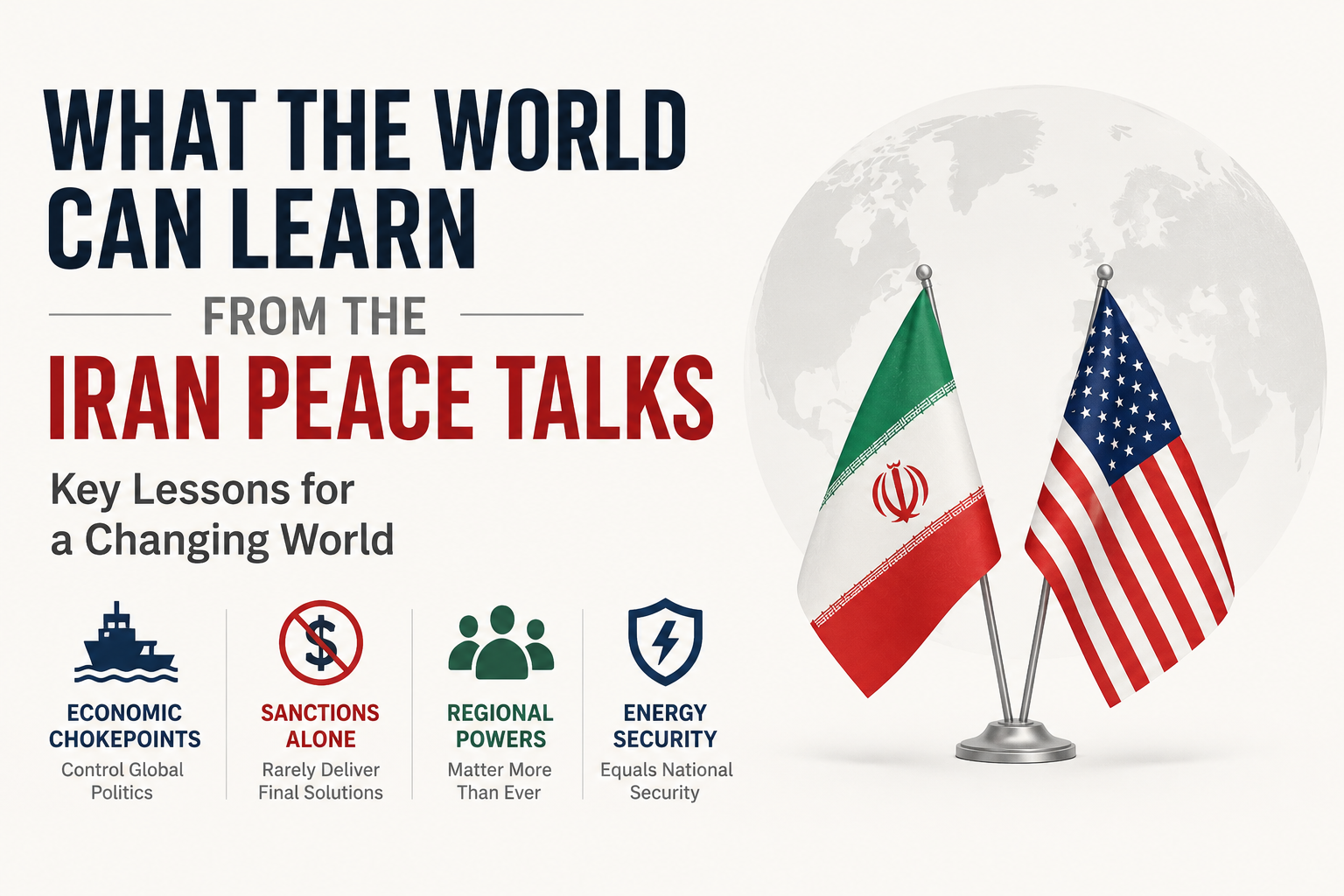
The emerging Iran negotiations may ultimately become one of the most important geopolitical case studies of the decade — not only because of what they reveal about the Middle East, but because of what they reveal about the changing structure of global power itself.
For years, the Iran crisis was treated primarily as a regional security issue centered around:
- Nuclear negotiations
- Sanctions enforcement
- Proxy warfare
- U.S.–Iran hostility
But the recent escalation and return to diplomacy exposed something much larger.
The crisis demonstrated how deeply interconnected the modern global system has become. Energy markets, shipping routes, digital infrastructure, financial systems, supply chains, sanctions regimes, and regional diplomacy are now intertwined in ways that allow localized instability to generate immediate global consequences.
The Iran negotiations are therefore not simply about Iran.
They are about:
- The fragility of globalization
- The limits of economic warfare
- The growing influence of regional powers
- The strategic importance of energy security
- The declining monopoly of Western-led diplomacy
The world is learning — often painfully — that geopolitical crises in the modern era cannot be isolated geographically for long.
Where Does the Iran Crisis Fit in the Global Order?
The Middle East in 2026 sits at the center of several overlapping strategic systems:
- Global energy flows
- Maritime trade routes
- Great-power competition
- Financial sanctions enforcement
- Regional security architecture
The Iran negotiations emerged not because underlying ideological differences disappeared, but because prolonged instability began threatening broader international interests.
As tensions escalated:
- Oil prices surged
- Shipping insurance costs rose
- Energy markets became volatile
- Currency pressures intensified
- Maritime risks expanded
This forced governments far beyond the Middle East to reassess the strategic importance of:
- Energy resilience
- Maritime infrastructure
- Regional diplomacy
- Supply chain security
The lesson is increasingly clear:
modern geopolitical crises no longer remain regional crises.
Section I: Lesson One — Economic Chokepoints Control Global Politics
One of the clearest lessons from the Iran negotiations is the extraordinary strategic power of economic chokepoints.
The Strait of Hormuz remains one of the most important maritime corridors in the world, carrying a significant portion of global oil and LNG shipments. The moment instability threatened maritime movement near the Strait:
- Oil markets reacted immediately
- Shipping rates increased
- Insurance premiums surged
- Global financial markets became volatile
The world economy remains deeply dependent on a small number of vulnerable transit corridors.
This creates a form of structural fragility inside globalization itself.
Modern economies depend on:
- Continuous energy flows
- Stable maritime trade
- Predictable shipping networks
- Secure infrastructure corridors
Any disruption near strategic chokepoints can rapidly trigger:
- Inflationary pressure
- Currency instability
- Industrial cost increases
- Supply chain disruptions
The Iran crisis demonstrated that even the threat of disruption can be economically destabilizing.
The strategic implication is profound:
control over geography still matters enormously in the digital age.
“Globalization created the illusion that geography mattered less. The Strait of Hormuz crisis demonstrated the opposite — geography still controls economics.”
— International Energy Security Analyst
Section II: Lesson Two — Sanctions Alone Rarely Deliver Final Solutions
The Iran case also revealed the limitations of sanctions-based strategy.
Sanctions undeniably weakened the Iranian economy through:
- Currency pressure
- Banking restrictions
- Investment limitations
- Oil export constraints
However, sanctions alone did not eliminate:
- Iran’s strategic ambitions
- Regional influence networks
- Domestic industrial adaptation
- Nuclear development capability
Instead, Iran gradually adapted through:
- Alternative trade networks
- Regional economic partnerships
- Informal financial systems
- Domestic production expansion
- Non-Western commercial channels
This adaptation process revealed a broader trend:
highly sanctioned states increasingly seek parallel economic systems outside traditional Western-controlled frameworks.
The long-term consequence may be a gradual fragmentation of global economic integration.
Sanctions remain powerful tools.
But the Iran experience suggests they are often more effective at generating pressure than producing final political settlements.
In many cases, sanctions can:
- Delay outcomes
- Increase economic pain
- Reshape incentives
…without necessarily resolving the underlying geopolitical dispute.
Section III: Lesson Three — Regional Powers Matter More Than Ever
Another major lesson from the Iran negotiations is the growing importance of regional middle powers.
For decades, Middle Eastern diplomacy was heavily dominated by:
- The United States
- European governments
- International institutions
That environment is changing.
Countries such as:
- Saudi Arabia
- United Arab Emirates
- Qatar
- Pakistan
- Türkiye
…now play increasingly important diplomatic, economic, and strategic roles.
These states possess:
- Financial leverage
- Energy influence
- Geographic access
- Mediation channels
- Security relationships with multiple rival actors
Regional powers are no longer simply participants in great-power diplomacy.
They are becoming diplomatic architects themselves.
This reflects a larger transformation in international politics:
the gradual movement from a heavily Western-dominated order toward a more multipolar negotiation environment.
The Iran talks highlighted how regional actors increasingly shape:
- Crisis de-escalation
- Backchannel negotiations
- Energy coordination
- Maritime security discussions
The era of exclusively Western-managed diplomacy is fading.
Section IV: Lesson Four — Energy Security Equals National Security
The Iran crisis also accelerated a major strategic realization:
energy security is no longer simply an economic issue.
It is a national security issue.
Countries across Asia, Europe, and the Middle East increasingly recognize that:
- Energy dependence creates strategic vulnerability
- Maritime disruptions can destabilize entire economies
- Infrastructure resilience is essential
- Energy diversification is becoming a survival strategy
This includes:
- LNG diversification
- Renewable energy expansion
- Strategic petroleum reserves
- Pipeline alternatives
- Nuclear energy investment
- Grid modernization
The geopolitical significance of energy has expanded beyond oil production itself.
Now the focus includes:
- Shipping route protection
- Port infrastructure
- Subsea cables
- LNG terminals
- Electricity grid resilience
- Cybersecurity protection
Digital infrastructure itself has become vulnerable near strategic chokepoints.
Modern economies require not only fuel flows, but also:
- Data connectivity
- Satellite coordination
- Secure communications infrastructure
The Iran crisis exposed how interconnected these systems have become.
Section V: Future Implications — The Emerging Strategic Environment
The lessons of the Iran negotiations extend beyond the Middle East.
The broader global system is increasingly characterized by:
- Economic weaponization
- Supply chain competition
- Energy insecurity
- Multipolar diplomacy
- Maritime vulnerability
- Technological fragmentation
Several future trends are becoming more visible.
Strategic Regionalization
Countries are increasingly building:
- Regional trade corridors
- Alternative payment systems
- Localized supply chains
- Regional energy partnerships
This reduces dependence on single global systems.
Maritime Militarization
Strategic waterways are becoming increasingly militarized due to:
- Energy security concerns
- Great-power competition
- Shipping vulnerabilities
- Naval deterrence expansion
Economic Security Policy
Governments increasingly view:
- Energy
- Technology
- Shipping
- Semiconductors
- Digital infrastructure
…as national security assets rather than purely commercial sectors.
Diplomacy Through Pressure Cycles
The Iran negotiations also reinforced a recurring modern pattern:
- sanctions
- escalation
- economic disruption
- crisis diplomacy
- temporary stabilization
This cycle risks becoming normalized across multiple geopolitical theaters.
Frequently Asked Questions
Why was the Strait of Hormuz so important during the Iran crisis?
The Strait of Hormuz carries a major portion of global oil and LNG shipments. Any instability there affects:
- Energy prices
- Shipping costs
- Inflation
- Financial markets
- Global trade flows
Did sanctions work against Iran?
Sanctions created major economic pressure but did not fully eliminate Iran’s regional influence or strategic objectives. Iran adapted through alternative trade mechanisms and regional partnerships.
Why are regional powers becoming more important diplomatically?
Countries like Saudi Arabia, UAE, Qatar, and Türkiye possess increasing influence due to:
- Economic leverage
- Strategic geography
- Energy importance
- Diplomatic flexibility
- Relationships with competing global powers
Why is energy security now considered national security?
Modern economies depend on stable energy flows for:
- Industry
- Transportation
- Technology infrastructure
- Financial systems
- Military readiness
Disruptions can rapidly destabilize national economies and political systems.
What broader lesson does the Iran crisis teach?
The crisis demonstrated how interconnected the modern world has become. Regional conflicts now rapidly affect:
- Global markets
- Supply chains
- Energy systems
- Maritime trade
- International diplomacy
Conclusion: The Return of Strategic Geography
The Iran negotiations may ultimately be remembered less for the agreements themselves and more for the strategic lessons they revealed about the changing global order.
The crisis exposed:
- The fragility of globalization
- The limits of sanctions
- The growing role of regional powers
- The centrality of energy security
- The continuing importance of geography
For decades, globalization encouraged the belief that economic integration would reduce geopolitical confrontation.
Instead, the modern world is entering an era where:
- trade routes become strategic assets
- sanctions become instruments of economic warfare
- energy infrastructure becomes security infrastructure
- maritime chokepoints shape global stability
The Iran talks demonstrated that diplomacy itself is changing.
Negotiations are no longer shaped only by ideology or military power.
They are shaped by:
- shipping routes
- energy flows
- currency systems
- technological dependence
- infrastructure resilience
The emerging global system is becoming more interconnected economically while simultaneously becoming more fragmented strategically.
That contradiction may define the geopolitical environment of the next decade.
The world learned from the Iran crisis that energy security, maritime stability, regional diplomacy, and economic resilience are no longer separate policy areas.
They are now part of the same strategic battlefield.


