


The Year the World Could Change Direction
The international system enters 2027 facing one of its most uncertain periods since the end of the Cold War.
Wars remain unresolved.
Great-power competition is intensifying.
Economic fragmentation is accelerating.
Technological disruption is transforming both prosperity and security.
Climate pressures are increasing.
The assumptions that underpinned global stability for much of the past three decades are under strain.
Yet history rarely changes because of long-term trends alone.
It is often shaped by flashpoints—specific regions or issues where tensions accumulate, miscalculations become possible, and local crises produce global consequences.
Some flashpoints remain dormant for years.
Others erupt suddenly.
But all have the potential to alter the trajectory of international politics.
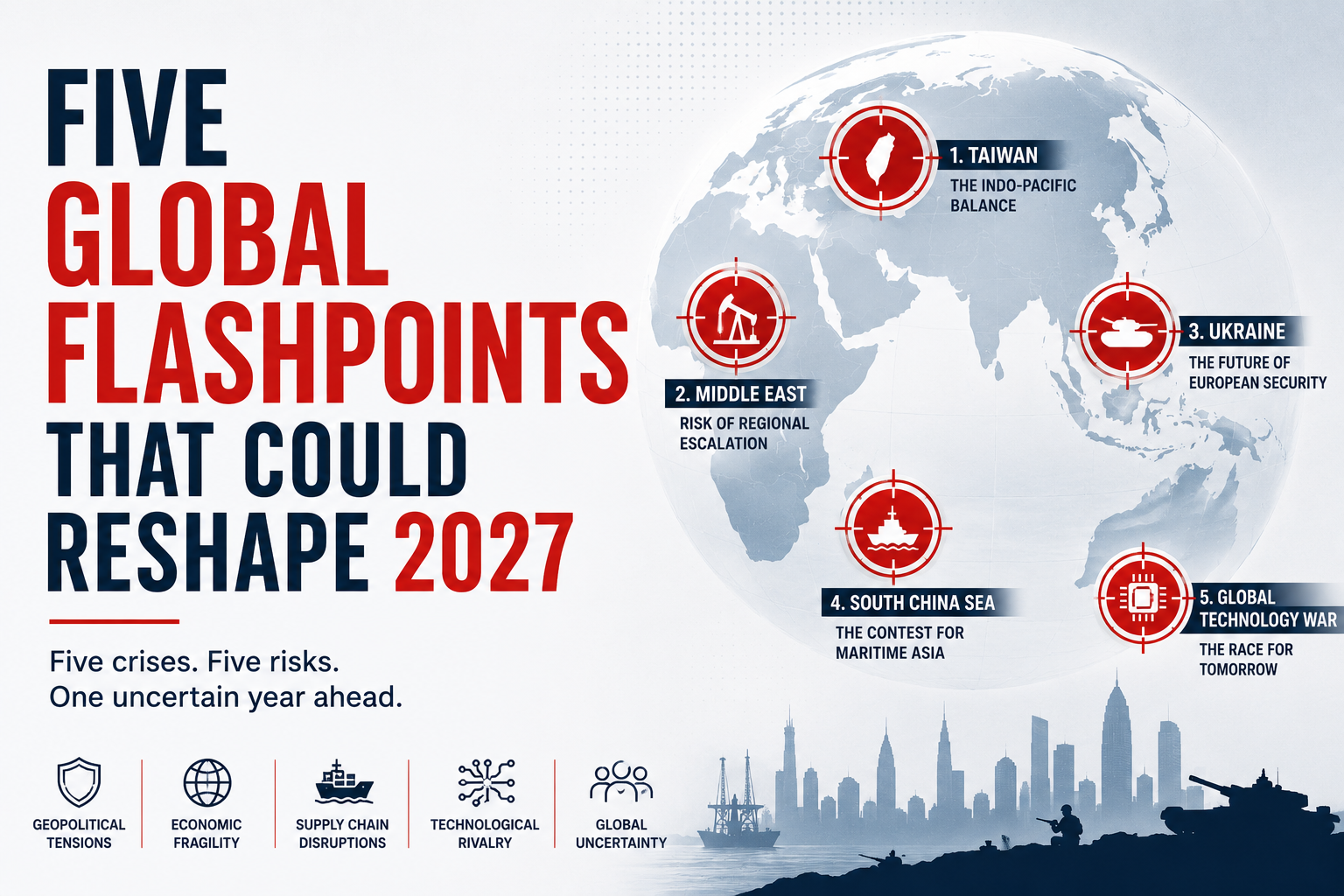
As 2027 approaches, five flashpoints stand out as particularly consequential.
Their outcomes could redefine alliances, disrupt economies, reshape supply chains, and accelerate the transition toward a new world order.
Flashpoint One: Taiwan and the Future of the Indo-Pacific
No geopolitical issue has greater potential to transform the international order than Taiwan.
For Beijing, Taiwan represents unfinished national reunification and a matter of sovereignty and national identity.
For the United States and its allies, preserving stability in the Taiwan Strait is essential for maintaining credibility, protecting regional security, and safeguarding the principles of international order.
Taiwan also occupies an extraordinary economic position.
It sits at the center of global semiconductor supply chains.
A major disruption in the Taiwan Strait would have consequences far beyond East Asia.
The effects would be felt across manufacturing, technology, financial markets, and international trade.
Why Taiwan Matters
Technology: Taiwan is indispensable to advanced semiconductor production.
Security: The Strait is central to military balance in the Indo-Pacific.
Economics: Global supply chains depend heavily on regional stability.
Diplomacy: Any crisis would force countries worldwide to make difficult strategic choices.
Even without conflict, increasing military activity and strategic competition around Taiwan are likely to remain among the defining features of global politics in 2027.
Flashpoint Two: The Middle East and the Risk of Regional Escalation
The Middle East remains one of the world’s most volatile regions.
Multiple conflicts intersect simultaneously.
Competition between regional powers.
Unresolved political disputes.
Militant organizations.
Humanitarian crises.
Strategic waterways.
Energy security concerns.
The region has repeatedly demonstrated its capacity to generate global consequences.
A disruption in energy flows could affect inflation and economic growth worldwide.
Escalation involving major regional actors could draw in external powers and destabilize international markets.
The Middle East increasingly matters not simply because of hydrocarbons, but because it sits at the crossroads of global trade routes connecting Asia, Europe, and Africa.
Why the Middle East Matters
Energy Security: Global markets remain sensitive to supply disruptions.
Shipping Routes: Strategic waterways underpin international commerce.
Great-Power Competition: Multiple external powers possess interests in the region.
Regional Stability: Escalation risks extending beyond national borders.
The region’s importance is likely to remain disproportionate to its size because disruptions there often generate global effects.
Flashpoint Three: The Ukraine War and the Future of European Security
The war in Ukraine has become more than a regional conflict.
It has evolved into a defining contest over European security and the future of international order.
The conflict has reshaped defense spending across Europe.
Expanded military alliances.
Accelerated energy diversification.
Triggered sanctions on an unprecedented scale.
And transformed assumptions about interstate conflict in Europe.
The fundamental questions remain unresolved.
How will the conflict eventually end?
Can European security architecture be reconstructed?
What lessons are being learned by other major powers?
The answers will influence international politics far beyond Europe.
Why Ukraine Matters
Security: The conflict is redefining European defense policy.
Economics: Energy markets and food systems remain vulnerable.
Geopolitics: The conflict influences global perceptions of deterrence and power.
Diplomacy: The war continues to test international institutions and alliances.
The outcome of the conflict could shape global strategic thinking for decades.
Flashpoint Four: The South China Sea and the Contest for Maritime Asia
The South China Sea has emerged as one of the world’s most strategically significant waterways.
Trillions of dollars in trade pass through it annually.
Multiple countries maintain overlapping territorial claims.
Military deployments have increased.
Competition over maritime rights, fishing resources, and strategic positioning has intensified.
The South China Sea represents something larger than territorial disputes.
It is increasingly a test of how international rules will function in an era of great-power competition.
Why the South China Sea Matters
Trade: Some of the world’s busiest shipping routes pass through the region.
Security: Military activities continue to expand.
Diplomacy: Competing interpretations of maritime law remain unresolved.
Regional Stability: Miscalculation risks persist.
Even a limited incident could produce consequences far beyond Southeast Asia.
Flashpoint Five: The Global Technology War
The fifth flashpoint is not defined by geography.
It is defined by technology.
Competition over artificial intelligence, semiconductors, quantum computing, cyber capabilities, and advanced manufacturing has become increasingly strategic.
Technology is no longer simply an economic sector.
It has become infrastructure for national power.
Countries are increasingly competing to control supply chains, secure access to critical minerals, develop advanced computing capabilities, and shape global technological standards.
The implications are enormous.
The countries that dominate future technologies may gain significant economic, military, and geopolitical advantages.
Why Technology Matters
Economic Power: Advanced technologies increasingly determine productivity and competitiveness.
National Security: Military capabilities depend heavily on technological superiority.
Supply Chains: Semiconductors and critical minerals have become strategic assets.
Global Governance: Competition over standards and rules is intensifying.
The technology race may ultimately prove as consequential as any traditional geopolitical confrontation.
Why These Flashpoints Are Connected
These crises should not be viewed independently.
They increasingly interact.
A disruption in Taiwan affects global technology supply chains.
Energy shocks in the Middle East influence inflation and political stability worldwide.
The Ukraine conflict shapes defense strategies in Asia.
Competition in the South China Sea affects trade and maritime security.
Technology competition influences every major geopolitical rivalry.
The modern international system is deeply interconnected.
Local crises increasingly generate global consequences.
This interdependence makes managing risks considerably more difficult.
Frequently Asked Questions
Which flashpoint poses the greatest risk?
Taiwan arguably represents the highest-impact flashpoint because of its strategic location and centrality to global semiconductor supply chains, although all five possess significant global implications.
Why does the South China Sea matter to countries outside Asia?
The South China Sea is a vital artery of international commerce. Disruptions would affect global trade, supply chains, and economic stability.
Why is technology considered a geopolitical flashpoint?
Control over advanced technologies increasingly determines economic competitiveness, military capabilities, and strategic influence.
Could these flashpoints trigger a wider global crisis?
Each possesses the potential to generate wider consequences because of the interconnected nature of the global economy and international security architecture.
Are these flashpoints likely to be resolved in 2027?
Most are structural challenges rather than temporary crises. They are more likely to evolve than disappear.
The World Is Entering an Age of Persistent Flashpoints
The international system is moving toward an era where geopolitical tension becomes a permanent feature rather than an exception.
Competition between major powers is intensifying.
Economic interdependence is becoming increasingly strategic.
Technological change is accelerating.
Regional conflicts are producing global consequences.
The five flashpoints outlined here differ in geography and character.
But they share a common feature.
Each has the capacity to reshape the international order.
The future of global politics may depend less on the intentions of great powers alone and more on how successfully the international community manages these interconnected points of friction.
The year 2027 may not witness a single defining event.
Instead, it may be remembered as the year when several unresolved tensions simultaneously pushed the world toward a new geopolitical era.
And in that emerging era, managing flashpoints may become the central challenge of international politics.


