


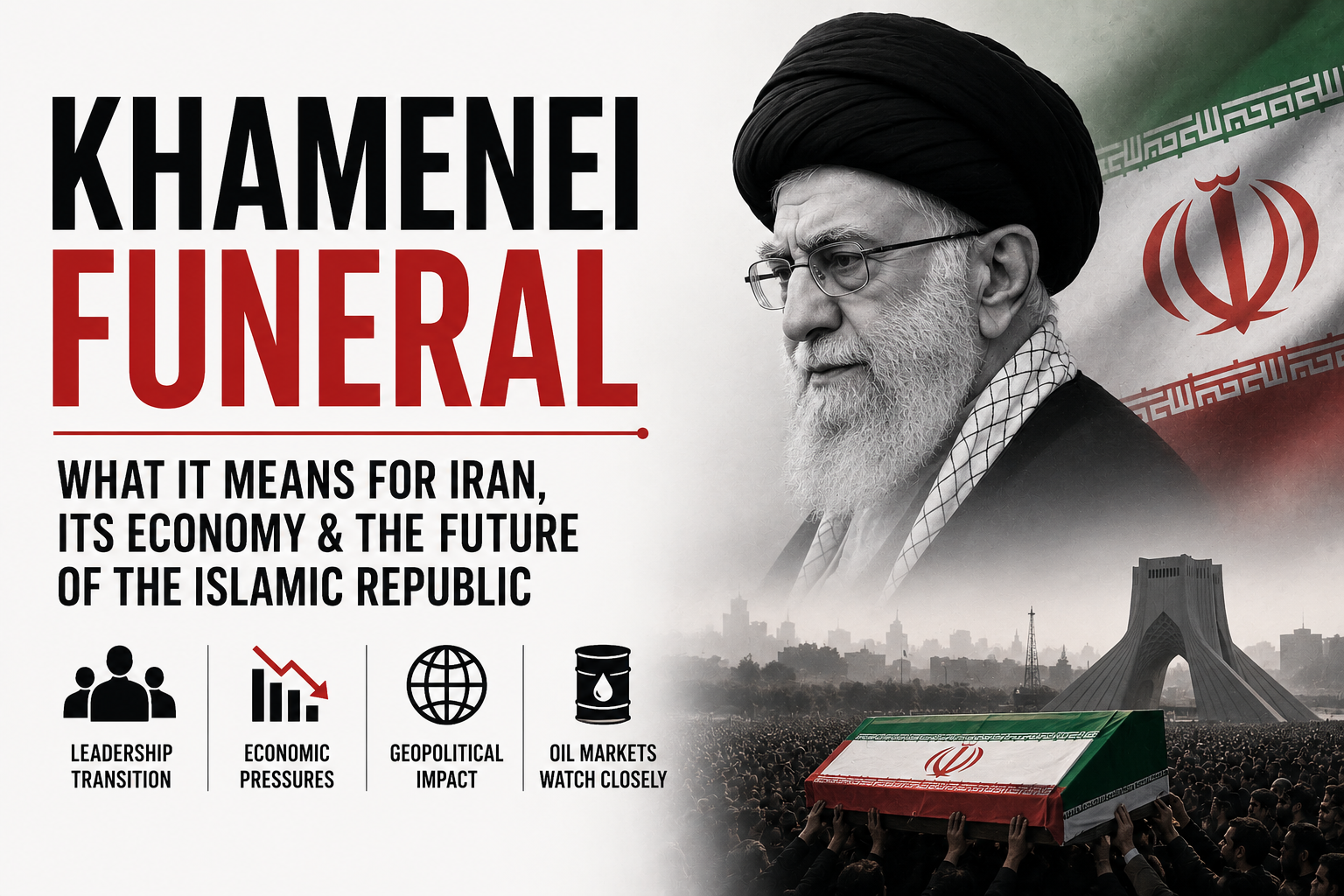
More Than a Funeral
State funerals often commemorate the past.
Some redefine the future.
The funeral of Ayatollah Ali Khamenei was not simply the burial of Iran’s longest-serving Supreme Leader. It was a carefully orchestrated demonstration of continuity at a moment when the Islamic Republic faces one of the greatest political, economic, and geopolitical challenges in its history.
For nearly four decades, Khamenei stood at the center of Iran’s political system.
Every major decision—from foreign policy and nuclear negotiations to military strategy and economic direction—ultimately flowed through his office.
His passing therefore represents far more than a leadership transition.
It marks the beginning of a new era for Iran.
The biggest question is not who succeeds him.
It is whether the economic model that sustained the Islamic Republic for decades can survive the pressures that lie ahead.
A Nation Facing Economic Exhaustion
Even before the latest crisis, Iran’s economy was under severe strain.
Years of sanctions had reduced oil revenues.
The national currency had weakened dramatically.
Inflation had eroded household purchasing power.
Foreign investment remained limited.
Youth unemployment remained persistently high.
Businesses struggled with restricted access to global financial markets.
Economic frustration had become one of the principal sources of domestic dissatisfaction.
The funeral therefore took place against a backdrop of economic uncertainty rather than national prosperity.
Political stability and economic stability have become increasingly inseparable.
The Cost of Regional Power
Iran has spent decades projecting influence across the Middle East.
Support for allied governments.
Backing regional armed groups.
Missile development.
Military modernization.
Strategic deterrence.
These policies expanded Iran’s regional influence but also imposed significant economic costs.
Defense spending competed with domestic investment.
International sanctions intensified.
Trade relationships became more constrained.
For many ordinary Iranians, the central question has increasingly become whether regional ambitions have come at too high an economic price.
The leadership transition may reopen this debate inside Iran’s political establishment.
Can Mojtaba Khamenei Deliver Economic Stability?
Attention has naturally focused on Mojtaba Khamenei, who has reportedly assumed leadership following his father’s death.
His immediate challenge is not only political legitimacy.
It is economic credibility.
The next Supreme Leader inherits an economy confronting multiple structural problems.
Inflation.
Currency volatility.
Investment shortages.
Limited access to international finance.
An expanding young workforce demanding opportunity.
Whether Iran continues its current economic trajectory or pursues greater international engagement may become one of the defining decisions of the post-Khamenei era.
Why Investors Around the World Are Watching
Iran is not isolated from the global economy.
It possesses some of the world’s largest oil and natural gas reserves.
It occupies one of the most strategic geographic positions on Earth.
It borders major energy producers.
It sits near some of the world’s busiest maritime trade routes.
Any major political change inside Iran therefore carries implications for international investors.
Financial markets closely monitor leadership transitions because uncertainty often influences energy prices, investment flows, and regional stability.
Markets dislike uncertainty.
Leadership transitions inevitably create it.
Oil Markets React Before Politics Does
Energy markets often respond to expectations rather than events.
The funeral itself does not change oil production.
But uncertainty surrounding future Iranian policy affects market psychology.
Questions include:
Will Iran seek confrontation?
Will sanctions remain?
Could negotiations resume?
Will regional tensions escalate?
Even without immediate changes in production, uncertainty alone can contribute to higher price volatility.
For oil-importing economies, political stability inside Iran remains economically important.
Could the Leadership Transition Restart Diplomacy?
Every political transition creates an opportunity for policy reassessment.
Whether Iran chooses greater confrontation or renewed diplomacy remains uncertain.
Economic realities may increasingly influence strategic calculations.
Sanctions continue to constrain growth.
Foreign investment remains limited.
Access to technology and global capital has become increasingly important.
Future leaders may conclude that economic modernization requires greater international engagement.
Others may argue that national security should remain the overriding priority.
The balance between these competing visions will shape Iran’s future.
The Global Shipping Question
The funeral also takes place against continuing concerns over maritime security.
The Strait of Hormuz remains one of the world’s most strategically important waterways.
Shipping companies.
Energy traders.
Insurance markets.
Governments.
All continue monitoring developments closely.
Leadership uncertainty increases geopolitical risk assessments.
Even without military escalation, uncertainty alone can influence freight costs, insurance premiums, and investment decisions.
The global economy has become highly sensitive to events occurring along the Gulf’s maritime corridors.
What It Means for the Middle East
Iran’s future matters to every major regional actor.
Saudi Arabia seeks continued stability following recent diplomatic normalization.
The United Arab Emirates prioritizes trade and investment.
Israel remains focused on Iran’s military capabilities.
Iraq depends heavily on regional stability.
The Gulf’s economic transformation requires predictable security conditions.
Whether the post-Khamenei leadership chooses continuity or recalibration will influence regional economics for years.
What It Means for the Global Economy
The implications extend far beyond the Middle East.
Energy prices.
Inflation.
Shipping costs.
Supply chains.
Defense spending.
Financial markets.
All could respond to future Iranian policy decisions.
The world has learned repeatedly that instability in the Gulf rarely remains regional.
Modern globalization ensures that geopolitical shocks quickly become economic shocks.
Frequently Asked Questions
Why is Khamenei’s funeral economically significant?
Leadership transitions in major energy-producing countries influence investor confidence, energy markets, and regional political stability.
Will Iran’s economic policy change?
It is too early to know. Future policy will depend on the priorities of the new leadership, domestic political dynamics, and relations with the international community.
Could sanctions eventually be eased?
That would depend on future diplomacy, particularly regarding Iran’s nuclear program and broader regional security issues.
Why are oil markets watching Iran?
Iran possesses substantial oil and gas reserves and occupies a strategic position near the Strait of Hormuz, one of the world’s most important energy shipping routes.
What is the biggest challenge for Iran’s next leadership?
Restoring economic confidence while balancing domestic expectations, regional security priorities, and international relations.
The Beginning of Iran’s Next Chapter
History will remember Ali Khamenei as one of the most consequential figures in the history of the Islamic Republic.
His funeral marked the end of an era.
But it also marked the beginning of a more uncertain one.
The coming years will determine whether Iran continues along its existing economic and geopolitical path or gradually adapts to changing domestic and international realities.
The next Supreme Leader inherits more than political authority.
He inherits an economy constrained by sanctions, a young population seeking opportunity, and a region undergoing profound strategic transformation.
The decisions made in Tehran over the next few years will influence far more than Iran’s future.
They will affect energy markets, global shipping, regional investment, and international security.
The funeral closed one chapter of Iranian history.
The economic story that follows may prove even more consequential.
The Collapse of U.S.–Iran Peace Talks: What Comes Next for the Middle East?


