


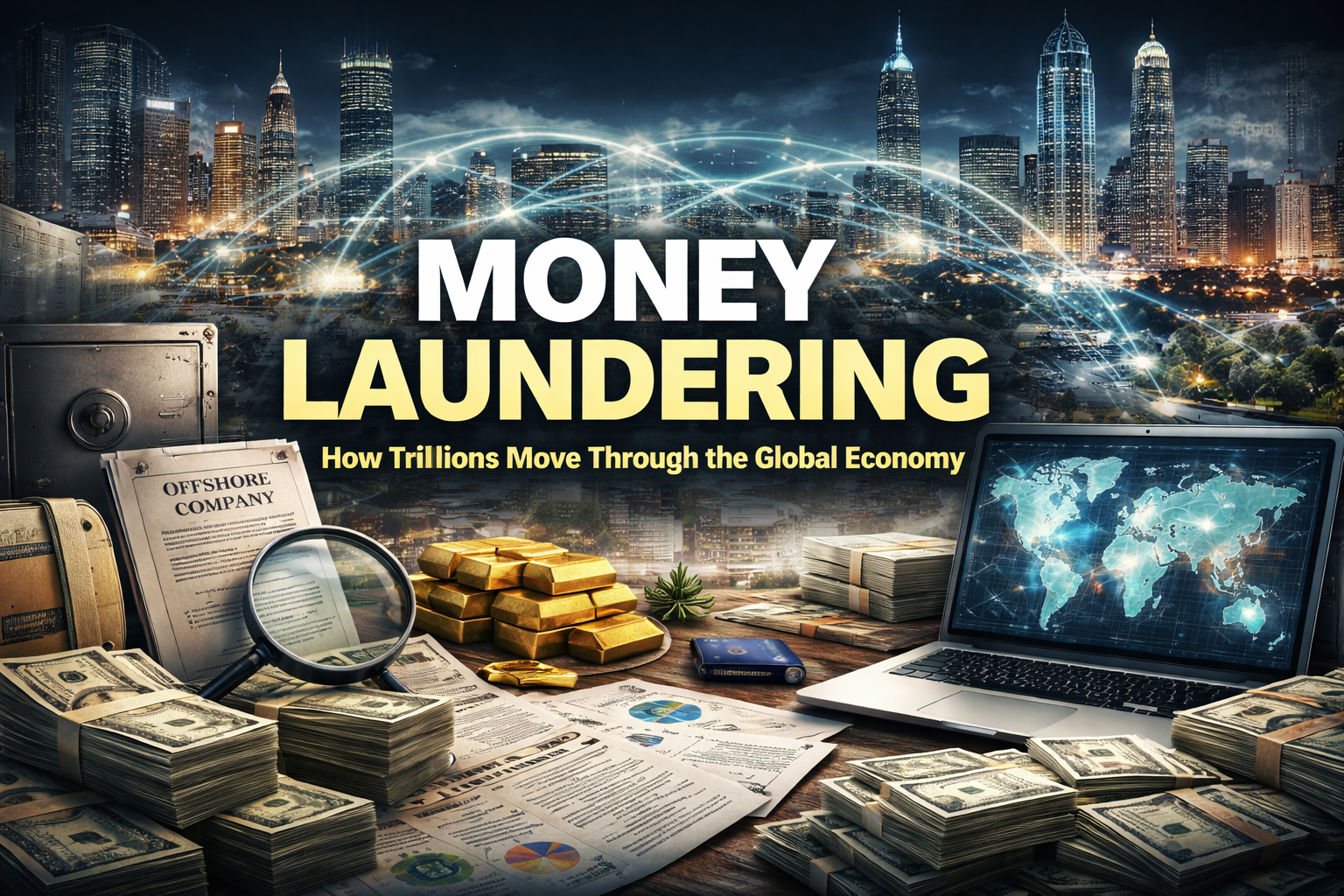
Money laundering is not merely a financial crime. It is a parallel system that distorts markets, undermines public institutions and erodes trust in the global economy. Despite decades of regulation and enforcement, illicit capital continues to move across borders with remarkable efficiency.
From complex shell-company networks to cryptocurrency transfers and real estate acquisitions, the methods evolve faster than the laws designed to stop them. Understanding how money laundering works — and why it persists — is central to understanding modern global finance.
What Is Money Laundering?
Money laundering is the process of disguising the origins of illegally obtained money so that it appears legitimate. It typically unfolds in three stages:
- Placement – Introducing illicit funds into the financial system (e.g., through banks, casinos, real estate purchases).
- Layering – Moving funds through complex transactions to obscure their origin (transfers between accounts, shell companies, cross-border movements).
- Integration – Reintroducing the funds into the economy as seemingly lawful assets (business investments, luxury goods, property).
According to estimates from the United Nations Office on Drugs and Crime (UNODC), between 2% and 5% of global GDP — potentially trillions of dollars annually — may be laundered worldwide.
How Shell Companies Work
Shell companies are legal entities with no significant operations or assets. On paper, they exist as corporations or limited liability companies. In practice, they often serve as vehicles to obscure ownership and financial flows.
A typical structure might involve:
- A shell company incorporated in a secrecy jurisdiction.
- Nominee directors listed in official documents.
- Bank accounts opened in a different country.
- Funds transferred across multiple entities before final investment.
The shell itself is not illegal. Many multinational corporations use holding companies for tax structuring or operational efficiency. The problem arises when shells are used to conceal beneficial ownership and facilitate corruption, tax evasion or criminal proceeds.
The exposure of such structures in leaks like the Panama Papers demonstrated how global networks of lawyers, accountants and intermediaries create intricate ownership webs that are technically compliant yet ethically dubious.
Regional Variations: Different Networks, Different Systems
Money laundering adapts to local conditions.
Europe: Financial Hubs and Regulatory Arbitrage
Major financial centres such as the City of London operate under robust regulatory frameworks. Yet complexity and cross-border banking can create loopholes. Smaller jurisdictions within Europe have historically marketed favourable tax regimes, drawing both legitimate business and illicit flows.
The European Union has introduced successive Anti-Money Laundering Directives and created supervisory mechanisms, yet enforcement remains uneven across member states.
North America: Banking Transparency and Real Estate Exposure
The United States enforces strict AML compliance through agencies like the Financial Crimes Enforcement Network(FinCEN). However, anonymous property purchases in major cities and corporate registration practices in certain states have historically provided channels for concealment.
Canada and Mexico face distinct challenges — from property-based laundering to narcotics-linked financial networks.
Asia-Pacific: Trade-Based Laundering and Informal Networks
In parts of Asia, trade-based money laundering is prevalent. Over- or under-invoicing goods allows value transfer across borders. Informal systems such as hawala networks operate outside formal banking structures, particularly in South Asia and the Middle East.
Meanwhile, global financial centres such as Singapore and Hong Kong maintain strong compliance systems but face continuous pressure from transnational capital flows.
Middle East and Africa: Cash Economies and Political Risk
In regions with higher cash usage and weaker institutional oversight, laundering may occur through gold trading, real estate or commodity exports. Political instability and corruption exacerbate risks, while enforcement capacity can be limited.
The Role of High-Profile Individuals
Money laundering networks often rely on reputational shields.
Politically exposed persons (PEPs), celebrities or business magnates may not always be the masterminds but can be linked to financial flows that attract scrutiny. Their prominence offers both cover and complexity — banks may hesitate to challenge influential clients, while legal teams construct elaborate defensive structures.
Financial institutions are required to conduct enhanced due diligence on PEPs, yet enforcement failures have surfaced repeatedly across jurisdictions.
Agencies That Fight Back
Globally, anti-money laundering (AML) frameworks are coordinated through the Financial Action Task Force (FATF), which sets standards and evaluates national compliance.
Domestic enforcement agencies — including financial intelligence units, central banks and anti-corruption bureaus — investigate suspicious transaction reports filed by banks.
Yet the system remains reactive. Criminal networks innovate faster than regulatory harmonisation can occur. The rise of digital assets and decentralised finance introduces new vulnerabilities, even as blockchain analysis tools enhance traceability.
The Impact on the Global Economy
The macroeconomic consequences are significant:
- Distorted Asset Prices: Real estate markets in global cities often inflate due to illicit capital inflows.
- Erosion of Tax Bases: Governments lose revenue when illicit gains escape taxation.
- Corruption of Institutions: Political systems weaken when illicit finance intersects with power.
- Capital Misallocation: Resources flow toward concealment structures rather than productive investment.
Developing economies suffer disproportionately, as capital flight drains public funds needed for infrastructure and social services.
How It Affects Law-Abiding Citizens
For ordinary taxpayers, the consequences are less visible but deeply felt.
- Higher taxes to compensate for lost public revenue.
- Inflated housing prices driven by opaque investment.
- Reduced trust in financial institutions.
- Underfunded public services.
Money laundering effectively socialises the cost of private crime. The burden falls on compliant citizens and small businesses.
Why It Persists
Despite global coordination, money laundering endures because:
- Jurisdictions compete for capital.
- Legal systems differ in transparency requirements.
- Professional enablers operate within grey zones.
- Enforcement is expensive and politically sensitive.
In an interconnected financial system, weak links become entry points. Coordination remains uneven, and national sovereignty often limits cross-border enforcement.
The Structural Dilemma
The global economy depends on the free movement of capital. Yet that same openness enables concealment.
Efforts to strengthen transparency — beneficial ownership registries, automatic exchange of information, digital monitoring — continue to expand. Still, laundering adapts. It migrates across jurisdictions, sectors and technologies.
The tension between financial openness and financial integrity remains unresolved.
- El Niño 2026: The Climate Phenomenon Reshaping Weather, Food Security and the Global Economy
- Rahul Gandhi’s Political Evolution: From Reluctant Heir to a More Assertive Challenger to the BJP
- India’s Middle East Strategy Explained: Energy, Alliances and the Battle for Strategic Autonomy
- The Rise of Private Military Technology Companies: Who Is Building the Future of Warfare?
- Riyadh Under Attack: Why Saudi Security Matters to the Entire World
DAVOS 2026 – Europe’s Push for Strategic Autonomy in a Divided World


