


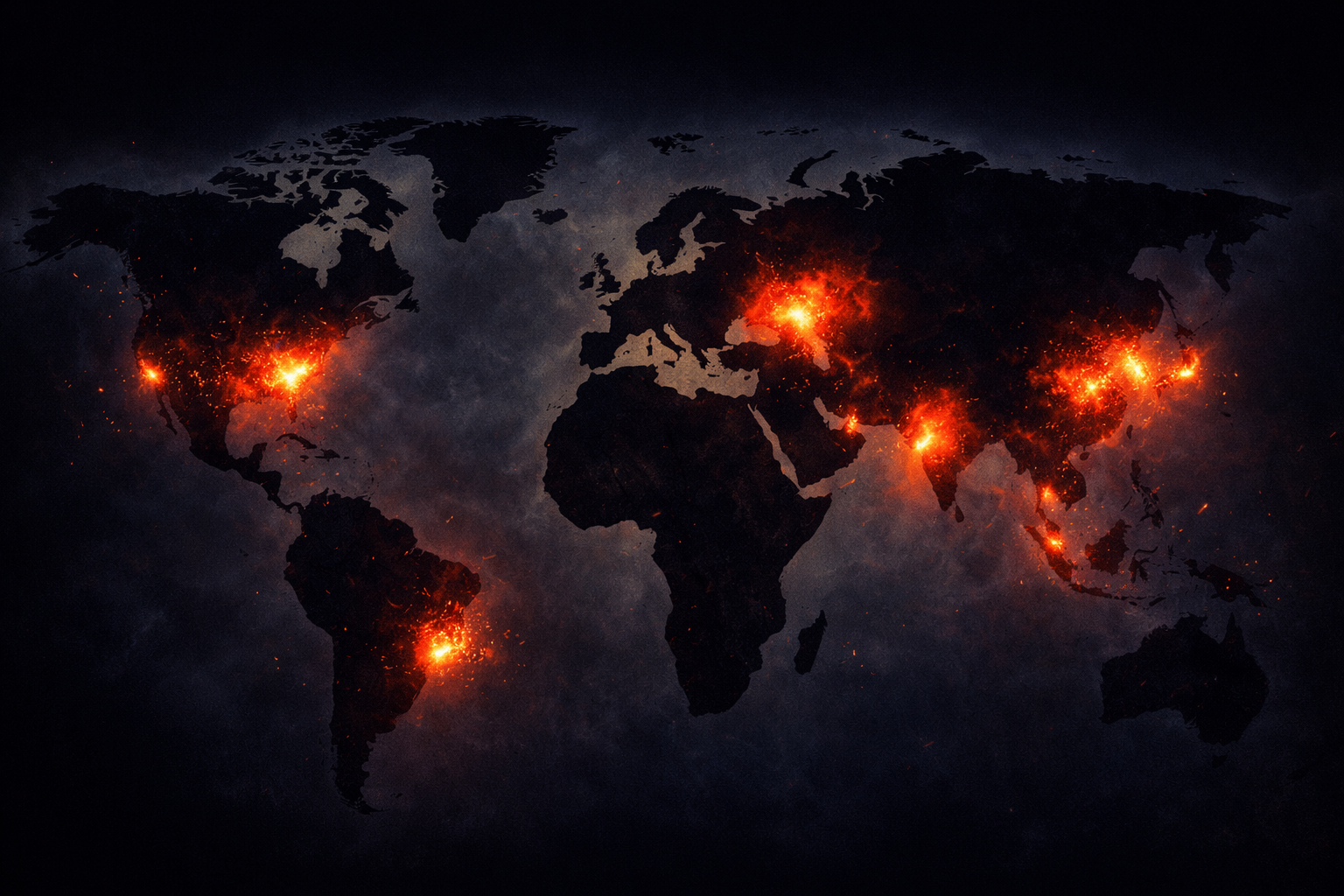
From Russia‘s Dead Hand to Iran’s distributed command and autonomous drone swarms, the architecture of modern conflict is shifting toward systems that can operate, escalate, and persist — even after human decision-makers are gone
| What Are Self-Sustaining War Systems? Self-sustaining war systems are military architectures — doctrinal, institutional, and technological — deliberately designed to continue operating even after leadership is destroyed, communications are severed, or central command is eliminated. They represent a fundamental shift in how conflict is structured: away from war as an event controlled by decision-makers, and toward war as a system capable of running itself. They already exist. Russia deploys one for nuclear retaliation. Iran has built one for conventional deterrence. Autonomous weapons are extending the logic into the battlefield. The question is no longer whether these systems are real — it is whether they can still be controlled once activated. |
For most of recorded history, the logic of war contained a built-in termination mechanism: destroy the command, and the conflict collapses. Kings fell, capitals were taken, generals were killed — and wars ended. Not because all capacity was exhausted, but because the human structure directing that capacity was gone. Leadership was the centre of gravity, and targeting it was how wars were decided.
That assumption is now breaking down — systematically, deliberately, and across multiple domains simultaneously.
Across nuclear doctrine, military organisation, and geopolitical strategy, a new model of conflict is taking shape — one in which war is no longer dependent on continuous human control. Instead, it is being architected to sustain itself: to absorb the destruction of leaders, the severing of communications, and the degradation of central command, and continue functioning as a coherent, escalating system regardless. Russia has built this logic into its nuclear posture. Iran has embedded it into its governing architecture. Advanced militaries are now extending it into the weapons themselves.
This is not a future projection. It is the strategic reality of 2026 — and understanding it is the prerequisite for understanding why the conflicts now underway are so difficult to end, and why the ones coming may be impossible to control at all.
| 4 Layers The architecture of self-sustaining war systems — from guaranteed nuclear retaliation to fully autonomous battlefield platforms Modern conflict is being designed across four distinct but interconnected layers: automated nuclear retaliation systems (Dead Hand/Perimeter), distributed institutional command structures (Iran’s mosaic leadership), semi-autonomous and autonomous weapons platforms, and decentralised proxy and hybrid warfare networks. Each layer reduces human decision-making requirements. Together, they represent a structural transformation in how war is organised. |
Section I: The Break From History — Why Command Is No Longer the Centre of Gravity
Traditional warfare rested on three foundational assumptions that were so deeply embedded in military doctrine that they were rarely made explicit. Leadership survives long enough to direct the conflict. Communication remains sufficiently intact to transmit orders. Control — however contested — can be maintained over the system’s key elements. Strategy, logistics, escalation management, and ultimately war termination all depended on these three conditions holding.
Modern warfare systematically attacks all three. Precision strikes can eliminate leadership in minutes. Cyber operations can sever communication networks in seconds. Hypersonic delivery systems compress the window between launch detection and impact to a span in which human decision-making is physically impossible. In this environment, designing a military system around the assumption of continuous human command is not a strategic choice — it is a vulnerability.
The strategic response — emerging independently across different states, doctrines, and technological domains — is to design systems that do not require those assumptions to hold. The priority shifts from control to continuity under collapse. From command to persistence beyond the commander. The result is a new class of war system: one that can outlast the humans who built it.
| “We have spent decades optimising our military systems for command efficiency — the ability to project controlled force from a central authority. What we are now facing is adversaries who have optimised for command resilience — the ability to continue projecting force after that central authority is gone. Those are fundamentally different design philosophies, and they have fundamentally different implications for how conflicts begin, escalate, and end.” — Dr. Paul Scharre Senior Fellow and Director of Studies, Center for a New American Security; Author of ‘Army of None: Autonomous Weapons and the Future of War’ |
Section II: The Four Layers of Self-Sustaining War — How the Architecture Is Built
Self-sustaining war systems have not emerged from a single strategic concept or a coordinated international programme. They have developed independently across four distinct domains — each driven by its own logic, each addressing a different layer of command vulnerability. Together, they constitute an architecture of conflict that is progressively more resistant to the disruption of its human components.
| 1 NUCLEAR | Guaranteed Retaliation — The First Self-Sustaining Layer Russia’s Dead Hand system (Perimeter) was the first operational self-sustaining war system. Designed to guarantee nuclear retaliation even after total leadership destruction, it monitors for attack indicators and severs command communications — then, if both conditions are met, transmits launch codes to the entire Russian nuclear arsenal without requiring a surviving human decision-maker. It transformed deterrence from a human transaction into a structural feature of the weapons system itself. The absence of leadership does not stop the war. It completes it. |
| 2 DOCTRINE | Distributed Command — Institutional Self-Sustainment Iran’s mosaic leadership architecture extends self-sustaining logic into conventional governance and military command. Authority is distributed across the Supreme Leader, IRGC provincial commands, parallel political institutions, and regional proxy networks. Each node carries standing doctrine and ideological direction that allows independent operation when the centre is disrupted. The elimination of senior leadership does not halt the system — it devolves authority to the next layer, which continues operating within pre-established parameters. War, in this structure, behaves less like a controlled campaign and more like a distributed network. |
| 3 TECH | Autonomous Systems — Self-Sustainment at the Battlefield Level The technological layer extends self-sustaining logic into individual weapons platforms and battlefield decision-making. Air defence systems detect and intercept threats automatically. Drone swarms coordinate attack patterns without continuous human input. AI-assisted targeting systems prioritise and engage faster than human operators can review. These systems are currently supervised — but the trajectory is unmistakable: decision-making authority is being pushed progressively downward from human commanders to the platforms themselves. At the limit of this trajectory, individual weapons conduct independent combat operations within mission parameters, without real-time human authorisation for each engagement. |
| 4 HYBRID | Proxy Networks — Strategic Self-Sustainment Across Borders The outermost layer of self-sustaining conflict architecture is strategic rather than technological: the use of proxy forces and hybrid warfare networks that continue operating independently of the state that built them. Hezbollah, the Houthis, Iraq’s Hashd al-Sha’bi, and various Palestinian factions each carry sufficient institutional depth, independent financing, and pre-established doctrine to impose costs on adversaries without requiring continuous direction from Tehran. The result is a conflict without a single battlefield, no clear beginning or end, and no central command node whose elimination terminates the system. |
Section III: The Logic Behind the Shift — Why States Are Building These Systems
The move toward self-sustaining war systems is not driven by a single strategic theory or a coordinated international programme. It is the convergent response of multiple states to three structural realities of the contemporary strategic environment — each of which independently creates pressure toward designs that reduce human decision-making requirements.
| The Three Structural Drivers of Self-Sustaining War Systems Vulnerability of centralised command: Centralised command structures are efficient under normal conditions and catastrophically fragile under targeted attack. Precision strike capabilities — now available to multiple state and non-state actors — make leadership and communication nodes viable targets in any serious conflict. A system that depends on central command to function is a system with a single catastrophic failure point that adversaries are incentivised to target first. Speed compression: Hypersonic weapons travel at speeds that reduce warning time to minutes. Cyber operations can degrade communication networks in seconds. Real-time surveillance and AI-assisted targeting eliminate the delays that once provided decision space. In an environment where the timeline from threat detection to impact is measured in minutes, human decision-making loops — with their requirements for confirmation, deliberation, and authorisation chains — are physically too slow to manage the system’s most critical functions. Deterrence through complexity: Distributed and automated systems are fundamentally harder for adversaries to map, model, and plan against than centralised ones. A system with a single command node can be targeted; a system with hundreds of autonomous nodes operating under pre-established doctrine cannot. The complexity is itself a deterrent — it prevents adversaries from calculating that a limited strike can produce decisive effect, and forces them to confront the possibility that any action triggers consequences they cannot fully anticipate or control. |
War is no longer just fought — it is architected. And the architecture is increasingly designed to function without the architects.
The defining strategic shift of the 2020s
Section IV: The Advantages — Why These Systems Work
Self-sustaining war systems offer genuine and significant strategic advantages to the states that deploy them — advantages that are not merely theoretical but have been demonstrated in operational environments. Understanding these advantages is essential to understanding why states continue to develop and expand these architectures despite the risks they carry.
Resilience under attack is the primary advantage. A system that continues functioning despite the loss of leadership, destruction of infrastructure, and severance of communications cannot be disabled through decapitation strikes — the primary mechanism by which superior conventional military power neutralises adversary command. Iran’s mosaic system has demonstrated this in the March 2026 conflict: senior IRGC commanders were killed, command infrastructure was degraded, and communication was disrupted — and the system continued operating, with replacement command authority devolving to pre-positioned successors within hours.
Deterrence credibility is the second major advantage. Classical deterrence requires the adversary to believe that retaliation is guaranteed. Self-sustaining systems make that guarantee structural rather than dependent on leadership survival — which is both more credible and more difficult to test. An adversary cannot reliably calculate that eliminating leadership will prevent response, because the response mechanism does not require leadership to survive.
Strategic scalability is the third. Decentralised systems can expand or contract across multiple domains simultaneously without requiring central coordination. Proxy networks can activate across multiple theatres. Autonomous systems can prosecute distributed engagements. The system’s operational footprint is not limited by the bandwidth of its human command structure — it scales with its institutional reach and pre-programmed parameters.
| “The military advantages of distributed, resilient command architectures are real and significant. We should not pretend otherwise. The question is not whether these systems work — they clearly do. The question is what kind of world we are building when the systems that make us most secure are also the systems least amenable to human control in a crisis.” — Dr. Rosa Brooks Professor of Law, Georgetown University; Former Senior Advisor, US Department of Defense; Author of ‘How Everything Became War and the Military Became Everything’ |
Section V: The Risks — When War Outlives the Will to Fight It
The properties that make self-sustaining war systems strategically effective are inseparable from the properties that make them strategically dangerous. This is not a design flaw that better engineering can correct — it is the fundamental tension at the heart of removing human decision-making from conflict architecture. Every reduction in human decision-making requirements that increases resilience also reduces the capacity for restraint.
| 1 ESCALATION | Escalation Without Intent Autonomous and semi-autonomous systems may respond to stimuli in ways that escalate conflict beyond what human commanders would have chosen. An IRGC provincial commander interpreting pre-defined doctrine as authorising an action that central leadership would have withheld; a drone swarm engaging a target that human operators would have reconsidered; an automated defence system triggering a response that cascades into a broader exchange. The March 2026 environment, with multiple autonomous actors simultaneously active across several theatres, is precisely the condition in which this risk is highest. |
| 2 OVERSIGHT | The De-escalation Problem Classical crisis management depends on the ability of political leaders to reassess, communicate, and choose restraint at critical moments. Self-sustaining systems reduce or eliminate this capacity precisely at the moments of highest stress — which are also the moments when de-escalation is most necessary. A system designed to function without human decision-making cannot be halted by human decision-making in the same timeframe. The compression of the decision loop cuts in both directions: it removes the adversary’s ability to stop the war by killing leadership, but it also removes the state’s own ability to stop the war by choosing restraint. |
| 3 PERSISTENCE | Conflicts Without Endpoints Wars have historically ended through the decisions of human leaders — defeated commanders surrendering, exhausted governments negotiating, political elites calculating that continuation no longer serves their interests. Self-sustaining systems have no equivalent termination mechanism. A distributed proxy network can continue imposing costs indefinitely without requiring a central decision to stop. An automated nuclear system will execute its pre-committed response regardless of whether the political conditions that originally justified it still obtain. Conflict becomes an ongoing condition rather than a defined event with a discernible end. |
| 4 COMPLEXITY | Systemic Miscalculation at Scale The more complex and distributed a war system becomes, the more difficult it is for any actor — including its creators — to model its behaviour under novel conditions. Interactions between distributed proxy networks, autonomous platforms, and pre-committed doctrine can produce emergent outcomes that no one planned and no one fully understands until after the fact. In a nuclear-armed environment, the consequences of systemic miscalculation are not correctable. |
| Zero The number of arms control frameworks currently designed to constrain autonomous weapons systems or self-sustaining war architectures Existing arms control frameworks — including New START and its potential successors — focus on warhead numbers, delivery vehicle types, and geographic deployment limits. None address the command systems that determine whether and how those weapons are used. Autonomous weapons, distributed command architectures, and pre-committed response systems fall entirely outside the current arms control architecture. This is not a gap being actively closed. |
Section VI: The Implications for Global Order — What Happens When War Systems Outlive Human Control
The proliferation of self-sustaining war systems carries implications that extend well beyond any individual conflict or bilateral relationship. It represents a structural change in the nature of conflict itself — and in the capacity of the international system to manage, contain, and resolve wars that states begin but may no longer be able to stop.
The most immediate implication is that conflicts become harder to end. Negotiating a ceasefire with a centralised authority is possible: the authority has the capacity to issue and enforce a halt. Negotiating with a distributed system — multiple autonomous proxy networks, pre-committed nuclear doctrine, and battlefield platforms operating under mission parameters — is a fundamentally different problem. There may be no single actor with the authority and the capacity to stop all elements of the system simultaneously. The Iran conflict of 2026 illustrates this: even if Tehran’s central leadership chose accommodation, it is not clear that every element of the mosaic — Hezbollah, the Houthis, autonomous IRGC provincial commands — would halt simultaneously in response.
The second implication is that the international community’s diplomatic tools are increasingly mismatched to the systems they are trying to manage. Diplomatic frameworks were built around state actors with centralised authority — governments that could make binding commitments and enforce them on subordinate actors. Self-sustaining war systems challenge both conditions: the authority may not be centralised, and the actors may not be states. Proxy networks, autonomous platforms, and pre-committed response systems do not negotiate and cannot be deterred through the same mechanisms that apply to rational state actors making deliberate decisions.
The third is strategic diffusion. States observing the demonstrated resilience of self-sustaining systems — Iran’s in 2026, Russia’s nuclear posture throughout — are drawing lessons and considering adaptation. If this model spreads to additional actors, the coercive diplomacy toolkit that major powers rely upon — sanctions, targeted strikes, leadership pressure — becomes progressively less effective across a wider range of contexts. The strategic premium on human-independent command architectures increases as the tools used against them become more sophisticated.
| “The danger is not that these systems will suddenly go rogue and start wars on their own — that is science fiction. The danger is far more mundane and far more real: that they will make existing wars harder to stop, that they will create escalation dynamics that human decision-makers cannot interrupt in time, and that we will build them faster than we build the frameworks needed to manage the world they create.” — Dr. Heather Roff Senior Research Fellow, Leverhulme Centre for the Future of Intelligence, University of Cambridge; former RAND Corporation researcher on autonomous weapons |
Frequently Asked Questions
| What is a self-sustaining war system? A self-sustaining war system is a military architecture — doctrinal, institutional, or technological — deliberately designed to continue operating even after the destruction of leadership, severance of communications, or elimination of central command. Examples include Russia’s Dead Hand nuclear retaliation system, which guarantees a retaliatory strike without surviving human commanders; Iran’s mosaic leadership, which distributes authority across overlapping institutions so that no single loss halts the system; and autonomous weapons platforms designed to prosecute engagements without real-time human authorisation. |
| Are self-sustaining war systems already deployed in 2026? Yes. Russia’s Dead Hand/Perimeter system has been confirmed as operational by Russian military officials and is assessed by analysts to have been modernised substantially since its Soviet-era design. Iran’s mosaic leadership architecture has been operationally demonstrated in the March 2026 conflict, where the system continued functioning after significant strikes on senior leadership and command infrastructure. Autonomous and semi-autonomous weapons are deployed across multiple militaries, including the United States, Russia, Israel, China, and Turkey, with varying levels of human supervision over engagement decisions. |
| What makes self-sustaining war systems dangerous? The same properties that make these systems resilient — reduced human decision-making requirements, pre-committed responses, distributed authority — also reduce or eliminate the capacity for restraint at moments of peak crisis. They may escalate beyond original intentions through autonomous action, persist long after political leaders on both sides would prefer to stop, and produce emergent outcomes in complex multi-actor environments that no one planned. In a nuclear context, these properties create risks that are not recoverable from. |
| How do self-sustaining war systems affect the ability to end conflicts? They make conflict termination substantially harder. Ending a war requires an authority with both the will to stop and the capacity to enforce a halt across all elements of its military system. Distributed and self-sustaining systems may lack a single authority capable of doing both simultaneously. Proxy networks may continue operating independently even if a central government chooses accommodation. Pre-committed response doctrines may execute regardless of changed political conditions. And autonomous systems may continue engaging targets within their mission parameters even as political negotiations proceed. |
| Do existing arms control frameworks address self-sustaining war systems? No. Current arms control frameworks, including New START and its potential successors, address warhead numbers, delivery vehicle types, and geographic deployment limits. They do not address command architectures, autonomous weapons systems, or pre-committed response doctrines. There is no operational international framework constraining the development or deployment of autonomous weapons. Multiple UN discussions have not produced binding agreements. The gap between the pace of self-sustaining system development and the pace of arms control adaptation is widening, not closing. |
| What is the difference between a proxy network and a self-sustaining war system? A proxy network becomes a self-sustaining war system when it develops sufficient institutional depth, independent financing, and pre-established doctrine to continue operating without continuous direction from the state that built it. Not all proxies meet this threshold — some are entirely dependent on state direction and logistical support, and halt when that support is withdrawn. But Hezbollah, the Houthis, and elements of Iraq’s Hashd al-Sha’bi have developed the institutional autonomy to continue imposing costs on adversaries independently of Tehran’s real-time direction. That is the distinguishing characteristic of a self-sustaining outer layer. |
| Can self-sustaining war systems be countered or dismantled? There is no single mechanism for countering all forms of self-sustaining war systems, because different layers of the architecture require different responses. Automated nuclear systems like Dead Hand can only be addressed through arms control frameworks and transparency agreements — there is no military counter that does not carry catastrophic risk. Distributed command architectures like Iran’s mosaic require sustained political, economic, and ideological pressure over long timeframes — not the kind of pressure that rapid military operations can deliver. Autonomous weapons may be subject to technical countermeasures and operational protocols, but only if binding international agreements constrain their development in parallel. No comprehensive strategy for addressing all four layers simultaneously exists. |
Conclusion: The Paradox of Control — Building Systems That Function Without It
The rise of self-sustaining war systems reflects a paradox at the heart of modern strategy: to maintain control, states are building systems that can function without it. They are doing so rationally, in response to real vulnerabilities — the fragility of centralised command, the compression of decision timelines, the credibility requirements of deterrence. The logic is sound. The engineering is advancing. And the world that results from its success is one in which the capacity to start a war may significantly exceed the capacity to stop one.
War, in this emerging architecture, is no longer primarily an event — a bounded period of violence between defined actors with a beginning, a trajectory, and an end. It is becoming a system: a persistent condition managed by distributed networks, pre-committed doctrine, and autonomous platforms, capable of continuing indefinitely below the threshold of decisions that human leaders can confidently reach, interrupt, or reverse. The battlefield, in this sense, is no longer a place. It is an architecture — and it is designed to outlast the humans who built it.
The question that self-sustaining war systems pose to the international community is not whether they can be built — they already have been. It is whether the frameworks, the institutions, and the political will exist to manage a world in which the machines of war are increasingly capable of making the decisions that their creators set them in motion to make. If the answer is yes, the architecture of self-sustaining conflict may remain contained within strategic logic. If the answer is no, then the systems designed to guarantee survival may become the mechanism through which the possibility of survival itself is eliminated.
| “We are not building terminators. We are building something more subtle and more dangerous: systems that make each individual human decision slightly less necessary, slightly less timely, slightly less decisive — until collectively, we have built a world in which the humans are still nominally in charge, but the systems are actually running the war.” — Dr. Kenneth Payne Reader in Strategy, King’s College London; Author of ‘I, Warbot: The Dawn of Artificially Intelligent Conflict’ |
The question is no longer just who controls the battlefield. It is whether the battlefield — now embedded in systems, networks, and machines — can still be controlled at all.
What If the Biggest Hole in Global Climate Policy Isn’t Coal or Oil — It’s War?


