


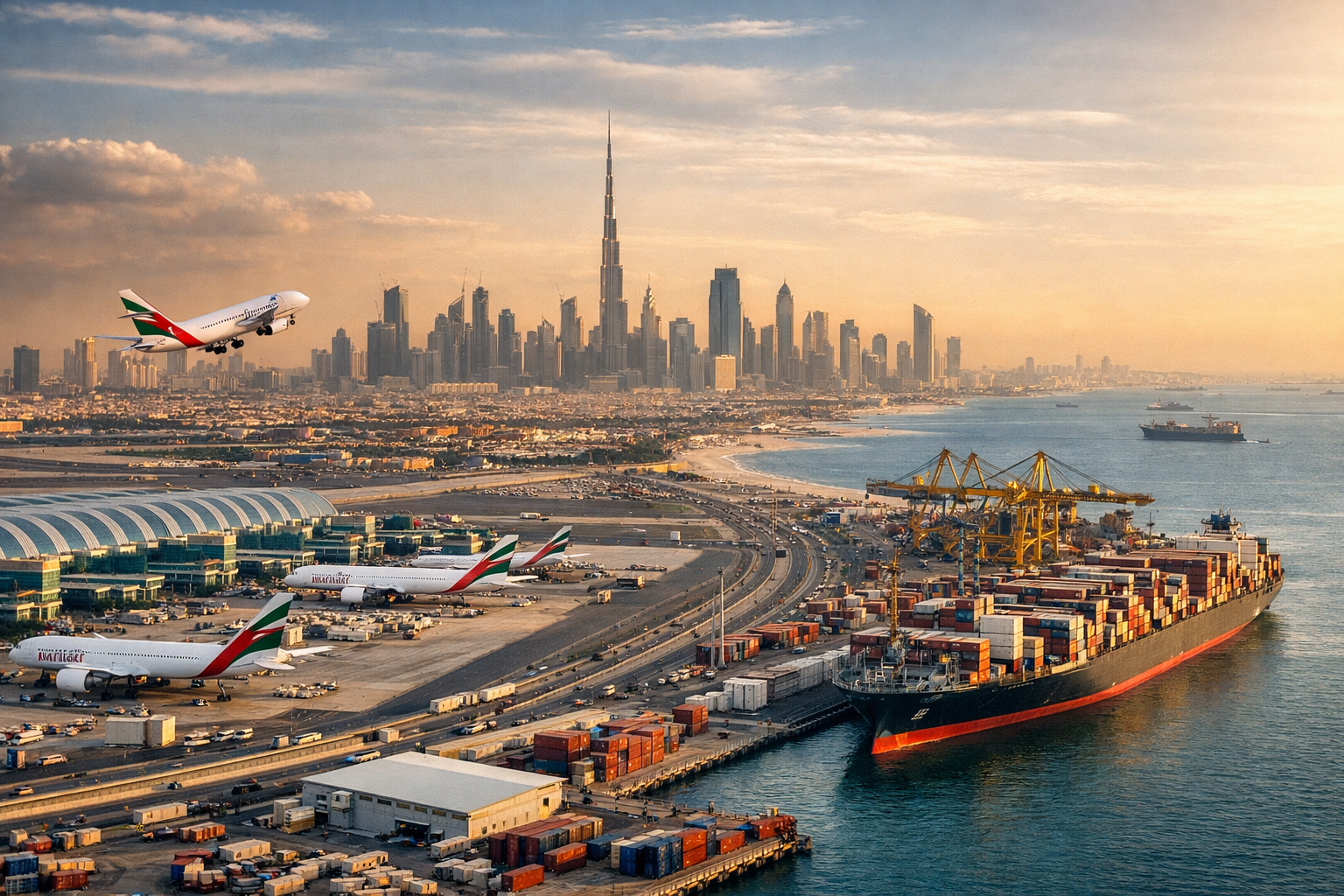
At a time when global supply chains are fragmenting and trade routes are increasingly politicised, Dubai has emerged as one of the world’s most reliable logistics connectors. Goods, people, and capital continue to move through the city with a speed and predictability that many larger economies now struggle to guarantee.
This position was not inherited, nor was it an inevitable outcome of geography. Dubai did not become a logistics hub because it sat between East and West; it became one because it made connectivity a deliberate policy choice.
Over several decades, the city invested heavily in aviation, ports, and multimodal infrastructure, often expanding capacity long before demand appeared. These investments were matched by regulatory decisions that prioritised openness, speed, and commercial neutrality over protectionism or industrial self-sufficiency.
The result is a logistics ecosystem in which airports, seaports, free zones, and global transport networks operate as a single integrated system. Dubai today functions less as a destination economy and more as a platform—one designed to serve markets far larger than its own.
Understanding how Dubai built this system offers insight into how infrastructure, policy, and trade diplomacy can be aligned to create durable economic power in an increasingly uncertain global economy.
1. A Clear Strategic Premise: Connectivity Over Autarky
From the late 1970s onward, Dubai’s leadership made a foundational decision:
the city would not compete on production, but on circulation.
Unlike resource-heavy states that prioritised domestic industry, Dubai positioned itself as:
- A neutral intermediary between markets
- A facilitator of trade rather than a gatekeeper
- A jurisdiction optimised for movement, speed, and scale
This premise shaped aviation policy, port development, labour rules, and trade diplomacy in a mutually reinforcing way.
2. Aviation Liberalisation as a Strategic Bet
Hub-and-Spoke as National Policy
Dubai embraced open skies and bilateral air service agreements early, allowing airlines to operate with minimal restrictions. This stood in contrast to protectionist aviation regimes elsewhere.
The result was the emergence of Dubai International Airport as a global transit node rather than a destination airport. Its growth was demand-agnostic: traffic expanded because connectivity improved, not the other way around.
The Airline–Airport Feedback Loop
The creation of Emirates institutionalised this strategy. Emirates was structured to:
- Focus on long-haul routes underserved by direct connections
- Use fleet scale to drive down per-seat costs
- Align schedules tightly with transfer efficiency
Airport expansion followed airline growth, not political cycles—ensuring continuity rarely seen in global aviation planning.
3. Ports as Economic Anchors, Not Utilities
Jebel Ali: Building for the World, Not the City
When Jebel Ali Port was developed, Dubai’s domestic trade volumes did not justify its scale. The port was built instead for anticipated global flows, particularly Asia–Europe container traffic.
Key decisions included:
- Deep-water capacity for future vessel sizes
- Immediate integration with a free trade zone
- No distinction between domestic and re-export cargo
This made Dubai indispensable to regional trade even when nearby markets were underdeveloped.
From Infrastructure to Influence
Through DP World, Dubai exported its port management expertise worldwide. This created:
- Commercial intelligence across trade corridors
- Preferential routing through Dubai-linked networks
- Strategic presence in emerging markets
Logistics thus became both an economic engine and a soft-power instrument.
4. Multimodal Integration: Reducing Friction, Not Just Distance
Dubai’s competitive advantage lies less in asset size than in system integration.
- Sea-to-air transfers reduced to hours
- Customs clearance digitised and centralised
- Logistics parks co-located with transport nodes
- Road and future rail links aligned with port and airport flows
The development of Dubai World Central exemplifies this thinking: an aerotropolis designed to synchronise cargo, manufacturing, and distribution in one ecosystem.
5. International Agreements and Trade Diplomacy
Dubai’s logistics rise was underpinned by predictable external relationships, not geopolitical alignment.
Trade and Transit Frameworks
- Early adoption of WTO-compliant trade practices
- Bilateral logistics and aviation agreements across Asia, Africa, and Europe
- Support for regional customs harmonisation
Dubai avoided entanglement in trade disputes, reinforcing its image as a commercially neutral zone even during periods of sanctions and regional conflict.
Legal and Arbitration Confidence
By offering internationally recognisable commercial law and arbitration mechanisms, Dubai reduced legal risk for global firms using it as a base for regional operations.
6. Capital and Regulation: Stability Over Incentives
Rather than relying on subsidies, Dubai prioritised regulatory certainty:
- Long-term infrastructure planning insulated from political turnover
- Low-tax, high-compliance business environment
- Fast licensing and minimal bureaucratic discretion
Free zones were not isolated enclaves but interfaces between global firms and regional markets—critical to scaling logistics operations.
7. Labour and Demographics: Importing Capability
Dubai treated labour mobility as an economic tool:
- Open recruitment of aviation, logistics, and engineering talent
- Flexible visa regimes aligned with sectoral needs
- Cost-efficient workforce enabling 24/7 operations
This ensured that human capital expanded in parallel with physical infrastructure—avoiding the bottlenecks that constrain other hubs.
8. Timing and First-Mover Advantage
Dubai invested ahead of demand at multiple inflection points:
- Containerisation boom
- Long-haul aviation expansion
- E-commerce and time-sensitive cargo growth
By the time competitors reacted, Dubai’s ecosystems were already mature, making replication costly and slow.
9. Resilience Through Diversification
Logistics in Dubai is embedded within:
- Finance and insurance
- Legal and arbitration services
- Regional headquarters operations
- Tourism and business travel
This diversification insulated the model from shocks such as pandemics, trade downturns, or regional instability.
Conclusion: Logistics as Long-Term State Strategy
Dubai’s ascent as a logistics hub demonstrates that infrastructure, when aligned with policy and diplomacy, becomes power. The city did not wait for markets to mature or demand to appear. It built systems first—and allowed the world to plug into them.
In an era of fragmented supply chains and geopolitical uncertainty, Dubai’s model stands out not for ideology or scale alone, but for coherence: a rare case where aviation, ports, trade policy, labour, and capital moved in the same strategic direction for decades.
Why is Dubai considered a global logistics hub?
Dubai is considered a global logistics hub because it connects major markets across Asia, Europe, and Africa through integrated air, sea, and land infrastructure. Its airports, ports, and free zones operate as a single system designed for transit and re-export rather than domestic consumption.
How did Dubai’s location help its logistics growth?
Dubai’s geographic location placed it within an eight-hour flight of a large share of the world’s population. However, location alone was not decisive. The city’s leadership deliberately invested in infrastructure and policies that turned geography into a strategic advantage.
What role did aviation play in Dubai’s logistics strategy?
Aviation was central to Dubai’s rise. The city adopted liberal air service agreements, built large-scale airport capacity ahead of demand, and supported the growth of long-haul connecting flights, making it one of the world’s busiest transit points for passengers and cargo.
Why do global companies use Dubai as a regional base?
Companies use Dubai as a regional base because it offers predictable regulation, access to multiple markets, a large international workforce, and efficient logistics infrastructure. This makes it suitable for regional headquarters, distribution, and supply-chain management.
How important are Dubai’s ports to global trade?
Dubai’s ports, particularly Jebel Ali, are critical to regional and global trade. They handle large volumes of container traffic, support re-exports across the Middle East, Africa, and South Asia, and are tightly integrated with free zones and logistics parks.
What is the significance of re-export trade in Dubai?
Re-exports allow goods to enter Dubai, be stored or processed, and then shipped onward to other markets. This model enables Dubai to serve economies far larger than its own and reduces reliance on domestic demand.
How did government policy shape Dubai’s logistics sector?
Government policy prioritised long-term planning, regulatory stability, and openness to foreign investment. Infrastructure expansion was insulated from short-term political cycles, allowing logistics systems to scale consistently over decades.


