


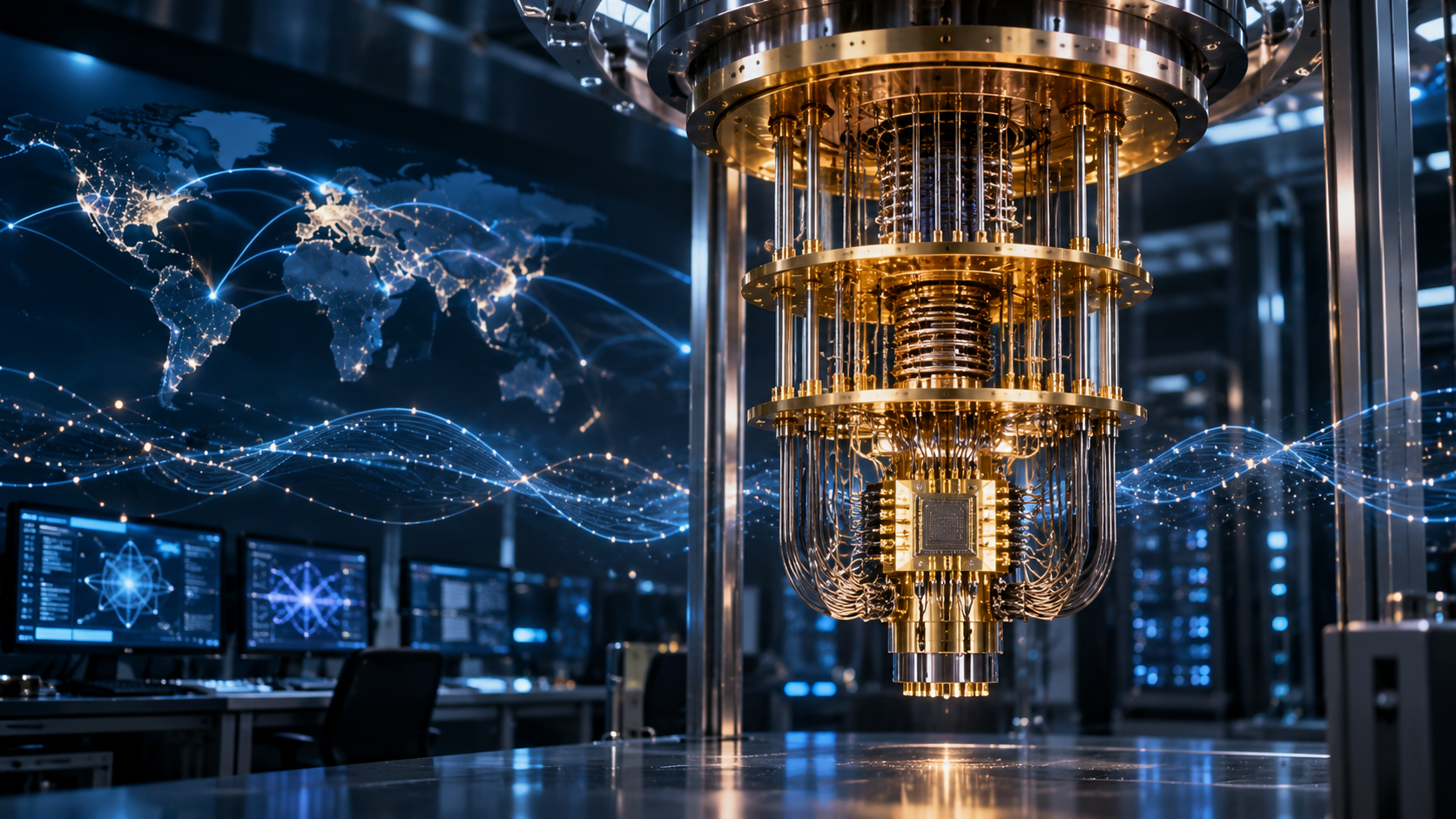
The next great technology race will not be fought over smartphones, social media or even AI models. It will be fought over a machine that could eventually solve problems that today’s most powerful computers cannot.
For decades, quantum computing lived largely inside physics laboratories.
Researchers talked about qubits, superposition, entanglement and quantum error correction while conventional computers continued getting faster and cheaper.
That era is changing.
In 2026, the quantum computing race has become a strategic competition involving governments, technology giants, universities, defense establishments and a rapidly expanding startup ecosystem.
The United States and China are at the center of the competition.
Europe, the United Kingdom, Japan, Canada and India are building their own capabilities.
Google, IBM, Microsoft, Amazon and specialist quantum companies are pursuing radically different approaches to the hardware problem.
And governments are beginning to treat quantum technology as they treated semiconductors, AI and telecommunications: as a strategic technology with economic and national-security consequences.
The most important question is no longer:
Who has the most qubits?
It is:
Who can turn fragile quantum systems into reliable machines capable of solving commercially and strategically important problems?
That distinction could determine who leads the next computing era.
What Exactly Is Quantum Computing?
A conventional computer processes information using bits.
A bit is either:
0 or 1.
A quantum computer uses qubits.
Because of quantum mechanical effects such as superposition, a qubit can exist in a combination of states until it is measured.
Qubits can also become entangled, creating correlations that have no direct classical equivalent.
The result is not simply a faster version of an ordinary computer.
It is a fundamentally different computational architecture.
A useful analogy is this:
A classical computer is like a highly efficient calculator that explores a problem through a structured sequence of operations.
A quantum computer uses quantum mechanical behavior to manipulate a much richer mathematical state space.
But there is a major catch.
Quantum information is extraordinarily fragile.
Noise, temperature, electromagnetic interference and imperfections in hardware can destroy the information contained in a qubit.
That is why building a quantum computer is not primarily a race to add more qubits.
It is a race to control them.
The Real Enemy: Error
This is the central problem of quantum computing.
A conventional computer can store a bit reliably.
Quantum systems are much more sensitive to their environment.
As quantum processors become larger, errors can accumulate.
That means a machine with thousands of physical qubits may still be less useful than a much smaller machine whose operations are substantially more reliable.
The solution is quantum error correction.
Instead of relying on one fragile physical qubit, researchers can distribute quantum information across multiple physical qubits to create a more robust logical qubit.
The ultimate objective is a fault-tolerant quantum computer containing enough high-quality logical qubits to execute long and complex algorithms without errors overwhelming the computation.
This is why the quantum race has entered a new phase.
Physical qubits measure hardware scale.
Logical qubits measure computational reliability.
The second metric is increasingly becoming the one that matters.
Google: The Error-Correction Breakthrough
Google is one of the most visible competitors in the quantum race.
Its superconducting quantum processor Willow, announced in December 2024, demonstrated an important quantum-error-correction result.
Google reported that as the number of physical qubits used in its error-correction architecture increased, the logical error rate decreased — crossing what researchers call the error-correction threshold.
That is important because the field has spent decades trying to reach the point where adding more hardware actually produces more reliable quantum information.
Google also reported that Willow completed a particular benchmark calculation in less than five minutes that, according to Google’s comparison, would take a leading classical supercomputer an estimated 10 septillion years.
That figure should be interpreted carefully.
It represents a highly specialized benchmark rather than evidence that quantum computers have suddenly become universally faster than classical computers.
The larger significance is architectural:
Google demonstrated progress toward making quantum error correction work at scale.
In 2026, Google continues to work on more advanced error-correction techniques, including dynamic surface-code approaches designed to reduce errors and hardware overhead.
IBM: From Quantum Demonstrations to Logical Computing
IBM has pursued a somewhat different path.
Its strategy emphasizes improving qubit quality, error mitigation, modularity and the ability to combine quantum processors into larger systems.
In July 2026, IBM and researchers from the University of Chicago reported a demonstration involving 70 logical qubitsand a quantum computation that they said was beyond the practical reach of leading classical simulation approaches.
IBM reported that the computation took approximately 15 minutes and included statistical verification of the result — an important point because quantum advantage is meaningful only if researchers can trust that the machine produced the claimed result correctly.
IBM’s newer Nighthawk r2 processor has 120 programmable physical qubits and is designed to increase circuit throughput while supporting error-correction research.
IBM says Nighthawk r2 can execute more than 100,000 circuits per second and has demonstrated accurate computations involving more than 7,500 gates.
This illustrates an important shift.
The industry is moving from:
“How many qubits do you have?”
toward:
“How much reliable computation can you perform?”
Microsoft Is Betting on a Different Physics
Microsoft has chosen one of the most ambitious approaches.
Instead of relying primarily on conventional superconducting qubits, it is pursuing topological quantum computingbased on Majorana states.
In February 2025, Microsoft announced its Majorana 1 processor and argued that its approach could eventually provide more stable qubits and reduce the burden of error correction.
Microsoft’s approach is technically controversial and difficult to compare directly with Google’s or IBM’s systems.
But that is precisely what makes the quantum race unusual.
There is no guarantee that the company with the largest current machine will ultimately win.
The winning architecture could emerge from a technology that currently appears less mature.
Microsoft’s 2026 work continues to focus on Majorana-based hardware and scalable quantum architectures.
The lesson is similar to the early semiconductor industry:
The first transistor was not the final computer architecture.
Quantum computing may go through the same process.
Amazon Is Taking Another Route
Amazon Web Services is also investing heavily in quantum computing.
Its research effort includes superconducting approaches and a strong focus on error correction and scalable architectures.
Amazon’s broader advantage is its cloud ecosystem.
This could matter enormously.
Quantum computers are unlikely to replace classical computers.
Instead, the future is likely to involve hybrid computing:
Classical supercomputers handle conventional workloads.
Quantum processors handle specialized quantum algorithms.
AI systems help design and optimize experiments.
Cloud infrastructure connects users to quantum hardware.
The winner may therefore not be the company with the most impressive standalone machine.
It may be the company that successfully integrates quantum computing into the existing computing ecosystem.
The Quantum Race Is Not Just a U.S. Race
The United States currently has one of the deepest quantum ecosystems in the world.
It combines:
- Major technology companies
- Universities
- National laboratories
- Venture capital
- Defense research
- Semiconductor expertise
- Cloud infrastructure
- A large startup ecosystem
But China is pursuing quantum technology as a national strategic priority.
A 2026 assessment by the Center for Strategic and International Studies describes China as pursuing a patient, state-directed strategy across quantum computing, communication and sensing, while seeking to strengthen its domestic supply chains and national capabilities.
A June 2026 assessment from the Special Competitive Studies Project similarly concluded that the United States currently leads China across several dimensions including innovation, industrial capacity, markets and talent, while China has an advantage in national leverage and is closing gaps.
That makes the competition different from a normal corporate technology race.
The United States has powerful private companies.
China has an unusually strong ability to coordinate government funding, research institutions, industry and strategic national objectives.
Both models have advantages.
China: The State-Directed Quantum Strategy
China has spent years building capabilities across the broader quantum ecosystem.
Its efforts extend beyond computing into:
Quantum communications.
Quantum sensing.
Quantum networks.
Quantum cryptography.
Quantum materials.
That breadth matters.
Quantum computing is only one component of quantum technology.
China has also been building institutional mechanisms around standards.
In July 2026, China’s Ministry of Industry and Information Technology established a technical committee dedicated to quantum-information standardization covering quantum computing, communication and precision measurement.
Standards may sound less exciting than processors.
But standards can determine which technologies become commercially interoperable.
In a strategic technology race, who writes the standards can influence who builds the market.
Europe Is Building a Quantum Ecosystem
Europe faces a different challenge.
It has world-class physics and engineering research but historically struggled to turn scientific strength into technology platforms with the scale of American technology companies.
The European Union is therefore attempting to build a coordinated quantum infrastructure.
The EU’s Quantum Technologies Flagship has a long-term budget of approximately €1 billion, while EuroHPC is integrating quantum computers with Europe’s supercomputing infrastructure.
In February 2026, the EU inaugurated Euro-Q-Exa in Munich, a 54-physical-qubit quantum computer supplied by IQM, with plans to expand it beyond 150 qubits by 2027.
The European strategy is increasingly about hybrid computing.
Instead of treating quantum computers as replacements for supercomputers, Europe is connecting the two.
That could become an important model for the industry.
Britain Wants to Become a Quantum Superpower
The United Kingdom is pursuing an unusually ambitious national strategy.
Its National Quantum Strategy commits £2.5 billion over ten years to quantum technologies, with the objective of building a leading quantum-enabled economy by 2033.
In March 2026, the British government announced a further package worth up to £2 billion and said it wanted Britain to become the first country to commit to deploying quantum computers at scale by the early 2030s.
Britain’s strengths include:
- Quantum physics
- University research
- Quantum startups
- Photonics
- Quantum sensing
- Software
- Government-backed research programs
The UK’s challenge is commercial scale.
Turning scientific leadership into globally dominant companies is much harder than producing excellent research papers.
India Is Building Its Own Quantum Stack
India is not currently competing with the United States and China at the same hardware scale.
But it is building an important national quantum ecosystem.
India’s National Quantum Mission was approved with an outlay of approximately ₹6,003.65 crore for 2023–24 through 2030–31.
Its objectives include developing quantum computers in the range of 50 to 1,000 physical qubits, alongside quantum communications, sensing, metrology, quantum materials and devices.
India’s mission also includes ambitious goals for secure quantum communication, including satellite-based links and inter-city quantum key distribution.
The country’s strategy is therefore broader than simply building a processor.
It is attempting to create:
Hardware + communications + sensing + materials + talent + startups.
India’s advantage is its large scientific and engineering talent base, expanding semiconductor ambitions and growing technology ecosystem.
The challenge will be converting that talent into globally competitive quantum hardware and companies.
Japan and Canada Matter Too
The quantum race is not limited to the largest economies.
Canada has developed significant expertise in quantum computing, particularly through companies and research institutions working on photonic and other architectures.
Japan has major strengths in:
- Quantum hardware
- Photonics
- Materials
- Electronics
- Precision engineering
These countries demonstrate another characteristic of quantum technology:
specialization matters.
A country does not necessarily need to build the world’s largest quantum computer to become strategically important.
It could dominate:
- Quantum sensors
- Cryogenic systems
- Photonic components
- Control electronics
- Quantum software
- Error-correction technology
- Specialized materials
The future quantum economy will probably resemble the semiconductor industry.
No single country will control every layer.
The Race Is Actually Five Races
Calling it “the quantum computing race” is slightly misleading.
There are at least five interconnected competitions.
1. The Hardware Race
Who can build the most reliable physical qubits?
2. The Error-Correction Race
Who can convert physical qubits into useful logical qubits?
3. The Algorithm Race
Who can develop quantum algorithms that solve economically valuable problems?
4. The Manufacturing Race
Who can produce quantum processors and components reliably and at scale?
5. The Talent Race
Who has enough physicists, engineers, mathematicians, software developers and quantum specialists?
A country could lose the hardware race but win the software race.
A company could lose the qubit race but dominate quantum networking.
Another could build the processor but lack the ecosystem to commercialize it.
That makes quantum competition unusually multidimensional.
Why Governments Care So Much
The potential applications are enormous.
Quantum computers could eventually contribute to:
Drug Discovery
Simulating molecular interactions could help researchers explore new pharmaceuticals.
Materials Science
Quantum systems could help model materials that are extremely difficult to simulate classically.
Energy
Better modeling of chemical processes could contribute to batteries, catalysts and energy technologies.
Finance
Certain optimization and simulation problems could potentially benefit from quantum algorithms.
Logistics
Complex optimization problems could eventually become candidates for quantum approaches.
Defense
Quantum computing could contribute to optimization, simulation and cryptanalysis.
Artificial Intelligence
Quantum systems could eventually interact with machine-learning workloads, although practical quantum advantage for AI remains an open research question.
The word that matters throughout is:
Eventually.
Most commercially transformative applications remain ahead of today’s hardware.
The Cybersecurity Race May Arrive Before the Quantum Computer
There is one area where the quantum race is already producing real-world consequences:
cryptography.
A sufficiently capable quantum computer could threaten widely used public-key cryptographic systems such as RSA and elliptic-curve cryptography.
That does not mean today’s encryption is already broken.
There is currently no cryptographically relevant quantum computer capable of carrying out such an attack.
But organizations cannot wait until one exists.
Why?
Because replacing global cryptographic infrastructure takes years.
NIST’s post-quantum cryptography program has already finalized three standards designed to resist quantum attacks and recommends that organizations begin migration now.
NIST’s transition work notes that cryptographic migrations can take a decade or more.
That creates a strategic concept known as:
“Harvest now, decrypt later.”
An adversary could collect encrypted information today and attempt to decrypt it in the future when quantum capabilities become sufficient.
Data with a long lifespan — government secrets, military information, intellectual property and sensitive personal records — could therefore already be relevant to the quantum threat.
Quantum Computing and National Security
This is why governments increasingly see quantum technology as a national-security issue.
Imagine a future in which one country possesses a cryptographically relevant quantum computer while its competitors do not.
The consequences could extend beyond economics.
It could potentially undermine:
- Secure communications
- Financial systems
- Military networks
- Intelligence systems
- Digital identities
- Government infrastructure
The response is not simply to build a quantum computer.
Countries must also build quantum-resistant cybersecurity.
This creates an unusual strategic paradox:
The quantum race involves both building the weapon and redesigning the defenses against it.
The United States Is Now Treating Fault-Tolerant Quantum Computing as a National Mission
The urgency has increased sharply in 2026.
On September 17, 2026, the U.S. Department of Energy announced the Quantum Genesis Q Competition, with up to $215 million in planned funding.
The competition seeks to accelerate development of scientifically relevant, fault-tolerant quantum computers capable of at least 100 logical qubits and hundreds of millions of fault-tolerant operations.
The DOE says the objective is to demonstrate quantum systems capable of addressing problems in areas including:
- Chemistry
- Materials
- Physics
- Applied mathematics
This is a significant evolution.
The government is no longer simply funding quantum research.
It is defining a measurable target:
Fault-tolerant logical computing.
That is where the industry is heading.
The Most Important Number May No Longer Be Qubits
For years, quantum companies competed over qubit counts.
That produced impressive headlines.
But qubit counts can be misleading.
A 1,000-qubit processor with high error rates may be less useful than a smaller system capable of performing long, reliable calculations.
Future quantum benchmarks will increasingly involve:
Logical qubits.
Gate fidelity.
Circuit depth.
Error rates.
Throughput.
Useful runtime.
Energy consumption.
Cost per computation.
That changes the race.
The question becomes similar to aviation.
The world’s first aircraft was a technological achievement.
But the real revolution came when aircraft became reliable, scalable and commercially useful.
Quantum computing is approaching a similar transition.
The “Quantum Advantage” Problem
Another source of confusion is the term quantum advantage.
It means a quantum computer can perform a particular computational task more effectively than classical systems.
But there is a huge difference between:
winning a benchmark
and
solving an economically valuable problem.
A quantum computer might beat a classical supercomputer on a carefully designed mathematical test and still have no immediate commercial application.
The real breakthrough will occur when quantum machines can repeatedly solve meaningful problems faster, cheaper or more accurately than the best classical alternatives.
That is why the next stage of the race will be about use cases.
Not demonstrations.
The Hybrid Future
The most likely future is not:
Quantum computers replace classical computers.
It is:
Classical + AI + quantum computing.
A future scientific computing system could look something like this:
A classical supercomputer prepares the problem.
AI helps optimize the algorithm.
A quantum processor performs a specialized calculation.
The classical system analyzes the output.
AI interprets the result.
The entire process happens through a cloud platform.
This is why companies such as IBM, Google, Amazon and Microsoft are integrating quantum research into broader cloud and computing ecosystems.
Quantum computing may become another specialized accelerator — like GPUs became accelerators for AI.
If that happens, the technology could eventually become invisible to ordinary users.
People may not “use a quantum computer.”
Their applications may simply call quantum capability when it is useful.
The Race Is Also a Race for Talent
Quantum computing requires an unusual combination of disciplines.
A successful quantum engineer may need knowledge of:
- Physics
- Mathematics
- Computer science
- Electronics
- Materials
- Cryogenics
- Software
- Control systems
This makes talent one of the biggest bottlenecks.
Countries can buy some equipment.
They can build laboratories.
They can subsidize companies.
But developing generations of quantum scientists takes time.
This is why national quantum strategies increasingly include:
universities + research institutes + startups + industry + government procurement.
The countries that build the strongest talent pipelines today could have an advantage a decade from now.
The Supply Chain Could Become the Next Battlefield
Quantum computers require specialized components.
Depending on the architecture, these can include:
- Cryogenic systems
- Lasers
- Photonic components
- Ultra-pure materials
- Control electronics
- Specialized semiconductors
- Vacuum systems
- Quantum sensors
- Precision measurement equipment
This creates a strategic supply-chain issue.
The lesson from semiconductors and AI is becoming obvious:
A technology is only as sovereign as its most vulnerable supply chain.
That is why China is working to localize parts of its quantum supply chain, while the United States, Europe, Britain, Japan and others are also attempting to strengthen domestic capabilities.
Who Is Actually Winning?
The answer depends on what “winning” means.
The United States currently possesses perhaps the broadest combination of:
private-sector scale + research + capital + cloud infrastructure + talent + national laboratories.
China has enormous state backing and a long-term strategic approach.
Europe possesses exceptional scientific capabilities and is building coordinated infrastructure.
Britain has strong research and a focused national strategy.
Japan and Canada have important specialized capabilities.
India is building a national ecosystem with a large talent pool and ambitious public investment.
But quantum computing is still early enough that declaring a permanent winner would be premature.
The architecture that dominates in 2035 may not be the architecture that appears strongest in 2026.
The companies leading today’s headlines may not necessarily dominate the eventual commercial market.
And a breakthrough in error correction, materials or manufacturing could rapidly change the competitive landscape.
What Happens If Someone Gets There First?
A sufficiently capable, fault-tolerant quantum computer could create enormous advantages.
In science:
New materials and medicines.
In industry:
Optimization and simulation.
In defense:
Advanced modeling and potentially cryptographic capabilities.
In finance:
New approaches to complex simulation and optimization.
In cybersecurity:
The potential ability to attack some existing public-key cryptography.
But there is another possibility.
Quantum computing could become an enabling technology rather than a standalone industry.
Much like electricity, nobody may care which quantum processor performed a calculation.
They will care about what the calculation enabled.
A better battery.
A new drug.
A stronger material.
A more efficient logistics network.
A more accurate scientific model.
That is when quantum computing will have truly arrived.
The 2030s Could Be the Decade of Quantum Deployment
Nobody can reliably predict the exact year a large-scale fault-tolerant quantum computer will emerge.
The technology is too uncertain.
Some researchers expect major breakthroughs within the next decade.
Others believe significant engineering barriers remain.
Governments are nevertheless planning for the possibility.
The United States has set a new 2026 program around scientifically relevant fault-tolerant machines.
Britain is targeting large-scale deployment in the early 2030s.
India’s National Quantum Mission runs through 2030–31.
Europe is building hybrid quantum-supercomputing infrastructure now.
The strategic message is clear:
Governments do not know exactly when the quantum era will arrive — but they do not want to be unprepared when it does.
The Bigger Geopolitical Picture
The quantum race is becoming the latest chapter in a much larger technology competition.
The 20th century had:
Nuclear technology.
Then:
Space.
Then:
Semiconductors.
Today:
Artificial intelligence.
And increasingly:
Quantum computing.
These technologies share something important.
They create enormous economic benefits.
But they can also create military and intelligence advantages.
That is why technology leadership has increasingly become a component of national power.
Quantum computing may eventually determine not just who has the fastest computers.
It could influence:
Scientific leadership.
Cybersecurity.
Defense.
Industrial competitiveness.
Financial infrastructure.
Drug discovery.
Energy technology.
National sovereignty.
Frequently Asked Questions
Is quantum computing faster than a normal computer?
Not generally. Quantum computers are designed for specific classes of problems where quantum algorithms may provide major advantages. They are not universal replacements for classical computers.
What is a qubit?
A qubit is the basic unit of quantum information. Unlike a classical bit, which is either 0 or 1, a qubit can occupy a quantum superposition of states before measurement.
What is a logical qubit?
A logical qubit is quantum information encoded across multiple physical qubits using error-correction techniques. Logical qubits are intended to be much more reliable than individual physical qubits.
Why is quantum error correction so important?
Physical qubits are fragile and prone to errors. Without effective error correction, adding more qubits can make a computation more difficult rather than more useful. The ability to create reliable logical qubits is therefore one of the industry’s most important milestones.
Could quantum computers break the internet?
A sufficiently powerful quantum computer could threaten some of today’s widely used public-key cryptographic systems. That machine does not currently exist, but NIST has already finalized post-quantum cryptographic standards and is urging organizations to migrate now.
Which countries are investing in quantum computing?
The United States, China, European countries, the United Kingdom, India, Japan, Canada, Australia and others have significant national quantum programs or research ecosystems.
Is India part of the quantum race?
Yes. India’s National Quantum Mission has a budget of about ₹6,003.65 crore and targets quantum computers with 50–1,000 physical qubits, as well as quantum communications, sensing and materials.
When will quantum computers become commercially useful?
There is no reliable consensus on a precise date. The industry is moving toward useful applications, but major engineering challenges remain. The key milestone is not simply increasing qubit counts but demonstrating reliable, fault-tolerant computation on economically valuable problems.
Conclusion
The quantum computing race is often presented as a competition to build the biggest machine.
That is not really the race.
The real race is to turn one of the strangest phenomena in physics into a reliable engineering platform.
The winner will need more than qubits.
It will need:
Error correction.
Algorithms.
Manufacturing.
Talent.
Capital.
Software.
Cybersecurity.
Supply chains.
Customers.
And perhaps most importantly:
patience.
Google is trying to make quantum errors fall as systems scale.
IBM is pushing toward logical computing and practical quantum advantage.
Microsoft is betting on a radically different architecture.
Amazon is building toward cloud-integrated quantum computing.
China is pursuing a broad, state-backed national ecosystem.
Europe and Britain are building sovereign infrastructure.
India is creating its own quantum technology stack.
Nobody knows exactly which architecture will dominate.
That uncertainty is what makes the race so consequential.
Because if quantum computing works at the scale researchers hope, the first country or company to achieve reliable, fault-tolerant quantum computing will not simply have a better computer.
It may possess a new instrument for discovering materials, designing medicines, optimizing complex systems and potentially challenging the foundations of modern cryptography.
The AI race is about teaching machines to think with today’s computing architecture.
The quantum race is about building an entirely new architecture of computation.
And the country that learns how to make the quantum world useful may shape the technological balance of the 2030s — and perhaps much of the century that follows.


