


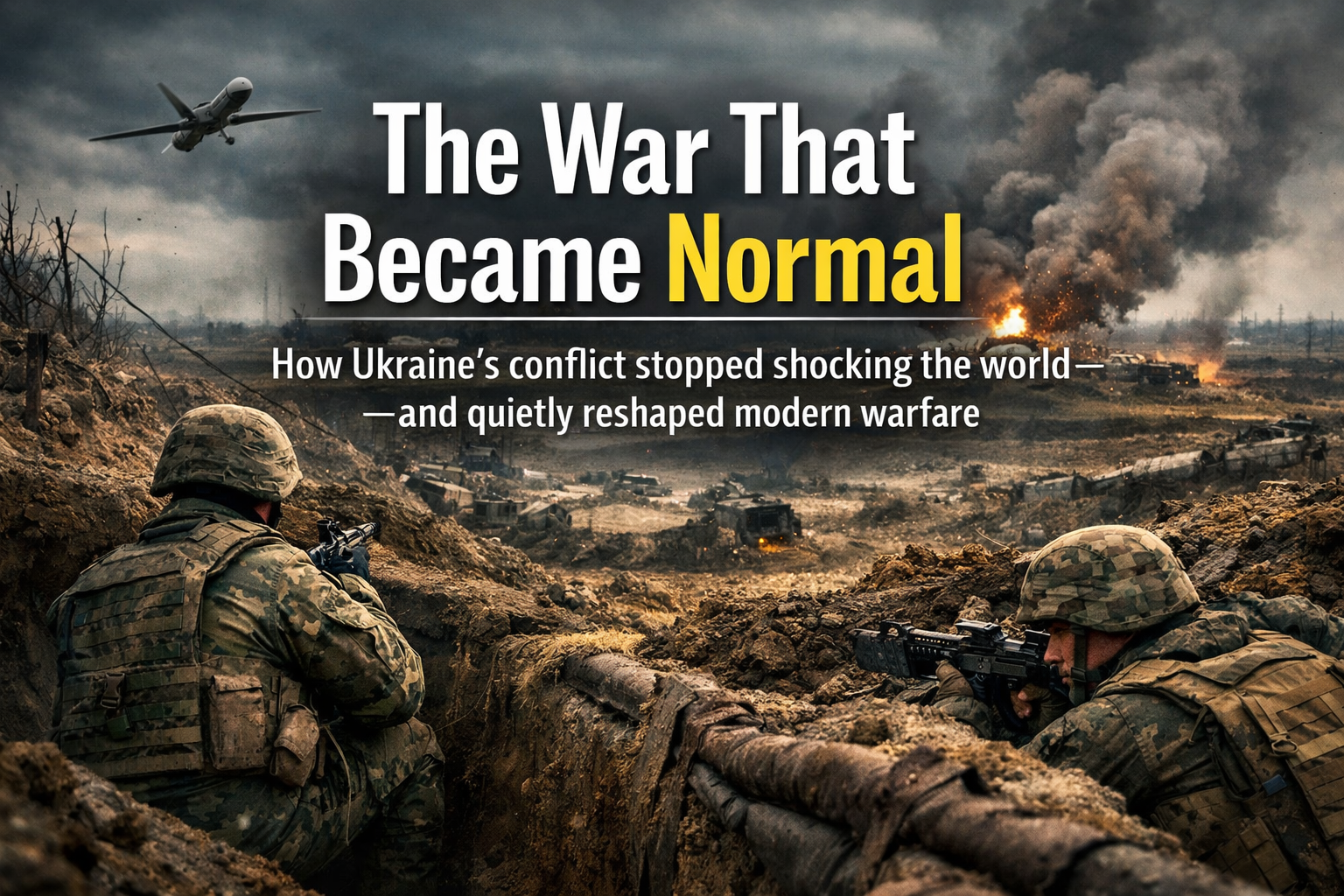
As global attention shifts elsewhere, the war in Ukraine continues transforming every dimension of modern warfare and its lessons are reshaping military thinking worldwide
Introduction: The First Large-Scale War of the Drone Age
When Russia launched its full-scale invasion of Ukraine in February 2022, military analysts initially framed the conflict through familiar frameworks: territorial advance, armoured manoeuvre, air supremacy, and the decisive use of conventional military power. Three years later, the war has produced something quite different. The front line has stabilised into attritional grinding reminiscent of the First World War — multi-layer trench systems, intensive artillery exchanges, and tactical advances measured in hundreds of metres per week. The decisive technologies are not the advanced air forces and armoured formations of conventional doctrine but cheap commercial drones, electronic warfare systems, and the industrial capacity to sustain high-volume munitions production over years.
Ukraine has become the most comprehensive empirical test of twenty-first century high-intensity warfare yet conducted. Its lessons are reshaping procurement priorities, updating operational doctrine, and fundamentally challenging assumptions that have guided military thinking in major armed forces for three decades. Understanding what is happening in Ukraine is essential context for understanding where warfare is going — and what deterrence will require in the years ahead.
Section I: The FPV Drone Revolution
The Cheap Weapon That Changed Everything
First-person view drones — FPV — are modified commercial racing drones equipped with cameras and explosive payloads, costing a few hundred dollars each and producible in tens of thousands per month by small workshop networks on both sides of the conflict. They have become one of the primary instruments of anti-armour and anti-personnel warfare on the Ukraine front line. Their tactical effect has been to threaten vehicles worth millions of dollars with weapons costing hundreds — a cost inversion that no previous anti-armour system has achieved at comparable scale.
| ~$400 Average cost of a front-line FPV attack drone Compared to $2–4 million for a main battle tank. This cost asymmetry — cheap attacker, expensive target — is the defining economic feature of drone warfare and is fundamentally reshaping military procurement calculations globally. Every major armed force is now rethinking armoured vehicle survivability in light of Ukraine. |
| “Ukraine is the first conflict where FPV drones have been used at industrial scale in direct anti-armour roles. The implications for combined arms warfare are profound — not because tanks are obsolete, but because the integrated air defence and counter-drone environment they now require is completely different from anything previous doctrine assumed.” — Justin Bronk Senior Research Fellow, Royal United Services Institute (RUSI), London |
Electronic Warfare — The Counter-Revolution
The proliferation of FPV drones has driven a parallel arms race in electronic warfare — jamming and spoofing of the radio control links and GPS signals on which drones depend. Drone operators report failure rates from jamming of 20 to 50 percent in heavily contested zones, driving development of wired-guided fibre-optic drones that cannot be jammed, and increasingly autonomous guidance systems operating without external radio control. The EW-drone interaction is among the most rapidly evolving tactical dynamics on the modern battlefield.
Section II: The Return of Trench Warfare
The most unexpected visual of the Ukraine war is the trench. Both Russian and Ukrainian forces have constructed extensive multi-layer defensive fortifications — trench systems, concrete bunkers, minefields, anti-tank obstacles — along approximately 1,000 kilometres of front line. The causes are multiple and mutually reinforcing: surveillance drones providing near-constant overhead observation make large-scale force concentrations immediately visible and subject to precision fires before tactical surprise can be achieved; the density of anti-tank weapons makes open-country armoured advance essentially suicidal; artillery exchanges of a density not seen in decades grind any attempted assault.
The trench has returned not because military technology has regressed to 1916 but because drone surveillance and precision anti-armour weapons have made tactical concealment and rapid manoeuvre over contested ground impossible. The physics of the modern battlefield have produced positional warfare conditions.
Section III: The Industrial Dimension
The Ukraine war’s most consequential strategic lesson is that high-intensity conventional warfare is fundamentally an industrial competition. The side that can produce more artillery shells, more drones, more missiles, more replacement vehicles — and sustain that production over years — holds the structural advantage. Western defence industrial bases optimised for expeditionary operations and precision strike were not calibrated for this reality. The United States’ pre-war capacity of approximately 14,000 155mm artillery shells per month was publicly identified as dramatically insufficient for a proxy support role in high-intensity conflict within months of the invasion.
| “Ukraine has forced a fundamental reassessment of what defence industrial capacity means for deterrence. Sustaining high-volume production of unglamorous munitions matters as much as possessing technologically sophisticated platforms. That is not a comfortable conclusion for procurement systems optimised around the latter.” — Mara Karlin Former Assistant Secretary of Defense for Strategy, Plans and Capabilities, US Department of Defense |
Conclusion: The War’s Legacy for Military Thinking
When the Ukraine war ends, it will leave behind the most comprehensive empirical dataset on high-intensity conventional warfare in the drone age yet assembled. The preliminary verdict challenges multiple assumptions guiding Western military procurement and doctrine: cheap abundant systems have proven at least as decisive as expensive sophisticated platforms; electronic warfare is integral to every tactical domain simultaneously; industrial capacity matters as much as technological sophistication; and the defensive advantage in positional warfare remains as powerful as it has been in every era of modern military history. The armed forces that absorb these lessons most completely and act on them most quickly will be demonstrably better prepared for the security challenges the current global environment may produce.


