


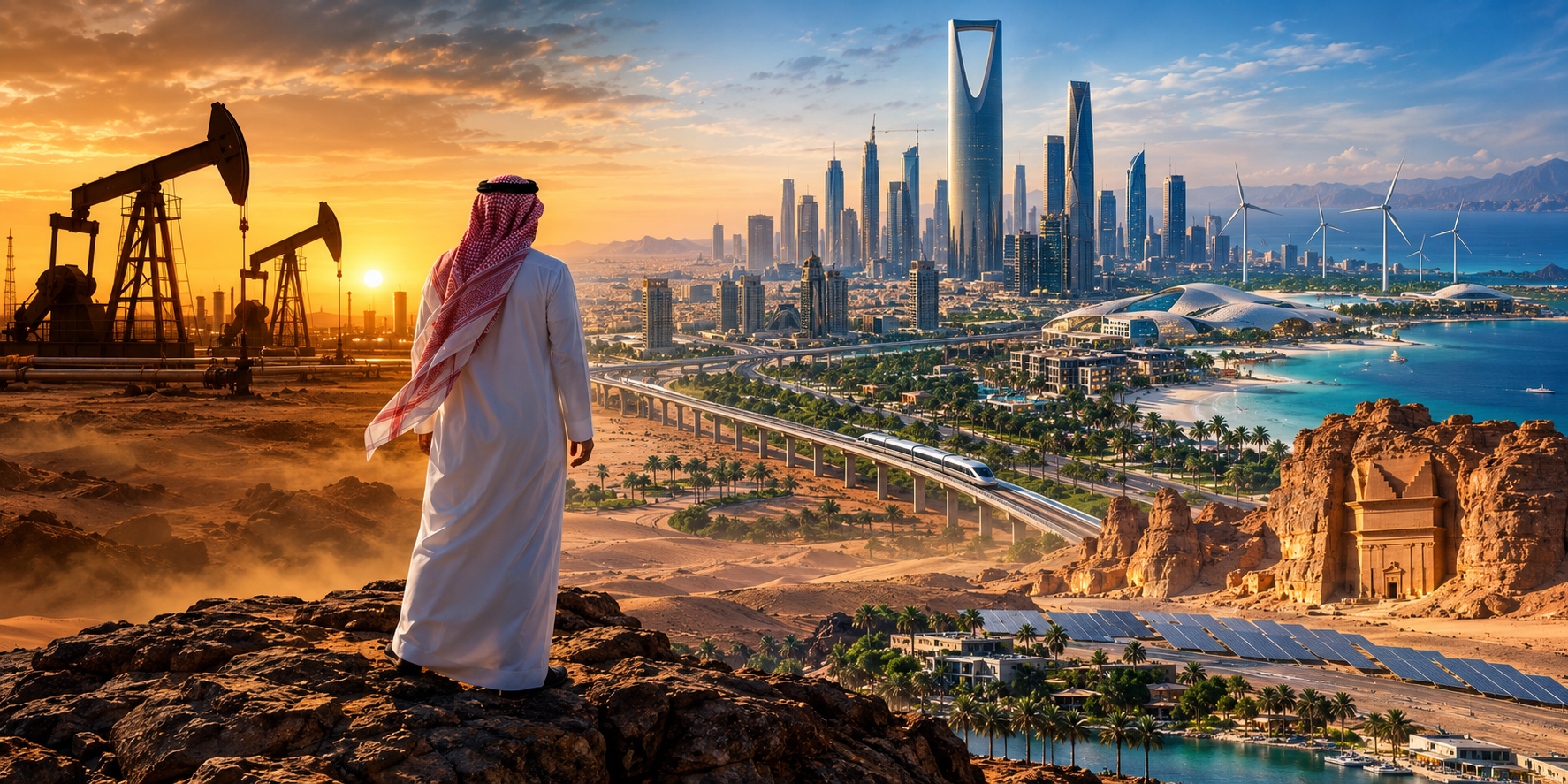
Saudi Arabia has spent the last decade proving that it can change. The next five years will determine whether it can build an economy that no longer depends on oil to define its future.
When Saudi Arabia launched Vision 2030 in 2016, the ambition appeared almost impossible.
The world’s largest oil exporters wanted to become something more: a tourism destination, manufacturing hub, technology investor, logistics gateway, financial center and global capital.
Ten years later, the transformation is no longer theoretical.
Saudi Arabia’s real GDP grew 4.5% in 2025, with non-oil activities expanding 4.9%. Manufacturing, construction, retail, hospitality, tourism and other domestic sectors have become increasingly important to economic growth.
Tourism has exploded. The Kingdom recorded around 123 million domestic and inbound tourists in 2025, generating approximately SAR304 billion in tourism spending. The original Vision 2030 target of 100 million visitors was reached years ahead of schedule and has now been raised to 150 million by 2030.
Women have entered the workforce at unprecedented rates. Saudi female labor-force participation reached 35% in 2025, compared with 22.8% in 2016.
And the Public Investment Fund, once primarily a sovereign investment vehicle, has become one of the central engines of Saudi Arabia’s economic transformation, with assets under management exceeding $900 billion.
But this is where the easy part ends.
Saudi Arabia is entering the most important phase of Vision 2030: the transition from building the new economy to proving that the new economy can sustain itself.
The First Decade Changed the Question
The original question was simple:
Could Saudi Arabia diversify beyond oil?
The answer is increasingly yes.
The harder question is now:
Can Saudi Arabia create a productive, private-sector-led economy that remains competitive when government spending and oil revenues are no longer doing most of the heavy lifting?
That distinction matters.
Building airports, resorts, industrial zones, stadiums, cities and digital infrastructure is one thing.
Creating companies that generate globally competitive products, exports, intellectual property, jobs and recurring private investment is another.
That is why the second half of the decade will look different from the first.
Saudi Arabia’s own policy architecture is beginning to reflect this shift.
The Public Investment Fund’s 2026–2030 strategy describes the next phase as a move from rapid growth toward “sustained value creation,” with greater emphasis on investment efficiency and private-sector participation.
The transformation is moving from state-led construction to ecosystem building.
That may ultimately be the most important change in Vision 2030.
1. Oil Is Not Disappearing — Its Role Is Changing
The phrase “Saudi Arabia after oil” can be misleading.
Saudi Arabia is not abandoning oil.
Nor would it make economic sense to do so.
Oil remains one of the Kingdom’s most important economic assets, and hydrocarbons still dominate exports. The IMF estimates that oil and oil products accounted for about 69% of Saudi exports in 2025.
The objective of Vision 2030 is therefore not to eliminate oil.
It is to make Saudi Arabia less vulnerable to oil.
That is a very different proposition.
Oil can continue generating enormous cash flows while the economy increasingly uses those revenues to build other engines of growth.
Saudi Arabia is effectively attempting something few commodity economies have successfully achieved:
turning resource wealth into a diversified economic platform before the resource loses its strategic importance.
This matters even more as the global energy system changes.
Electric vehicles, renewable energy, efficiency improvements, alternative fuels and technological changes could eventually reduce the structural growth rate of oil demand.
Saudi Arabia therefore has an unusual advantage.
It has time, capital and scale.
The challenge is using all three intelligently.
2. The PIF Is Becoming Saudi Arabia’s Economic Operating System
No institution is more important to the Vision 2030 experiment than the Public Investment Fund.
The PIF’s assets have grown from approximately $150 billion in 2015 to more than $900 billion today. Between 2021 and 2025, it invested more than $199 billion in new projects inside Saudi Arabia and contributed more than $342 billion cumulatively to the Kingdom’s real non-oil GDP.
But its next phase is arguably more important than its expansion during the first decade.
The PIF’s new 2026–2030 strategy organizes its domestic investment around six ecosystems:
- Tourism, travel and entertainment
- Urban development and livability
- Advanced manufacturing and innovation
- Industrials and logistics
- Clean energy, water and renewable infrastructure
- NEOM
The emphasis is increasingly on connecting companies, infrastructure, suppliers, investors and technology rather than simply funding individual mega-projects.
This is a significant evolution.
A sovereign wealth fund can build a hotel.
It can finance an airline.
It can develop an industrial city.
But the real economic payoff comes when hundreds or thousands of private companies emerge around those assets.
That is when a project becomes an ecosystem.
And ecosystems are what Saudi Arabia needs.
3. Tourism Could Become the New Oil of the Service Economy
Few sectors demonstrate the speed of Saudi Arabia’s transformation better than tourism.
For decades, Saudi Arabia was primarily associated with religious pilgrimage and business travel.
That is changing rapidly.
AlUla, Diriyah, the Red Sea, Riyadh, Jeddah and other destinations are being positioned as components of a much larger tourism economy.
In 2025, Saudi Arabia recorded approximately 123 million domestic and inbound tourists and around SAR304 billion in tourism spending. International visitors numbered approximately 29.3 million, generating SAR176.6 billion in inbound tourism spending.
The significance goes beyond hotels.
Tourism creates demand for:
- Airlines
- Airports
- Restaurants
- Entertainment
- Retail
- Construction
- Financial services
- Digital platforms
- Events
- Sports
- Real estate
- Transportation
- Cultural industries
It can therefore become a multiplier for the broader non-oil economy.
Saudi officials now aim for tourism to contribute around 10% of the economy by 2030, compared with roughly 5% today.
The strategic opportunity is enormous.
But tourism also illustrates the central challenge facing Vision 2030:
Visitors can be attracted through investment. They cannot be manufactured through investment.
The Kingdom will ultimately need a globally competitive hospitality culture, international connectivity, trained workers, compelling experiences and private businesses capable of surviving without permanent state support.
4. The Real Test Is the Private Sector
This may be the single most important economic metric for Saudi Arabia between now and 2030.
The government can build the infrastructure.
The PIF can provide capital.
But private companies must eventually generate the economic output.
Saudi Arabia’s private-sector contribution to GDP has already risen significantly. The IMF’s 2026 assessment puts it at approximately 51%, compared with a 44% baseline at the beginning of Vision 2030. The official 2030 ambition is 65%.
That gap represents one of the most important challenges of the next five years.
Saudi Arabia needs more:
Startups.
Manufacturers.
Exporters.
Technology companies.
SMEs.
Financial institutions.
Global companies with regional headquarters.
Saudi companies capable of expanding internationally.
The next phase therefore requires a subtle but fundamental change in government behavior.
The state must increasingly move from being the customer, investor and builder to being the platform, regulator and enabler.
That transition is difficult.
But it is essential.
5. Manufacturing Is the Missing Piece
Tourism can diversify services.
Finance can diversify capital.
Technology can diversify productivity.
But manufacturing can transform the structure of an economy.
Saudi Arabia has significant advantages:
- Cheap and abundant energy
- Large industrial companies
- Major ports
- Strategic geography
- Significant domestic capital
- Access to Asian, European and African markets
- Growing logistics infrastructure
The Kingdom is increasingly targeting advanced manufacturing, industrial localization, mining, metals, chemicals, defense and clean-energy technologies.
The objective should not simply be to manufacture products for the Saudi market.
It should be:
Build in Saudi Arabia. Export from Saudi Arabia.
That is a much more ambitious goal.
The next generation of Saudi industry could include batteries, chemicals, advanced materials, machinery, defense equipment, renewable-energy components, food processing and industrial technology.
If successful, manufacturing could become one of the strongest bridges between Saudi Arabia’s resource economy and a post-oil economy.
6. Saudi Arabia Wants to Become an AI Power
The next phase of Vision 2030 is not only about physical infrastructure.
It is increasingly about computing infrastructure.
Saudi Arabia has enormous advantages in the emerging AI economy:
- Cheap energy
- Capital
- Land
- Growing digital infrastructure
- A young population
- Government willingness to deploy technology
- Proximity to Europe, Asia and Africa
The Kingdom is positioning AI as part of its broader economic transformation.
Recent investments in data centers, digital infrastructure and AI companies indicate that Riyadh increasingly views computing capacity as strategic infrastructure rather than simply another technology investment.
That strategy is visible in NEOM as well.
In August 2026, Saudi AI company Humain and DataVolt announced plans for a 100-megawatt initial data-center project at Oxagon on the Red Sea coast.
The opportunity is bigger than building data centers.
Saudi Arabia could potentially combine:
Energy + compute + capital + connectivity + AI deployment.
That combination could make the Kingdom an important AI infrastructure hub between Europe and Asia.
But again, infrastructure is only the first step.
The ultimate objective should be developing Saudi intellectual property, AI companies and globally competitive technology businesses.
7. The Workforce Revolution May Be More Important Than the Giga-Projects
The most consequential Vision 2030 transformation may not be NEOM.
It may be the Saudi labor market.
Female labor-force participation has risen dramatically since 2016, reaching 35% in 2025 against a 22.8% baseline. The 2030 target is now 40%.
That represents a profound structural change.
A country cannot diversify its economy while leaving a large portion of its educated population outside the labor market.
Saudi Arabia is also trying to increase the participation of young Saudis in technology, finance, tourism, engineering and advanced industries.
But the next challenge is more difficult:
productivity.
Employment numbers alone are not enough.
Saudi Arabia needs workers who can compete globally in:
- Artificial intelligence
- Engineering
- Software
- Advanced manufacturing
- Finance
- Healthcare
- Scientific research
- Design
- Logistics
- Entrepreneurship
This makes education reform one of the most important components of the next five years.
The country needs to move from creating jobs to creating high-productivity careers.
8. The Next Decade Will Be Less About Megaprojects
This is perhaps the most important change taking place inside Vision 2030.
The first decade was dominated by spectacular projects.
NEOM.
The Line.
Red Sea tourism.
Qiddiya.
Diriyah.
New airports.
Industrial zones.
Sports and entertainment infrastructure.
The second phase will be more disciplined.
The PIF’s new strategy emphasizes selective capital allocation, efficiency, value creation and crowding in private investment. The IMF has explicitly welcomed this recalibration.
That does not mean Saudi Arabia is abandoning its ambitions.
It means the Kingdom is becoming more selective about where capital creates the greatest economic return.
That is a sign of maturation.
The first phase was about proving that Saudi Arabia could build.
The next phase is about proving that what it built can generate returns.
9. The Biggest Risk: Building an Economy That Still Needs the State
There is an inherent paradox in Vision 2030.
Saudi Arabia needs massive government investment to create a diversified economy.
But eventually, the diversified economy must become less dependent on government investment.
That creates a difficult transition.
If PIF companies and government-backed projects continually require new capital, the diversification process could become expensive without producing enough independent economic returns.
The IMF has already highlighted the importance of medium-term fiscal consolidation and more selective capital allocation. It also stresses the need to expand the private sector, improve productivity, deepen capital markets and strengthen human capital.
The defining question is therefore not:
How much does Saudi Arabia spend?
It is:
How much economic activity does each riyal of investment eventually generate without requiring another government riyal?
That is the productivity test.
10. Oil Will Still Finance the Post-Oil Economy
There is another paradox.
Saudi Arabia’s post-oil economy will initially be built using oil money.
That is not necessarily a weakness.
It may be the Kingdom’s greatest strategic advantage.
Saudi Arabia can use today’s oil revenues to purchase the infrastructure, technology, companies, skills and intellectual property needed for tomorrow’s economy.
The danger lies in wasting that window.
If oil remains highly profitable for another decade, the temptation to delay difficult reforms will remain strong.
But if oil revenues decline faster than expected, the diversification program will face much greater pressure.
The smartest strategy is therefore to accelerate diversification while oil remains valuable.
Saudi Arabia does not need to wait for the end of the oil age.
It needs to use the oil age to prepare for it.
11. Geopolitics Could Accelerate the Transformation
Saudi Arabia’s geography gives it an unusual strategic position.
It sits between:
Asia.
Europe.
Africa.
It is also at the center of the world’s energy system and increasingly wants to become a hub for logistics, finance, tourism, technology and investment.
Regional instability has demonstrated why diversification matters.
The 2026 disruption to shipping through the Strait of Hormuz tested Saudi Arabia’s economic resilience. The IMF noted that diversified logistics infrastructure, including the East-West pipeline and Red Sea routes, helped Saudi Arabia manage the shock.
This illustrates a broader point.
Economic diversification is not only about GDP.
It is also about national resilience.
A country that can generate income from tourism, manufacturing, logistics, technology, finance, mining and services is better positioned to absorb an oil or geopolitical shock.
12. Saudi Arabia Could Become the Economic Hub of the Arab World
If Vision 2030 succeeds, its consequences will extend far beyond Saudi Arabia.
The Kingdom has the scale to become the largest economic platform in the Middle East.
Its capital could become a regional headquarters hub.
Its ports could connect Asia with Europe and Africa.
Its financial institutions could become major providers of regional capital.
Its tourism industry could reshape Middle Eastern travel.
Its energy companies could finance global energy-transition investments.
Its technology infrastructure could support AI development across emerging markets.
Its sovereign wealth fund could become one of the world’s most influential pools of long-term capital.
Saudi Arabia is therefore not simply trying to become a diversified economy.
It is trying to become a platform economy for the wider region.
The Five Tests That Will Define 2030
The success of Vision 2030 should ultimately be measured against five questions.
1. Can non-oil growth become self-sustaining?
The Kingdom needs growth that does not depend primarily on oil prices or government spending.
2. Can the private sector become the dominant engine?
The 2030 target is 65% private-sector contribution to GDP. Getting there will require genuine productivity and investment rather than simply transferring ownership.
3. Can Saudi companies become global companies?
Domestic champions must eventually compete internationally.
4. Can human capital match infrastructure?
World-class cities without world-class talent will not produce a world-class economy.
5. Can the Kingdom turn capital into productivity?
This may be the ultimate test.
Saudi Arabia has enormous capital.
The question is whether that capital can generate lasting productivity, exports, technology and private-sector growth.
What Success Would Look Like in 2030
A successful Saudi Arabia in 2030 will not necessarily be an economy without oil.
It will be an economy in which oil is no longer the only story.
Imagine a Saudi economy where:
A visitor arrives in Riyadh for a global technology conference.
The aircraft is serviced by a Saudi aviation company.
The hotel is operated by a Saudi hospitality group.
The conference is powered by Saudi digital infrastructure.
The data is processed in a Saudi AI facility.
The investment comes through Saudi financial markets.
The equipment is manufactured locally.
The logistics network moves products through Saudi ports.
The workers are increasingly Saudi.
And the companies involved generate revenue from markets outside the Kingdom.
That would represent genuine diversification.
Not because oil disappeared.
But because the economy became much bigger than oil.
The Defining Decade
Vision 2030 began as a radical proposition.
Ten years later, many of its most visible targets have already been exceeded.
Tourism has surpassed its original goal.
Female participation has transformed.
The non-oil economy has expanded.
The private sector has grown.
PIF has become a global investment institution.
Digital infrastructure has accelerated.
Saudi Arabia has become more open to international capital, visitors and businesses.
But the next five years will be fundamentally different.
The Kingdom is entering the third and final phase of Vision 2030 from 2026 through 2030. The emphasis is shifting toward long-term sustainability, stronger private-sector participation and adapting implementation to changing priorities.
The first decade was about transformation.
The next five years are about proof.
Saudi Arabia has demonstrated that a resource-rich state can change its economic trajectory at extraordinary speed.
Now it must demonstrate something harder:
that the new economy can stand on its own.
If it succeeds, Saudi Arabia will not simply be a country that survived the end of the oil era.
It could become one of the countries that defines what comes after it.
Frequently Asked Questions
Is Saudi Arabia really moving away from oil?
Yes, but not by abandoning oil. The strategy is to reduce the economy’s dependence on oil by expanding non-oil sectors, private enterprise, tourism, manufacturing, logistics, technology and investment.
What is the biggest achievement of Vision 2030 so far?
There is no single achievement. The most significant change is the broadening of the Saudi economy and labor market, particularly the expansion of non-oil activity, tourism, female workforce participation and private-sector involvement.
What is Saudi Arabia’s biggest economic challenge?
The central challenge is turning government-led investment into sustainable, productivity-driven private-sector growth.
What role will PIF play after 2030?
PIF is increasingly positioning itself not simply as a source of capital but as an architect of economic ecosystems. Its 2026–2030 strategy emphasizes more selective investment, returns, strategic assets and greater private-sector participation.
Could Saudi Arabia become a global technology or AI hub?
Potentially. Its combination of capital, energy, land, infrastructure and strategic geography provides major advantages. The challenge will be developing local talent, intellectual property and globally competitive companies rather than relying primarily on imported technology.
Will oil still matter in 2030?
Absolutely. Oil is likely to remain one of Saudi Arabia’s most important economic and geopolitical assets. The goal of Vision 2030 is not to make oil irrelevant, but to ensure that Saudi Arabia’s economic future does not depend on oil alone.
Conclusion
Saudi Arabia’s greatest transformation may not be the skyscrapers rising from the desert.
It may be the emergence of an economy capable of producing value long after the oil boom fades.
The first decade of Vision 2030 showed that Saudi Arabia could change.
The defining decade will show whether it can sustain that change.
And that may determine not only Saudi Arabia’s future — but the economic balance of the Middle East.


