


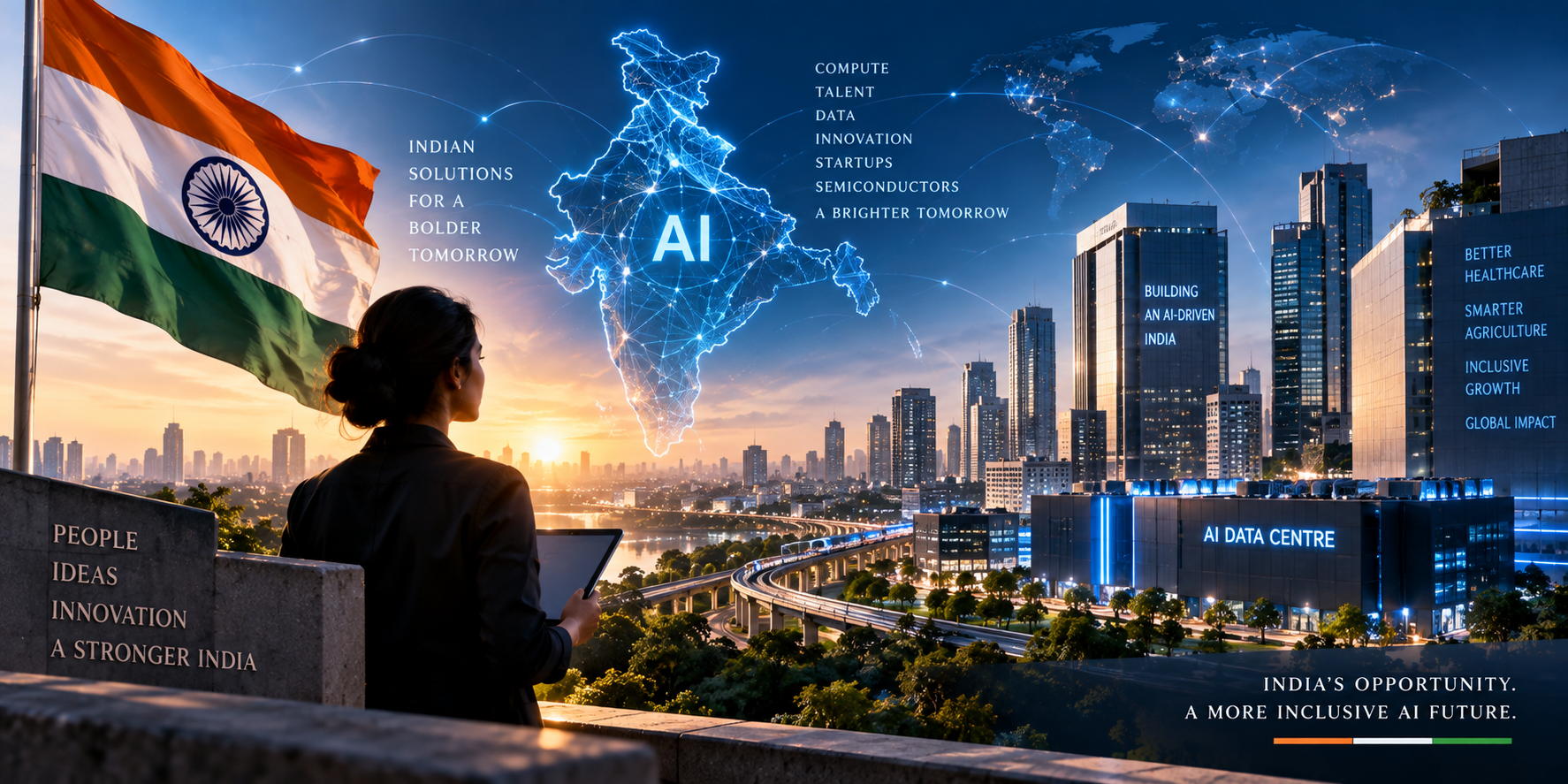
India wants to move from being the world’s software workshop to becoming one of the world’s AI platforms.
For more than two decades, India’s technology story has been built around software services, IT outsourcing, engineering talent and business-process expertise.
That model made India an indispensable part of the global digital economy.
But artificial intelligence is changing the competitive equation.
The next generation of technology leadership will depend not only on software engineers. It will depend on compute, chips, data, energy, foundation models, research, capital, talent and the ability to deploy AI at enormous scale.
India is now attempting to build all of those layers simultaneously.
The country’s strategy is becoming increasingly visible.
The IndiaAI Mission, approved in March 2024 with an allocation of ₹10,371.92 crore over five years, is designed to build computing infrastructure, indigenous models, datasets, AI applications, skills, startup financing and responsible-AI capabilities. By 2026, the government had also expanded common compute access to more than 38,000 GPUs and was moving to add another 20,000.
India also hosted the India AI Impact Summit 2026, bringing governments, technology companies, researchers and startups together in New Delhi. The event was the first major global AI summit of its series to be held in the Global South, with the government reporting investment commitments exceeding $250 billion across the AI value chain.
But becoming an AI powerhouse requires much more than announcing investment.
The harder question is:
Can India convert its enormous talent pool, digital infrastructure and domestic market into globally competitive AI capabilities?
That is the real race.
From IT Powerhouse to AI Powerhouse
India already possesses several advantages that are difficult for other countries to replicate.
It has a huge technology workforce.
A large English-speaking professional population.
One of the world’s largest digital consumer markets.
A rapidly expanding startup ecosystem.
A sophisticated payments and digital-identity infrastructure.
Large datasets across healthcare, agriculture, finance, education and public administration.
And perhaps most importantly, scale.
AI systems become increasingly valuable when they can be deployed across hundreds of millions of users.
India therefore has something that many smaller technology economies do not:
a giant domestic laboratory for AI.
The country’s challenge is to convert that advantage into intellectual property, products, companies and infrastructure that can compete internationally.
The First Battle: Compute
AI begins with computing power.
The companies developing frontier models require enormous quantities of GPUs and other specialized accelerators.
For years, this has been one of India’s structural weaknesses.
The world’s largest AI companies have access to enormous clusters of advanced processors, while startups and researchers in many countries have struggled to obtain affordable compute.
India is attempting to change that.
Under the IndiaAI Compute initiative, more than 38,000 GPUs have been made available through multiple providers, with access offered through a shared cloud infrastructure model. The government has also announced an additional 20,000 GPUs.
The IndiaAI Compute Portal is intended to provide affordable access to GPUs for startups, researchers, students, academia, MSMEs and industry.
This is strategically important.
If advanced compute is available only to the largest corporations, AI innovation becomes concentrated.
If researchers and startups can access compute at lower cost, the innovation base becomes much broader.
India is therefore treating compute partly as infrastructure rather than simply as a commercial commodity.
That approach could be particularly important for Indian startups building models for Indian languages and local applications.
The Race for Sovereign AI
Compute is only one part of the equation.
The second is models.
India does not necessarily need to build a model that is better than every frontier system in the world.
Its more immediate opportunity may be to develop models that are highly effective for Indian languages, Indian institutions and Indian economic conditions.
That is the logic behind India’s sovereign-model push.
The IndiaAI Mission has supported multiple indigenous foundation-model initiatives.
Government data published in August 2026 says 20 foundation-model proposals—12 large multimodal models and eight small language models—had been identified for support. Models from companies including Sarvam AI, Gnani AI and BharatGen have already been launched.
The opportunity is enormous.
India has hundreds of languages and dialects, millions of small businesses, enormous agricultural and healthcare needs, and a population with vastly different levels of digital literacy.
A model optimized for Silicon Valley may not automatically perform well in these environments.
India’s advantage could therefore lie in localization at massive scale.
The India Advantage: Languages
Language could become one of India’s most strategically important AI opportunities.
The internet was initially dominated by English.
AI has the potential to change that.
A genuinely multilingual AI ecosystem could allow people to interact with technology in their preferred languages through:
- voice,
- text,
- video,
- translation,
- education,
- healthcare,
- government services,
- agriculture,
- financial services.
This is why India’s foundation-model efforts are not merely about creating another chatbot.
They are also about building language infrastructure for a multilingual population.
BharatGen, for example, has developed multilingual foundation models, while other Indian initiatives are focusing on speech, document understanding and language processing.
If these systems become sufficiently capable, India’s domestic market could provide a huge testing and deployment environment.
AIKosh: The Data Layer
The third pillar is data.
Models require data.
And India has enormous quantities of it.
Government initiatives are attempting to make more high-quality datasets available for AI development through AIKosh, a national platform for datasets and AI models.
As of February 2026, AIKosh contained more than 7,500 datasets and 273 AI models across 20 sectors, according to government figures.
The potential applications span:
- agriculture,
- healthcare,
- education,
- financial services,
- climate,
- transportation,
- governance,
- language technology.
But data quantity is not enough.
AI requires high-quality, well-labelled, legally usable and representative datasets.
This is one of the areas where India will have to solve difficult questions around privacy, interoperability, data governance and quality.
The country’s AI advantage will depend not simply on having more data, but on turning data into useful intelligence while maintaining appropriate safeguards.
India’s Digital Public Infrastructure Becomes an AI Asset
India has another unusual advantage.
It has spent years building large-scale digital public infrastructure.
Aadhaar created a digital identity layer.
UPI transformed digital payments.
Digital public platforms expanded access to government and financial services.
The next question is whether AI can be integrated into these systems.
Imagine an AI system that helps a farmer understand crop risks in a local language.
Or an AI assistant that helps a small business navigate taxation.
Or a multilingual healthcare system that helps patients understand medical information.
Or an AI interface that allows citizens to access government services through natural language.
This is where India’s AI strategy differs from simply trying to create another global chatbot.
The opportunity is to combine:
AI + digital public infrastructure + massive population scale.
That combination could become one of India’s most distinctive technology assets.
The Semiconductor Problem
There is, however, a major vulnerability.
AI ultimately depends on hardware.
GPUs and AI accelerators require advanced semiconductor manufacturing and packaging ecosystems.
India has historically been strong in chip design but much weaker in semiconductor fabrication.
The government is therefore trying to build a broader semiconductor ecosystem.
The India Semiconductor Mission has an outlay of ₹76,000 crore, while the government says 10 semiconductor projects had been approved by the end of 2025, representing cumulative investments of around ₹1.60 lakh crore across six states.
India also has substantial existing design capabilities.
Government data indicates that India hosts around 7% of the world’s semiconductor global capability centres and nearly 20% of the global semiconductor chip-design workforce.
This creates an important starting point.
India does not have to build its semiconductor industry from zero.
It already has a large design and engineering base.
The difficult part is extending that capability into:
design → fabrication → packaging → testing → advanced systems.
AI Needs Electricity
There is another constraint that receives less attention than GPUs.
Energy.
AI data centres consume enormous amounts of electricity.
As India expands its AI infrastructure, the country will need not only more data centres but reliable power, transmission capacity, cooling systems and increasingly sustainable energy sources.
India’s own Economic Survey has highlighted the resource intensity of AI infrastructure, including its requirements for electricity and water.
This creates a strategic equation:
AI capacity = chips + data centres + electricity + cooling + connectivity.
A country can purchase GPUs.
It cannot instantly build the power infrastructure needed to support them.
That is why India’s AI ambitions increasingly overlap with its energy and infrastructure policies.
The Data Centre Race
India’s data-centre industry is already expanding rapidly.
Government figures put current cloud data-centre capacity at approximately 1,280 MW, with capacity expected to increase several times by 2030.
States are competing to attract this infrastructure.
Karnataka, one of India’s biggest technology hubs, approved a 2026–31 data-centre policy targeting 1 GW of cumulative data-centre IT load by 2031, with the state aiming to contribute 10–12% of India’s AI-ready data-centre capacity.
The implications go beyond technology.
Data centres require:
- electricity,
- land,
- fibre connectivity,
- cooling,
- construction,
- engineering,
- security,
- water management,
- skilled operators.
The AI boom could therefore create a new infrastructure economy around India.
The Talent Advantage
India’s most established technology advantage remains its people.
The country has a very large engineering workforce and an expanding AI talent base.
The 2026 Stanford AI Index indicates that India had the world’s second-largest pool of identified top AI authors and inventors in 2025, behind the United States.
A government summary of Stanford’s research also reports that India ranked third in Stanford’s 2025 Global AI Vibrancy Ranking and had AI-skill penetration 2.5 times the global average across comparable occupations.
These numbers illustrate an important advantage.
India already has millions of professionals familiar with software, cloud computing, data and engineering.
The challenge is moving from AI-enabled services toward deeper AI research, product development and intellectual property.
The Talent Problem Is Still Real
A large workforce does not automatically create a frontier AI ecosystem.
AI research requires highly specialized expertise.
India must compete with the United States, Europe, China, Canada, the United Kingdom, Singapore and other technology centres for researchers and engineers.
The Stanford AI Index shows the scale of the competition: the United States remained the largest centre for AI researchers and developers, even as global talent flows changed.
India therefore faces two simultaneous tasks:
Train more AI professionals.
And:
Create enough high-value research and product opportunities to retain them.
The second may be just as important as the first.
A talented engineer can be trained in India and still build globally important technology elsewhere.
From Services to Products
This may be India’s most important economic transition.
India’s IT industry became globally successful by providing services.
AI creates an opportunity to build products.
The difference is significant.
A services company sells expertise.
A product company can sell intellectual property repeatedly across markets.
India could therefore move from:
“We build AI for global companies.”
to:
“We build AI companies that compete globally.”
That transition is already visible in India’s startup ecosystem.
The government is using the IndiaAI Mission to support startups and foundation-model development, while private capital is increasingly flowing into AI infrastructure and applications.
The real test will be whether Indian companies can build globally competitive products rather than primarily becoming implementation partners for foreign AI platforms.
The Rise of AI Infrastructure Companies
India’s AI opportunity is also producing a new infrastructure layer.
Cloud providers and data-centre operators are investing in large GPU clusters.
NVIDIA has highlighted partnerships with Indian infrastructure providers including Yotta, L&T and E2E Networks to expand AI compute capacity in India.
Yotta, for example, has announced large-scale GPU infrastructure using NVIDIA systems.
L&T is developing AI-factory infrastructure.
Other companies are building specialized cloud and supercomputing capacity.
This creates an ecosystem in which Indian companies can potentially train and deploy AI without sending every workload outside the country.
That has implications for both commercial competitiveness and technological sovereignty.
The Global AI Race Has Changed
India is not competing in a vacuum.
The United States remains the centre of the world’s largest private AI investment ecosystem and continues to host many of the leading frontier-model companies. Stanford’s 2026 AI Index reports $285.9 billion in U.S. private AI investment in 2025.
China is investing heavily in AI research, infrastructure and domestic technology ecosystems.
Europe is building its own regulatory and industrial approach.
The Gulf states are investing heavily in AI infrastructure and sovereign compute.
Japan and South Korea have major semiconductor and technology capabilities.
India therefore does not face one competitor.
It faces a global ecosystem race.
India’s Potential Niche: AI for the Global South
India may not need to reproduce Silicon Valley.
It could pursue a different proposition.
AI for scale, affordability and multilingual deployment.
The challenges India faces are shared by much of the Global South:
- multilingual populations,
- uneven digital literacy,
- limited healthcare capacity,
- agricultural uncertainty,
- informal economies,
- financial inclusion,
- education access,
- public-service delivery.
If India develops affordable AI solutions for these problems, those products could potentially find markets across Africa, Southeast Asia, Latin America and other emerging economies.
That would turn India’s domestic complexity into an export advantage.
The AI + Agriculture Opportunity
Agriculture illustrates the scale of the opportunity.
AI could eventually combine:
- satellite imagery,
- weather data,
- soil information,
- crop histories,
- market prices,
- local-language voice interfaces,
- agricultural research.
A farmer could potentially access personalized information without needing to understand complex software.
The same principle applies to healthcare.
AI could help extend scarce expertise through decision support, translation, triage and documentation.
Education could use AI to provide personalized tutoring.
Small businesses could use AI to automate accounting, customer service and market research.
India’s advantage is not simply having technology.
It is having millions of real-world problems at enormous scale that technology can potentially address.
The Governance Question
AI expansion also creates risks.
India has been developing an AI governance framework alongside its technology push.
The India AI Mission explicitly includes safe and trusted AI, while UNESCO’s 2026 India AI Readiness Assessment highlighted the need for stronger legal gap analysis and more inclusive planning for AI’s social effects.
The challenge is balancing two objectives:
Innovation
and
trust.
Too little oversight can create problems involving privacy, discrimination, misinformation, safety and accountability.
Too much uncertainty can discourage investment and experimentation.
India therefore has to build governance mechanisms that can evolve alongside rapidly changing technology.
The AI Employment Question
India’s AI strategy also has a particularly important employment dimension.
The country’s technology and business-services industries employ millions of people in tasks that AI can increasingly augment or automate.
That does not necessarily mean mass unemployment.
It means the composition of work is likely to change.
The important transition is from:
routine digital labour
toward:
AI-enabled knowledge work.
Software engineers may increasingly supervise AI coding systems.
Customer-service professionals may handle complex interactions while AI manages routine requests.
Analysts may spend less time preparing reports and more time interpreting them.
Sales professionals may use AI for prospecting and research while focusing more heavily on relationships and negotiation.
The question for India is whether reskilling happens fast enough.
The Next Competitive Advantage: Cost
India’s traditional technology advantage has often been cost.
AI could strengthen that advantage—but only if infrastructure remains affordable.
If Indian startups can access high-performance compute at significantly lower cost, they can experiment more.
If Indian companies can build AI applications with lower development costs, they can compete in emerging markets.
If AI can make India’s massive services workforce dramatically more productive, the country’s export competitiveness could increase.
This creates a potentially powerful combination:
low-cost talent + AI productivity + domestic scale.
But competitors around the world are also adopting AI.
India cannot assume that today’s cost advantage will remain sufficient.
Why Scale Could Become India’s Superpower
India has a population exceeding 1.4 billion.
That matters for AI.
Every large deployment generates feedback.
Every language creates training opportunities.
Every sector produces new use cases.
Every enterprise can become an AI customer.
The country can therefore function as one of the world’s largest AI testing environments.
But scale alone is not enough.
China has enormous scale.
The United States has enormous capital and research depth.
India’s challenge is to combine scale with technological depth.
That means research institutions, startups, universities, corporations and government programs must increasingly connect.
The Missing Link: Frontier Research
India has significant research output, but becoming a leading AI power requires more than publishing papers.
It requires breakthroughs.
That means investment in:
- fundamental AI research,
- advanced computing,
- robotics,
- multimodal systems,
- AI safety,
- semiconductor architecture,
- quantum computing,
- AI hardware,
- scientific computing.
The country’s research institutions will therefore become increasingly important.
IITs, IISc, national laboratories and private research centres will need stronger connections to industry.
The objective should not merely be producing more AI engineers.
It should be producing new AI knowledge.
The Infrastructure Challenge
India’s AI strategy ultimately comes down to infrastructure.
The country needs:
Compute.
Chips.
Data centres.
Electricity.
Networks.
Data.
Talent.
Capital.
Research.
Models.
Applications.
If one layer is missing, the others become less effective.
A powerful AI model without compute cannot scale.
Compute without models has limited value.
Models without data cannot improve.
Data without governance creates risk.
Talent without capital may leave.
Data centres without reliable power cannot operate.
This is why India’s AI strategy is becoming much broader than an AI strategy.
It is increasingly an industrial strategy.
The 2030 Question
By 2030, India’s AI position could look substantially different from today.
The country could have:
- a large sovereign compute ecosystem,
- multiple Indian foundation models,
- globally competitive AI startups,
- much larger data-centre capacity,
- deeper semiconductor capabilities,
- AI-enabled public infrastructure,
- millions of AI-skilled workers,
- major AI exports.
But none of these outcomes is guaranteed.
The constraints are equally clear:
- access to advanced chips,
- electricity and water,
- research funding,
- talent retention,
- startup capital,
- data quality,
- regulation,
- commercialization,
- global competition.
India’s challenge is therefore not simply to adopt AI quickly.
It is to build the ecosystem required to own more of the AI value chain.
From Digital India to AI India
The transformation can be understood as a sequence.
First came:
Digital India.
Build digital identity, payments and connectivity.
Then:
Cloud India.
Move computing and software infrastructure online.
Now:
AI India.
Build intelligence on top of those digital foundations.
The next stage could be:
AI-powered India.
AI embedded into government, industry, healthcare, agriculture, education, finance and everyday consumer services.
And eventually:
AI-exporting India.
Indian companies developing models, infrastructure and applications for the rest of the world.
That would represent a much larger transformation than simply adding AI tools to existing businesses.
What Would Make India an AI Powerhouse?
The phrase “AI powerhouse” can mean different things.
It could mean having the largest number of AI engineers.
It could mean building frontier models.
It could mean operating enormous data centres.
It could mean producing AI chips.
It could mean creating the world’s largest AI market.
Or it could mean something broader:
controlling enough of the AI value chain to influence how the technology develops and where its economic value is created.
That is the more meaningful benchmark.
India does not necessarily need to dominate every layer.
It needs enough strength across multiple layers to avoid becoming dependent on a handful of foreign platforms.
The Bigger Geopolitical Implication
AI is increasingly becoming a component of national power.
It affects:
- economic productivity,
- defence,
- cybersecurity,
- intelligence,
- scientific research,
- industrial competitiveness,
- financial systems,
- communications,
- public administration.
Countries that control AI infrastructure could gain influence over the technologies used by others.
That makes India’s AI strategy part of a broader question about technological sovereignty.
The objective is not necessarily isolation.
India remains deeply connected to global technology companies and supply chains.
The strategic question is whether India can participate in those global networks from a position of capability rather than dependency.
India Has the Ingredients. The Execution Will Decide the Outcome.
India enters the AI era with unusual advantages.
It has scale.
It has talent.
It has a huge digital market.
It has a growing startup ecosystem.
It has digital public infrastructure.
It has expanding compute.
It is building semiconductor capabilities.
And it has a government strategy explicitly aimed at developing domestic AI capacity.
But the hardest part is still ahead.
The transition from AI services to AI products.
From users of AI to builders of AI.
From software talent to frontier research.
From imported compute to domestic infrastructure.
From digital scale to technological depth.
The IndiaAI Mission, the expansion of GPU infrastructure, indigenous foundation models and the country’s semiconductor push indicate that India is attempting to build those capabilities simultaneously.
Whether that produces a genuinely globally competitive AI ecosystem will depend on what happens beyond the announcements: research quality, execution, infrastructure, capital, talent retention and the ability of Indian companies to turn technology into products used around the world.
India’s AI story is therefore not simply about catching up with America or China.
It is about deciding what kind of AI power India wants to become.
A giant market for other people’s models?
A low-cost implementation centre?
A provider of AI talent?
Or a country capable of building the infrastructure, models, companies and applications that shape the next generation of computing?
The answer will help determine India’s place in the global technology order of the 2030s.
The AI race has begun. India has entered it with scale.
The next challenge is turning that scale into technological power.


