


The International Wire | Indian Politics & Democracy
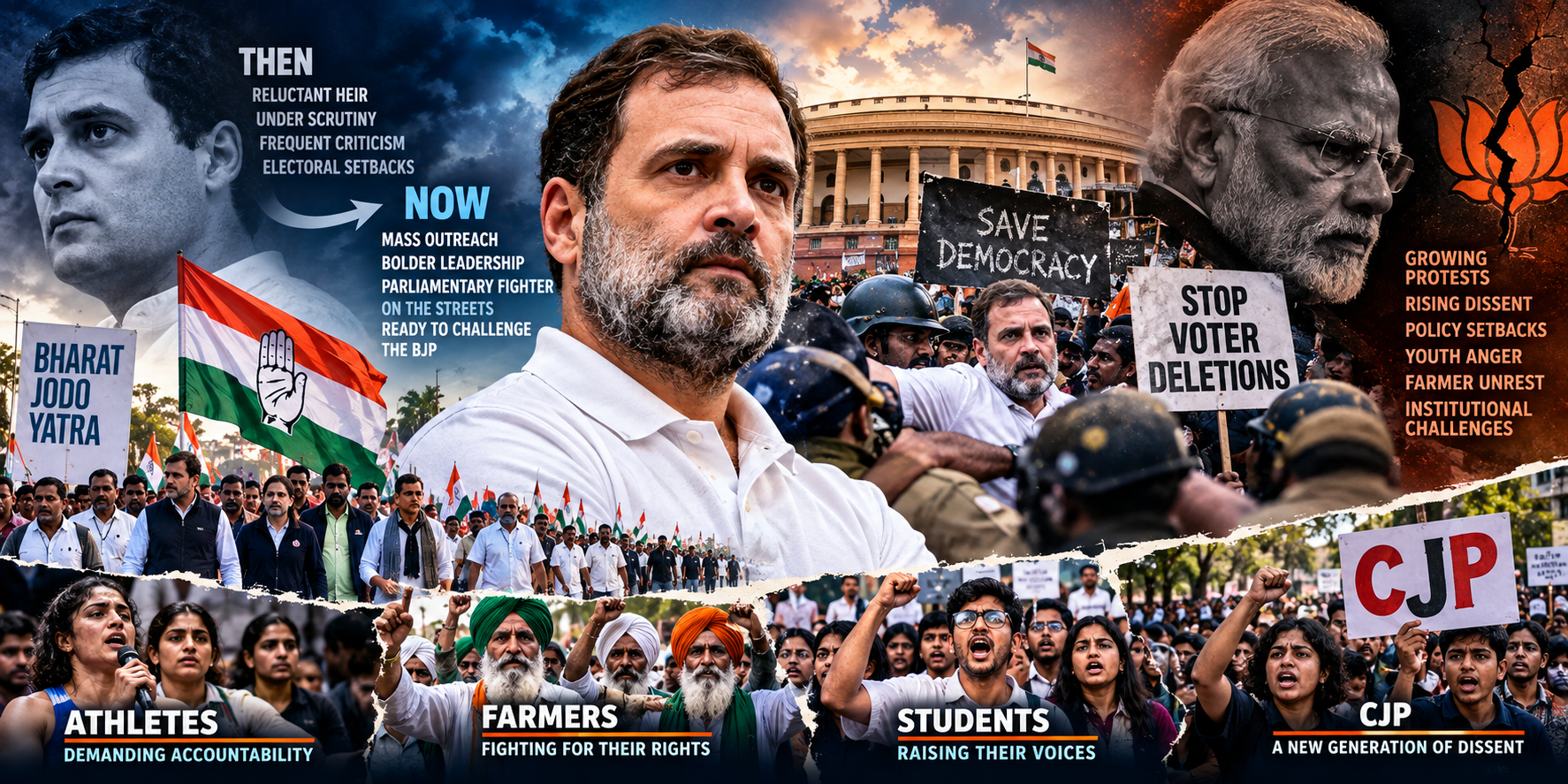
From the Bharat Jodo Yatra to confrontations with the police and protests over electoral rolls, Rahul Gandhi is reshaping his political image. As discontent among athletes, farmers, students and youth movements challenges the BJP, the question is whether he can turn a more assertive public persona into a credible national alternative.
Introduction: A Different Rahul Gandhi Is Emerging
For much of his political career, Rahul Gandhi has struggled against a perception that he was not fully prepared for the demands of national leadership. Critics questioned his consistency, his electoral strategy and his ability to convert public appearances into political results. The BJP built a sustained political narrative around these vulnerabilities, frequently portraying him as an inexperienced dynast in contrast with Prime Minister Narendra Modi’s image as an established leader.
That narrative has become more difficult to sustain without qualification.
Over the past several years, Gandhi has developed a more visible political identity: one built around mass outreach, social justice, economic inequality, institutional accountability and direct confrontation with the government. His Bharat Jodo Yatra marked an important stage in that evolution. His subsequent role as Leader of the Opposition in the Lok Sabha gave him a formal parliamentary platform, while his recent participation in street protests has added a more confrontational dimension to his public image.
In October 2026, that change became particularly visible. Gandhi took part in protests demanding accountability from Chief Election Commissioner Gyanesh Kumar over the revision of electoral rolls. Opposition leaders alleged that the process risked excluding legitimate voters and unfairly benefiting the BJP. The Election Commission and the government have rejected allegations of political bias, arguing that the exercise is intended to remove duplicate and ineligible entries. Gandhi and other opposition leaders were detained during protests in Delhi, generating widely circulated images of the confrontation.
The significance of these events extends beyond the immediate dispute over voter lists. They raise a larger question about Gandhi’s political evolution: has he moved from being a leader who frequently reacts to events into one increasingly willing to set the political agenda?
At the same time, protests by athletes, farmers, students and youth-led groups have created multiple points of pressure on the BJP. These movements have different origins and objectives, and they do not necessarily support the Congress. Yet their emergence raises questions about the government’s ability to manage public discontent and about the opposition’s capacity to turn separate grievances into a coherent national political challenge.
Rahul Gandhi’s evolving image and the BJP’s political pressures are connected, but neither guarantees the outcome of the next electoral contest. The decisive test is whether visible protest, parliamentary confrontation and public outreach can be translated into sustained political organisation, policy credibility and voter support.
1. The Early Years: A Political Heir Under Constant Scrutiny
Rahul Gandhi entered the Lok Sabha in 2004, representing Amethi in Uttar Pradesh. As a member of the Nehru-Gandhi political family, he entered public life with extraordinary name recognition, access to party leadership and a national platform.
Those advantages also created a demanding standard. His political career was judged not simply against other opposition leaders but against the legacy of his father, Rajiv Gandhi, his grandmother Indira Gandhi and his great-grandfather Jawaharlal Nehru.
Initially, Gandhi spoke about strengthening the Congress organisation, empowering young leaders and connecting the party with people outside its traditional political networks. He took an interest in the party’s youth organisations and made public interventions on issues affecting disadvantaged communities.
However, his political communication often appeared episodic. Critics questioned whether his interventions were followed by sustained organisational work or a clear political strategy. His public image was shaped by moments that opponents could use to portray him as inexperienced, inconsistent or insufficiently prepared for executive responsibility.
The Congress’s defeats in the 2014 and 2019 general elections intensified those criticisms. Gandhi’s leadership became inseparable from the party’s broader difficulties: weakening electoral networks in several states, leadership uncertainty, defections and the BJP’s ability to consolidate support around Modi.
The challenge was not merely personal. The Congress was confronting a transformed political environment in which social media, highly centralised campaigning, national security narratives and an increasingly powerful BJP organisational network changed the terms of political competition.
Gandhi needed more than a different communication style. He needed to demonstrate endurance, develop a recognisable political argument and establish a more direct connection with voters.
2. Bharat Jodo Yatra: The Beginning of a Different Political Image
The Bharat Jodo Yatra, which began in September 2022 and concluded in January 2023, marked an important phase in Gandhi’s public evolution.
Rather than relying exclusively on speeches, press conferences and conventional party events, he spent months walking across the country, meeting citizens and engaging with groups outside the Congress’s traditional political structures.
The march offered a different visual narrative. Gandhi appeared less as a politician operating primarily from party offices and more as a leader willing to spend extended periods on the road, listening to people and discussing unemployment, social divisions, economic hardship and constitutional values.
The journey also helped establish themes that have become central to his politics: the idea that social cohesion is under pressure, that economic opportunity is unevenly distributed and that political institutions require stronger accountability.
The electoral consequences should not be overstated. The Congress did not suddenly become dominant across the country. But the Yatra provided Gandhi with an extended platform to communicate his political philosophy and challenge the image of detachment that had followed him for years.
An analysis published after the 2024 general election found that the Congress and its INDIA bloc allies gained a combined 41 seats in constituencies along the routes of Gandhi’s two major yatras. That association does not establish that the marches alone caused the gains, since alliances, candidates, local issues and state-level political conditions also mattered. Nevertheless, the results demonstrated that the outreach coincided with meaningful electoral improvement in several constituencies.
The more lasting outcome may have been the development of a clearer political identity. Gandhi increasingly positioned himself around questions of representation, inequality, social justice and institutional accountability.
The Yatra did not resolve every weakness in the Congress organisation. It did, however, provide a foundation for a more sustained political narrative.
3. The 2024 Election: A More Consequential Opposition Leader
The 2024 Lok Sabha election represented an important turning point in India’s parliamentary balance.
The BJP won 240 seats, falling short of the 272 required for a single-party majority in the 543-member Lok Sabha. The National Democratic Alliance secured a majority with the support of its partners, enabling Modi to begin a third term. The Congress won 99 seats, its strongest result since 2009, while the INDIA opposition alliance secured a substantial parliamentary presence.
The outcome did not remove the BJP from power, nor did it establish that the opposition had overcome its organisational challenges. It did, however, change the political context in which Gandhi operated.
The BJP could no longer rely on its previous single-party majority in the Lok Sabha. Coalition partners became more important to the government’s parliamentary calculations, while the opposition gained a larger platform to scrutinise legislation and challenge government decisions.
Gandhi’s appointment as Leader of the Opposition in the Lok Sabha in June 2024 gave him a formal institutional role. He could question ministers, lead opposition interventions and place alternative arguments before Parliament with greater authority.
His position also changed the expectations attached to him. An opposition leader is not judged only by the ability to criticise the government. The role requires parliamentary discipline, policy knowledge, coalition management and the capacity to present credible alternatives.
The 2024 election therefore gave Gandhi an opportunity, not an automatic mandate for national leadership.
His subsequent challenge has been to convert the Congress’s improved parliamentary position into a stronger organisation, clearer policy commitments and a more effective relationship with opposition parties whose interests often differ.
4. The Protest Politics of 2026: A More Confrontational Rahul Gandhi
Gandhi’s recent protests have added a new dimension to his political image.
In early October 2026, he joined opposition leaders in demonstrations directed at the Election Commission over allegations concerning the Special Intensive Revision of electoral rolls. The opposition demanded accountability from Chief Election Commissioner Gyanesh Kumar and challenged the legitimacy and implementation of the revision process.
Police blocked opposition marches and detained several lawmakers. Gandhi and Priyanka Gandhi Vadra also climbed over barricades during one confrontation, keeping the protest in public view. The episodes were widely reported and amplified through television and social media.
The images mattered because political communication increasingly operates through short, highly visible moments. A photograph of a leader confronting a barricade can convey defiance more quickly than a lengthy parliamentary speech.
For Gandhi, the protest offered a way to project physical presence, determination and willingness to accept the immediate costs of confrontation. It also allowed him to connect an institutional question—how electoral rolls are revised—with a broader argument about democratic accountability.
The image is markedly different from the one his critics popularised during his earlier years.
Yet protest politics has limitations. A dramatic confrontation can attract attention without resolving the underlying dispute. It can also allow opponents to frame an issue around disorder or political theatre rather than its substance.
Gandhi must therefore demonstrate that the protest is part of a sustained strategy: presenting evidence, pursuing legal and parliamentary scrutiny, explaining the consequences for voters and offering a credible process for addressing legitimate concerns.
The distinction between symbolism and political effectiveness will be crucial.
5. From Athletes to Farmers to CJP: A Series of Challenges to the BJP
The BJP has faced protests arising from different sections of Indian society. These movements should not be treated as a single coordinated opposition campaign. Their demands, leadership and political affiliations differ. But collectively, they illustrate the range of issues that can place pressure on a government with a large national mandate.
Athletes and the question of accountability
In 2023, prominent Indian wrestlers, including Olympic medallists, protested against the leadership of the Wrestling Federation of India. They accused its then-president, BJP parliamentarian Brij Bhushan Sharan Singh, of sexual harassment and demanded accountability. Singh denied the allegations, and the dispute prompted intense public scrutiny of the handling of complaints against a powerful sports administrator.
The episode became a wider debate about the treatment of athletes, institutional accountability and the relationship between political influence and sports administration.
The protests did not establish that every allegation against a political figure was proven, nor did they translate directly into a national anti-BJP movement. Their significance lay in the fact that prominent athletes used their public standing to demand a response from institutions and political authorities.
For the BJP, the episode created an uncomfortable public-relations and accountability challenge. For the opposition, it demonstrated how a grievance outside conventional party politics could become a national issue.
Farmers and the limits of policy acceptance
The farmers’ protests presented a different challenge.
The large-scale mobilisation against the agricultural laws enacted in 2020 continued for more than a year. Farmers argued that the reforms threatened their livelihoods and bargaining power. In November 2021, the government announced that it would repeal the laws, a significant retreat following sustained protests.
The episode demonstrated that the government’s parliamentary majority did not guarantee public acceptance of every major policy. Sustained mobilisation, particularly when rooted in economically and politically influential constituencies, could force the government to reconsider its approach.
Farmers have continued to raise concerns about minimum support prices, debt, agricultural incomes and the implementation of earlier assurances. Their demands are not identical, and not all farmers support the same political parties. Yet the issue remains a test of the government’s relationship with rural India.
For Gandhi, the political lesson is that opposition credibility requires more than expressing solidarity during a protest. It requires a detailed understanding of agricultural economics, workable policy proposals and sustained engagement after media attention moves elsewhere.
Students and the emergence of CJP
In 2026, the youth-led Cockroach Janta Party (CJP) and student groups brought a different set of grievances into national politics. Their mobilisation began around concerns including examination paper leaks and accountability, before the campaign expanded into protests concerning electoral-roll revisions and the Election Commission.
The student movement’s pressure contributed to a political crisis that culminated in the resignation of Union Education Minister Dharmendra Pradhan in July, according to contemporary reporting. The movement later became involved in demonstrations demanding accountability from Chief Election Commissioner Gyanesh Kumar.
The CJP’s significance lies partly in its emergence outside the established party system. Youth-led movements can attract people who distrust conventional political organisations or do not see themselves represented by them. Digital platforms can accelerate mobilisation, while local demonstrations can turn a narrow grievance into a wider debate about governance.
The recent protests over voter-roll revisions have created another challenge for the government. Opposition parties allege that the removal of names risks excluding legitimate voters and disproportionately affecting groups likely to support the opposition. The Election Commission has rejected claims of political bias and says the process is intended to remove duplicate and ineligible entries. The scale of the revisions and the practical difficulty some voters may face in restoring their names have become central questions in the dispute.
The allegations require evidence and scrutiny rather than automatic acceptance. But the public controversy itself has increased pressure on the Election Commission and the government to explain the process transparently.
Do these protests mean the BJP is weakening?
The protests reveal vulnerabilities in the BJP’s political environment, but they do not, by themselves, establish a broad or irreversible decline.
The government has faced setbacks and has had to respond to public pressure in particular cases. The repeal of the agricultural laws and the education minister’s resignation demonstrate that mobilisation can produce concrete political consequences. The wrestlers’ protest raised questions about accountability, while the CJP’s campaigns have drawn attention to student grievances and electoral administration.
However, these movements differ in their demands and constituencies. A protest over sports governance does not automatically translate into support for the Congress. Farmers’ concerns vary across states, and student movements may resist being absorbed into party politics.
The BJP also retains substantial organisational capacity, national visibility and the advantages of incumbency. Its electoral strength varies across states and constituencies, and the 2024 result showed that a reduced parliamentary majority is not the same as losing the ability to form a government.
The more defensible conclusion is that the BJP faces a wider range of accountability challenges than a simple government-versus-opposition narrative can capture. Whether those challenges weaken its electoral position will depend on their persistence, public reach and ability to influence voting behaviour.
6. Rahul Gandhi’s Strategic Opportunity: Connecting Separate Grievances
Gandhi’s opportunity is not necessarily to lead every protest or bring every movement under the Congress banner. In some cases, overt party involvement could undermine the independence of movements whose supporters distrust established political organisations.
Instead, he could connect their underlying concerns through a broader political argument about accountability, opportunity and the functioning of institutions.
The issues differ, but several recurring questions emerge:
- Are public institutions responding effectively to complaints from citizens?
- Can young people trust examination and recruitment systems to operate fairly?
- Are farmers receiving adequate economic security?
- Are athletes protected when they report abuse or misconduct?
- Can citizens trust the accuracy and fairness of electoral processes?
These questions do not all have the same answers, and they should not be treated as proof of a single coordinated failure. They do, however, concern the relationship between citizens and institutions.
Gandhi’s recent political language increasingly places such questions within a broader argument about constitutional safeguards and social justice. That provides him with a possible framework for connecting issues without claiming ownership of every movement.
The challenge is to convert the framework into practical politics. The Congress would need credible policy proposals, local leadership, consistent engagement with affected communities and an ability to work with other opposition parties while respecting their independence.
If the party merely appears at protests after they become nationally prominent, it risks being seen as opportunistic. If it builds lasting relationships, explains the issues carefully and pursues outcomes after demonstrations end, it has a better basis for establishing credibility.
7. Is Rahul Gandhi Ready to Take Charge?
The question of whether Gandhi is ready to lead a national alternative cannot be answered by photographs, speeches or protest appearances alone. It requires an assessment of the responsibilities associated with national leadership.
There are signs of change.
He has become more visible in Parliament, developed a more consistent set of political themes and spent considerable time engaging with people outside formal party settings. The Bharat Jodo Yatra demonstrated endurance and a willingness to invest in long-form outreach. His role in the 2024 election and subsequent position as Leader of the Opposition have given him greater institutional standing. His recent protests have added a more assertive and confrontational dimension to his public image.
But leadership readiness has several dimensions.
First, organisation. The Congress needs stronger state-level leadership, reliable local networks, effective candidate selection and greater discipline in campaign execution. National visibility cannot compensate indefinitely for weaknesses on the ground.
Second, coalition management. The INDIA bloc includes parties with different social bases, regional interests and ambitions. Gandhi’s ability to maintain cooperation without demanding that every partner follow the Congress line will matter.
Third, policy credibility. Criticising the government is only one part of opposition politics. A credible alternative must explain how it would address employment, inflation, agriculture, education, public health, infrastructure and economic growth.
Fourth, consistency. Protest appearances create moments of visibility. National leadership requires sustained work between those moments: parliamentary scrutiny, public engagement, policy development and follow-through.
Fifth, electoral conversion. A leader’s public profile must eventually be tested against voter choices. Demonstrations, social-media attention and favourable commentary are not substitutes for election results.
Gandhi’s evolution suggests that he has become a more consequential political actor than the caricature that dominated much of his earlier career. Whether he can translate that change into national leadership remains an open question that will be answered through organisation, alliances, policy and electoral performance.
8. The BJP’s Challenge: From Dominance to Managing Pressure
The BJP continues to be a major political force, but governing from a coalition-dependent parliamentary position creates a different set of incentives from governing with a single-party majority.
The 2024 election made coalition partners more important to the government’s parliamentary arithmetic. Public controversies and protests have since required the government to respond to issues that extend beyond its preferred political agenda. The repeal of the agricultural laws remains a notable example of the capacity of sustained protest to force a policy reversal.
The BJP’s challenge is not simply to defeat the opposition’s arguments. It must also address public concerns about institutional accountability, employment, education, rural incomes and the implementation of policy.
In the voter-roll dispute, the Election Commission and government have defended the revision process as an effort to improve electoral integrity. The opposition argues that the scale and implementation of deletions risk excluding eligible citizens. The central institutional task is to establish the facts, provide transparent procedures and ensure that eligible voters can exercise their rights.
If concerns are resolved credibly, the controversy may lose political momentum. If confusion, exclusion allegations or public distrust persist, the issue could remain a source of pressure.
The same principle applies to other protests. Governments can sometimes contain a movement through negotiation or concessions. But unresolved grievances can return in different forms, especially when citizens believe that established channels are not producing satisfactory outcomes.
The BJP’s political position should therefore be assessed through concrete evidence—election results, public responses, policy changes and organisational performance—rather than the assumption that every protest signals an impending electoral reversal.
9. The Battle of Political Images: Modi’s Established Brand and Rahul’s Changing Persona
Indian politics increasingly operates through visual communication as well as policy and organisation.
Modi’s political brand has long been associated with centralised leadership, national identity, decisive communication and a sustained ability to dominate the public agenda. Gandhi’s emerging image is different: more informal, more visibly engaged in street politics and increasingly associated with institutional accountability and challenges to concentrated power.
His clothing, public interactions and protest appearances have become part of that communication. Recent reporting has noted his use of more varied clothing during youth-focused outreach, alongside his established informal style.
But image should not be confused with substance.
A change in clothing can make a politician appear more accessible, but it cannot establish policy competence. A confrontation with police can convey determination, but it does not demonstrate the ability to manage a government. Likewise, a powerful campaign message does not automatically overcome organisational weaknesses or regional political differences.
Gandhi’s task is to ensure that his evolving image reinforces a credible political programme rather than becoming a substitute for one.
For the BJP, the challenge is to respond to criticism without allowing every controversy to become a referendum on the government’s wider legitimacy. For the Congress, the challenge is to show that it can offer more than resistance—that it can articulate a coherent and practical alternative.
The next phase of Indian politics will depend on how effectively both sides connect their public narratives with governance, policy and the lived experiences of voters.
Conclusion: A Political Evolution Still in Progress
Rahul Gandhi’s journey from a frequently criticised political heir to a more assertive opposition leader has been neither linear nor complete.
The Bharat Jodo Yatra helped him establish a more sustained public presence. The 2024 general election strengthened the Congress’s parliamentary position and gave the opposition a larger platform. His subsequent role as Leader of the Opposition and his participation in recent street protests have reinforced an image of greater political engagement and willingness to confront the government.
At the same time, protests by athletes, farmers, students and the CJP have highlighted different points of friction between citizens, institutions and the BJP-led government. These movements have produced political consequences, including the repeal of agricultural laws and the resignation of an education minister. They have also raised questions about accountability and electoral administration.
Yet the movements are not interchangeable, and their participants cannot be assumed to support any single political party. The BJP retains substantial political and organisational strength. The Congress continues to face challenges in rebuilding its state-level structures, maintaining alliances and translating national visibility into consistent electoral gains.
Gandhi’s opportunity lies in connecting public grievances to a credible programme for governance while respecting the independence of movements that arise outside party politics. His challenge is to show that the determination visible in protests can also be sustained in policy development, organisation and coalition leadership.
The BJP, meanwhile, faces the task of demonstrating that its institutions and policies can withstand scrutiny and respond effectively to citizens’ concerns.
The real measure of Rahul Gandhi’s evolution will not be how dramatically he confronts the government, but whether he can turn that confrontation into durable political credibility. For the BJP, the corresponding test is whether it can address mounting questions of accountability while maintaining public confidence.
India’s political contest is therefore entering a phase in which image, protest and parliamentary confrontation are increasingly interconnected. Whether this produces a lasting shift in the balance of power will depend on what happens beyond the headlines: the quality of governance, the credibility of institutions, the strength of political organisation and the choices voters ultimately make.


