


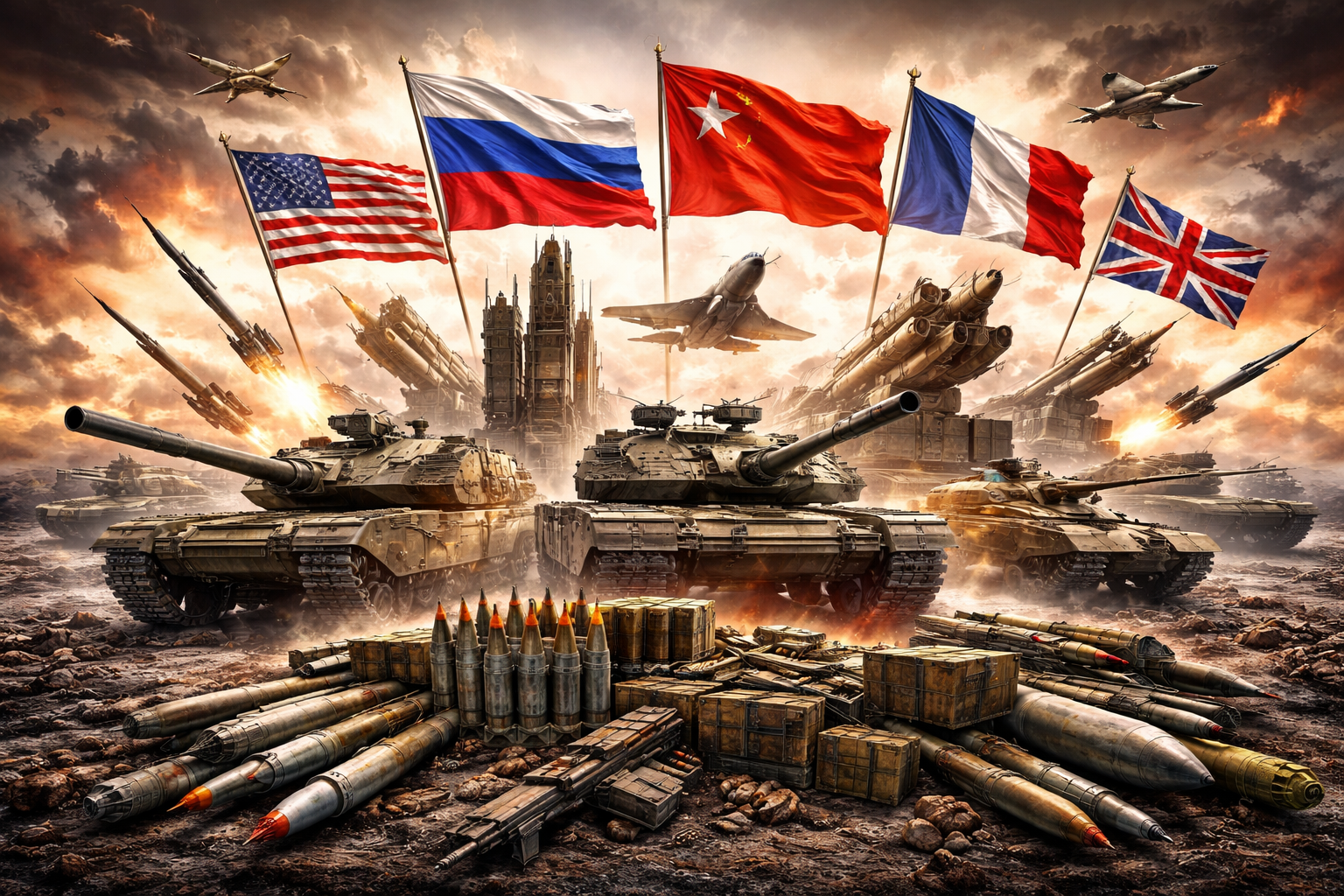
The defence industry is one of the largest, most technologically advanced, and most geopolitically consequential sectors of the international economy — and wars accelerate its dynamics in ways that reshape military alliances
Introduction: The Industry That Wars Are Made Of
The global defence industry occupies a unique position in the international economy: it is simultaneously a commercial sector governed by supply and demand, a strategic asset managed as an instrument of national security, a geopolitical tool deployed by governments to build and sustain alliances, and a moral and political flashpoint that generates more ethical and policy debate than almost any other sector of economic activity. It is also, by any measure, enormous.
Global military expenditure reached approximately $2.2 trillion in 2023, according to the Stockholm International Peace Research Institute (SIPRI), representing the ninth consecutive year of increase and the highest level in absolute terms since the Cold War. The five largest military spenders — the United States, China, Russia, India, and Saudi Arabia — together account for approximately 62% of global military spending. The global arms trade — the international transfer of major weapons systems — totalled approximately $117 billion in constant 2022 dollars for the five-year period 2018-2022, according to SIPRI’s most recent comprehensive assessment.
This analysis examines the structure and scale of the global arms market, who the major exporting and importing countries are, how arms sales function as a geopolitical instrument, the relationship between conflict and procurement cycles, and the ethical and political debates that the global arms economy generates.
Section I: The Scale of the Global Arms Market
Understanding the scale of the global arms economy requires distinguishing between several overlapping concepts that are sometimes conflated. Military expenditure is the broadest measure — it includes all government spending on defence, including personnel costs, maintenance, operations, and procurement. The United States alone accounts for approximately 37-40% of total global military expenditure — more than the next ten countries combined — with a defence budget that exceeded $886 billion in fiscal year 2024.
Within total military expenditure, arms procurement — the purchase of new weapons systems and military equipment — represents approximately 25-35% of the total in most countries. For the largest spenders, this translates into procurement budgets of tens to hundreds of billions of dollars annually. The US procurement budget alone typically exceeds $150 billion per year. China’s official procurement budget is smaller, but the true figure is difficult to assess because Chinese defence spending is not fully transparent.
The international arms trade — transfers of weapons between countries — is the most closely tracked component of the global arms economy, though it represents only a fraction of total defence spending (most military expenditure is domestic, on domestic procurement, personnel, and operations). SIPRI tracks major weapons transfers using a standardised metric called the Trend Indicator Value (TIV), which allows comparisons across different weapon types. By this measure, global arms transfer volumes in the five-year period 2018-2022 increased by 5.1% compared to 2013-2017.
Section II: Major Exporting Countries
The global arms export market is dominated by a small number of states whose defence industrial bases produce weapons at a scale and technological level that creates export demand. The United States is the world’s largest arms exporter by a significant margin, accounting for approximately 40% of all major weapons exports in the 2018-2022 period according to SIPRI. US arms exports go primarily to its treaty allies — Saudi Arabia, Australia, Japan, South Korea, Israel, UAE, Qatar, and European NATO members — and serve both commercial and geopolitical objectives simultaneously.
Russia was traditionally the world’s second largest arms exporter, but its share has declined significantly as the Ukraine war has absorbed domestic production capacity, damaged its reputation as a reliable supplier, and triggered weapons embargoes from countries that previously purchased Russian equipment. France has moved to become the second largest exporter in recent years, with Rafale fighter sales to India, Greece, Egypt, Qatar, Indonesia, and the UAE driving a dramatic increase in French export volumes. China is the fifth largest exporter, with export volumes increasing and a growing market in Asia, Africa, and the Middle East.
The United Kingdom, Germany, Spain, Italy, and Sweden are all significant exporters, with European defence companies — BAE Systems, Thales, Airbus Defence, Leonardo, MBDA, Saab — competing actively in global markets. The European export market has been complicated by the Ukraine war, which has both increased demand for European systems and created political debates about which countries should receive European arms in the current geopolitical environment.
The Major Importers
The major importing regions reflect the intersection of security demand, economic capacity, and geopolitical relationships. The Indo-Pacific is the largest importing region, with India the single largest importer of major weapons in the world — accounting for approximately 11% of global arms imports in the 2018-2022 period and simultaneously dealing with Russian-equipped legacy systems and new procurement from the United States, France, and Israel. Saudi Arabia is the largest importer in the Middle East and the second largest globally.
The pattern of arms imports provides a relatively reliable indicator of geopolitical alignment — countries that buy their weapons from the United States or Europe are typically within the American-led security architecture, while countries that buy from Russia or China are either aligned with the alternative pole or are deliberately maintaining strategic ambiguity by purchasing from multiple sources (India being the paradigmatic example of the latter).
Section III: The Geopolitical Instrument
Arms sales are rarely purely commercial transactions. They are instruments of alliance management, strategic signalling, and geopolitical influence that governments deploy with explicit political intent alongside whatever commercial objectives the defence industry may have.
For the United States, the Foreign Military Sales (FMS) programme — the government-to-government mechanism through which most US arms exports are conducted — is explicitly managed as a tool of alliance management and strategic influence. The access to advanced US weapons that FMS provides creates defence dependencies — the need for spare parts, maintenance, training, and software updates from American sources — that deepen recipients’ strategic relationships with Washington over time. The decision to supply or withhold specific weapons to specific allies is one of the most powerful tools of American foreign policy, as the debates over F-35 sales to Turkey and the UAE, Patriot air defence system supply to various Gulf states, and weapons supply to Taiwan all demonstrate.
Russia historically used arms exports as one of its primary instruments of strategic influence, particularly in South and Southeast Asia, the Middle East, and Africa, where its willingness to sell advanced equipment without the human rights conditions that European and American exporters attach gave it access to customers that Western suppliers could not reach. The Ukraine war’s impact on Russian export capacity and reputation has significantly reduced this instrument’s effectiveness.
China’s arms export strategy has been evolving as its indigenous capability has improved. Chinese exports have focused primarily on affordable, reliable systems for developing country customers — drones, armoured vehicles, naval vessels, and missiles that are priced significantly below comparable Western systems. Chinese arms sales have been accompanied by broader economic relationships, including investment, infrastructure finance, and diplomatic support, creating a package that some developing countries find more attractive than the conditions-attached relationships that Western suppliers offer.
Section IV: Conflict and the Procurement Cycle
Military conflicts are the most powerful accelerator of defence procurement cycles. They consume munitions and equipment that need to be replaced, they expose capability gaps that need to be addressed, they demonstrate the operational effectiveness (or ineffectiveness) of specific systems that shapes future procurement decisions, and they create the political conditions — elevated threat perceptions, loosened fiscal constraints on defence spending — that allow governments to advance procurement programmes that might otherwise face budget resistance.
The Ukraine war has been the most consequential driver of global arms procurement in decades. European NATO members, many of whom had allowed their defence spending and stockpiles to decline significantly in the three decades following the Cold War, have been confronted with the operational reality of high-intensity conventional warfare in Europe — the first since 1945 — and are undertaking the most significant rearmament programme since the Cold War. Germany has committed to reaching the NATO 2% of GDP defence spending target; Poland is on a trajectory to reach 4% of GDP. The demand for artillery ammunition, air defence systems, armoured vehicles, and long-range precision strike weapons has overwhelmed European production capacity and is accelerating both domestic production expansion and procurement from the United States.
The Middle East conflicts — including the Gaza war, the Houthi campaign, and the Iran conflict — have similarly driven elevated procurement of specific categories. Air defence interceptors — Iron Dome Tamir missiles, Arrow 3 interceptors, Patriot PAC-3 missiles — are being consumed at rates that have strained production capacity and prompted emergency procurement expansion. Precision strike munitions are being consumed at high rates by Israel and the United States. Electronic warfare systems are in high demand. The procurement decisions being made now — in response to current operational experience — will shape the military capabilities of the region’s armed forces for the next decade.
Section V: The Ethical and Political Debates
The global arms economy generates ethical and political debates that are among the most persistent and least easily resolved in contemporary international politics. The central tension is between the legitimate security interests that arms sales serve — the ability of states to defend themselves, the management of alliances, the maintenance of a defence industrial base as an element of national security — and the human cost of arms transfers to countries that use them in ways that cause civilian harm, enable human rights violations, or sustain conflicts that would otherwise end sooner.
The most acute ethical debates currently involve arms sales to states engaged in conflicts with high civilian casualty rates. The supply of American and European weapons to Saudi Arabia and the UAE during the Yemen war generated sustained political controversy in the United States and Europe, with multiple Congressional attempts to restrict or condition arms sales and several European countries temporarily suspending specific transfers. Similar debates have arisen around weapons supply to Israel during the Gaza conflict.
The legal framework for these debates is provided by export control regimes — the US Arms Export Control Act, the EU Common Position on arms exports, and various multilateral frameworks including the Arms Trade Treaty, which entered into force in 2014. These frameworks establish criteria for assessing whether arms exports are appropriate — including assessments of human rights situations in recipient countries, risk of diversion to unauthorised users, and potential for destabilisation. Their implementation is, in practice, highly inconsistent, with commercial and strategic interests regularly overriding the criteria that the frameworks establish.
The ethical dimension of the debate is also complicated by the domestic economic interests of defence production. Defence industries employ hundreds of thousands of workers in high-wage manufacturing jobs that are concentrated in politically sensitive regions and constituencies. The political pressure to maintain defence production employment — and therefore to find export markets for domestically produced systems — creates a structural bias toward arms export approval that complicates the application of human rights criteria.
Conclusion: Security, Technology and Geopolitics
The global arms economy sits at the intersection of three of the most powerful forces in international relations: the security imperatives that drive states to maintain military capability, the technological competition that makes military advantage increasingly dependent on advanced industrial capacity, and the geopolitical competition that makes arms transfers one of the primary instruments of alliance management and strategic influence.
Understanding the global arms economy is not a peripheral interest of international relations — it is central to understanding why military balances look the way they do, why alliances form and reform, why some conflicts escalate and others are contained, and why the ethical constraints on arms transfers are so consistently overridden by other interests.
The current moment — with the Ukraine war driving European rearmament, the Middle East conflict driving elevated procurement of specific systems, China expanding its defence industrial capacity and export reach, and AI and autonomous systems beginning to transform the nature of military technology — is one in which the global arms economy is more dynamic, more consequential, and more politically contested than at any point since the Cold War. The decisions being made now about what to produce, what to export, and to whom will shape the military landscape of the 2030s and beyond.
The Global Arms Race Has Quietly Returned


