


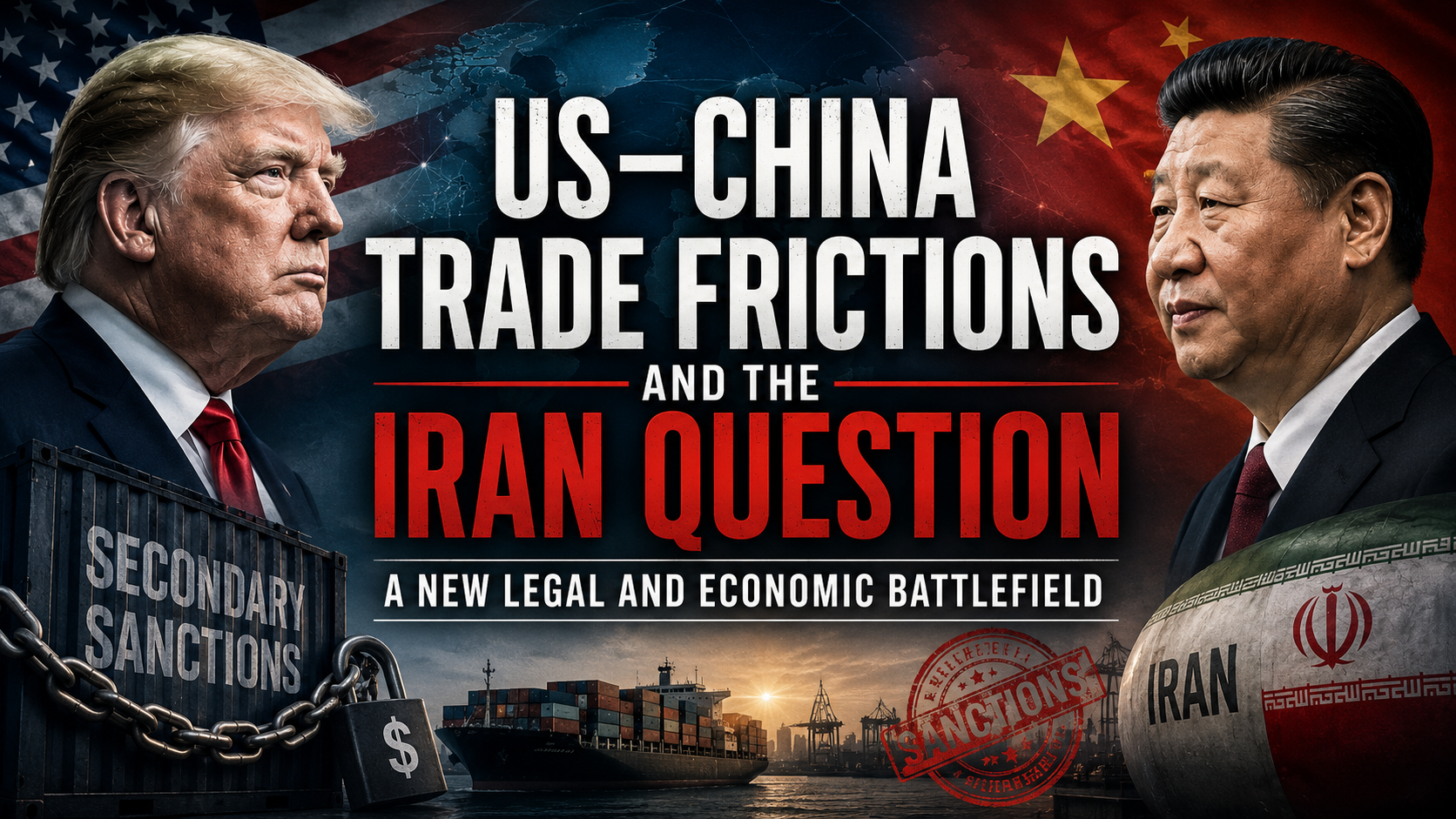
The intersection of US–China strategic competition and Iran sanctions enforcement is producing a new legal and economic battlefield — one in which secondary sanctions, technology controls, and supply chain weaponisation are creating pressure points that neither Beijing, Tehran, nor Washington can fully manage
How Do US–China Trade Frictions Intersect With Iran?
The US–China strategic competition and the Iran sanctions regime have become structurally intertwined in ways that are creating a new legal and economic battlefield with significant implications for both bilateral relationships and for the effectiveness of the Iran sanctions architecture. China is Iran’s largest oil customer and primary economic lifeline, purchasing Iranian crude at discounted prices through mechanisms designed to circumvent US sanctions. US secondary sanctions — which target non-US entities that do business with designated Iranian counterparts — create direct pressure on Chinese banks, energy companies, and shipping firms, compounding the broader economic friction between Washington and Beijing. The result is a triangular dynamic in which every escalation in US–China trade tensions has implications for Iran policy, and every escalation in Iran sanctions enforcement has implications for US–China economic relations.
The relationship between US sanctions on Iran and the trajectory of US–China economic competition is one of the most consequential and least publicly analysed dimensions of the current geopolitical environment. On the surface, they appear to be separate policy domains: trade tensions between the world’s two largest economies, managed through tariff negotiations, technology export controls, and investment screening; and a sanctions regime targeting Iran’s nuclear programme and regional behaviour, managed through OFAC designations, financial system exclusions, and diplomatic pressure. In practice, they are deeply entangled — and the entanglement is generating legal, economic, and diplomatic pressures that are reshaping both relationships.
China’s relationship with Iran is not incidental. It is strategic. The 25-year Comprehensive Cooperation Agreement signed in 2021 — covering energy, infrastructure, trade, and security cooperation — represents Beijing’s most explicit articulation of its intention to maintain Iran as a significant partner regardless of Western sanctions pressure. Iranian oil, purchased at discounts of 25–35% below market price through opaque transaction structures, provides China with a meaningful cost advantage in energy procurement while providing Iran with the hard currency revenue that sustains its economy and its regional activities. The arrangement is mutually beneficial and, from Beijing’s perspective, explicitly resistant to US coercive leverage.
From Washington’s perspective, China’s Iran engagement is simultaneously a sanctions compliance problem, a strategic competition problem, and a negotiating leverage problem. Every barrel of Iranian oil that reaches Chinese refineries represents a partial failure of the maximum pressure strategy. Every Chinese bank that processes Iran-related transactions without consequences represents an erosion of US financial system leverage. And every Chinese infrastructure investment in Iran represents a deepening of an alternative economic architecture that reduces Iranian incentives for nuclear negotiations and reduces US ability to use sanctions relief as a meaningful inducement.
| 1.5 million bpd Estimated Iranian crude oil exports to China in early 2026 — generating approximately $35 billion annually for Tehran despite nominal US sanctions, and representing a near-total circumvention of the sanctions architecture’s intended effect on Iranian oil revenue The gap between the declared ambition of US Iran sanctions — to reduce Iranian oil export revenue to near-zero — and the operational reality of 1.5 million barrels per day flowing to Chinese refineries is the most visible indicator of the sanctions architecture’s structural limitation when it confronts a non-compliant major power. The Trump-era maximum pressure campaign reduced Iranian exports to under 400,000 bpd at its peak; the Biden-era partial relaxation and China’s systematic sanctions circumvention have restored exports to levels that substantially fund the activities the sanctions were designed to prevent. |
Section I: The Mechanics of Sanctions Circumvention — How China Buys Iranian Oil
Understanding the US–China–Iran triangle requires understanding how Chinese purchases of Iranian oil actually operate — a set of financial and logistical mechanisms that are sophisticated, opaque, and specifically designed to create legal uncertainty about US sanctions applicability.
The primary circumvention mechanism is the use of Chinese renminbi rather than US dollars for Iran-related transactions, combined with routing through smaller Chinese provincial banks and trading companies rather than the major state banks that have the most to lose from US secondary sanctions exposure. Iran’s oil is typically loaded onto vessel fleets that disable or manipulate Automatic Identification System (AIS) transponders — the ‘dark fleet’ — and transferred ship-to-ship in international waters to obscure origin before delivery to Chinese ports or refineries. The invoicing, when it occurs in any traceable form, uses third-country intermediaries in the UAE, Hong Kong, or Central Asian jurisdictions that create additional layers between the transaction and its Iranian origin.
These mechanisms are not unknown to US sanctions enforcement authorities. OFAC has designated multiple entities involved in Iranian oil circumvention, including Chinese trading companies and vessel operators. But the enforcement dynamic has a structural imbalance: the US can impose secondary sanctions on Chinese entities it can identify, but it cannot impose those sanctions on Chinese state-owned enterprises without triggering a level of bilateral economic disruption that US policymakers have consistently assessed as too costly. The implicit understanding — that secondary sanctions will be applied to smaller actors as a deterrent signal but not to the largest Chinese state entities — has allowed the circumvention architecture to function at scale.
| 1 OIL | Iranian Oil — The Core Revenue Stream Iranian crude, primarily from the Khuzestan and offshore South Pars fields, flows to Chinese independent refineries (‘teapot refineries’) concentrated in Shandong province through the dark fleet mechanism. The price discount — averaging 25–35% below comparable grades — is both the incentive for Chinese purchase and the primary economic consequence of US sanctions on Iran’s oil sector. The revenue, approximately $35 billion annually at current volumes and prices, is the financial foundation of Iran’s defence budget, IRGC funding, and proxy network support. |
| 2 FINANCE | Financial Architecture — Renminbi, Barter, and Shadow Banking The financial infrastructure supporting China-Iran trade has progressively moved away from any mechanism with meaningful US dollar exposure. Payment mechanisms include renminbi transfers through designated Chinese banks, barter arrangements exchanging goods for oil (Chinese manufactured goods, steel, agricultural products), credit facilities denominated in non-dollar currencies, and in some cases direct commodity-for-commodity exchange that avoids conventional financial system interaction entirely. The CIPS (Cross-Border Interbank Payment System) provides an alternative to SWIFT for renminbi-denominated transactions, though its use for Iran-related payments creates secondary sanctions exposure for participating institutions. |
| 3 TECH | Technology Transfer — The Secondary Front Beyond energy trade, US–China technology export controls have become intertwined with Iran through a parallel channel: concerns that advanced semiconductors, dual-use technology, and military-relevant components restricted for China are being transshipped to Iran through Chinese or third-country intermediaries. The Bureau of Industry and Security (BIS) has designated multiple Chinese companies for facilitating such transfers. This creates a compound legal risk for Chinese technology firms: simultaneous exposure to Entity List restrictions for China-related business and to Iran-related secondary sanctions for transshipment activity. |
| 4 INFRA | Infrastructure Investment — The 25-Year Cooperation Agreement The 2021 China-Iran Comprehensive Cooperation Agreement commits China to $400 billion in investment over 25 years across Iranian infrastructure, industry, and energy sectors, in exchange for preferential oil supply. Implementation has been slower than announced — Chinese firms face internal risk management constraints around Iran exposure — but the agreement represents a strategic signal that China intends to maintain and deepen its Iran relationship regardless of Western sanctions pressure, and that Iran has a credible alternative to Western economic integration that reduces the leverage of sanctions-based diplomacy. |
Section II: The Legal Battlefield — Secondary Sanctions and Their Limits
The extraterritorial application of US sanctions law through secondary sanctions — the mechanism by which the US attempts to extend its Iran sanctions regime to non-US entities — is the primary legal dimension of the US–China–Iran triangle, and it represents one of the most contested areas of international economic law in the current environment.
Secondary sanctions work by threatening to exclude non-US entities from the US financial system — and by extension from dollar-denominated transactions and correspondent banking relationships — if they engage in transactions with US-designated entities or with the sectors of the Iranian economy that are subject to broad sanctions. For entities with significant US market exposure or dollar-denominated business, this threat is powerful: access to the US financial system is sufficiently valuable that exclusion from it is an unacceptable risk. For entities without significant US exposure — particularly Chinese state-owned enterprises whose primary market is domestic and whose transactions are increasingly renminbi-denominated — the threat is significantly diminished.
The structural limit of secondary sanctions is therefore a function of the degree of US financial system integration of the targeted entity. As China has deliberately reduced the dollar-denomination of its trade and financial flows — through CIPS, through bilateral currency swap arrangements with trading partners, through the internationalisation of the renminbi — it has simultaneously reduced the leverage that US secondary sanctions can exercise over Chinese entities. This is not an accidental byproduct of renminbi internationalisation; it is explicitly identified in Chinese strategic documents as one of its benefits.
| “The secondary sanctions architecture was designed for a world in which the US dollar was the indispensable medium of international trade — a world in which any significant commercial entity had dollar exposure that made exclusion from the US financial system prohibitively costly. China’s financial decoupling strategy is specifically designed to create an alternative architecture in which that dollar dependency no longer holds. We are watching, in slow motion, the construction of the infrastructure that will make secondary sanctions much less effective against Chinese entities than they currently are.” — Prof. Juan Zarate Former Deputy National Security Advisor for Combating Terrorism; Senior Adviser, Financial Integrity Network; Author of ‘Treasury’s War’ |
Section III: Implications for Nuclear Diplomacy and Regional Stability
The US–China–Iran economic triangle has direct implications for the prospects of nuclear diplomacy and for the broader regional stability architecture of the Middle East — implications that are, on balance, negative for the prospects of either a negotiated nuclear settlement or a stable regional order.
The sustained flow of oil revenue to Iran through the China channel fundamentally alters the sanctions leverage calculus of nuclear diplomacy. The theory of maximum pressure was that reducing Iranian oil revenues to near-zero would create economic pain sufficient to bring Tehran back to the negotiating table on terms acceptable to Western governments. At 1.5 million barrels per day of Chinese purchases, the revenue reduction is partial and manageable — providing Iran with sufficient economic oxygen to sustain its nuclear programme, its proxy network, and its domestic economy at levels that do not generate the political pressure that maximum pressure was intended to produce.
The diplomatic implication is that the US-led sanctions architecture cannot, on its own, produce the economic pressure that nuclear diplomacy requires as long as China chooses to maintain its Iran relationship. Any sustainable nuclear agreement — whether a return to JCPOA-like parameters or a new framework — requires Chinese participation in both the negotiations and the compliance monitoring architecture. The 2015 JCPOA included China as a P5+1 signatory precisely because Chinese participation was essential to both the agreement’s legitimacy and its enforceability. The deterioration of US–China relations since 2018 has made the reproduction of that cooperative dynamic much more difficult.
| The Legal and Economic Pressure Points in the US–China–Iran Triangle OFAC secondary designation risk: US Treasury’s Office of Foreign Assets Control has authority to designate Chinese entities engaged in Iran-related transactions — but has been selective in applying it to avoid triggering retaliatory Chinese measures in the broader trade relationship. Entity List compounding: Chinese entities on BIS’s Entity List for technology transfer concerns face compound legal risk from simultaneous Iran-related exposure — creating a category of Chinese firms subject to escalating US enforcement pressure across multiple regulatory frameworks. WTO compatibility: Multiple US tariff and technology control measures against China are subject to WTO dispute resolution proceedings — creating a legal forum where the intersection of trade and sanctions policy will be adjudicated in ways that constrain future US policy flexibility. EU autonomous position: The European Union maintains Iran sanctions aligned with UN Security Council resolutions but has diverged from extraterritorial US secondary sanctions — creating jurisdictional complexity for European firms and a transatlantic dimension to the legal landscape. |
Frequently Asked Questions
| How does China buy Iranian oil despite US sanctions? China purchases Iranian oil through a series of mechanisms designed to minimise US dollar exposure and legal traceability: renminbi-denominated transactions routed through smaller provincial banks; use of the dark fleet — vessels that disable AIS transponders and conduct ship-to-ship transfers in international waters to obscure origin; third-country intermediaries in the UAE, Hong Kong, and Central Asia that provide transactional layers; and in some cases direct barter arrangements that bypass conventional financial systems entirely. The result is an oil trade relationship that operates at approximately 1.5 million barrels per day — generating roughly $35 billion annually for Iran — within a legal grey zone that US enforcement authorities have been unwilling to address at the scale required to disrupt it. |
| What are secondary sanctions and do they work against China? Secondary sanctions are US legal provisions that threaten to exclude non-US entities from the US financial system if they engage in transactions with US-sanctioned counterparts. They are effective against entities with significant US dollar exposure or US market access — which describes most European financial institutions and many Asian trading companies. They are significantly less effective against Chinese state-owned enterprises whose primary market is domestic, whose transactions are increasingly renminbi-denominated, and whose US financial system exposure is limited. China’s deliberate renminbi internationalisation strategy is partly designed to reduce the secondary sanctions leverage that dollar dependency creates. |
| What is the China-Iran 25-year cooperation agreement? The Comprehensive Cooperation Agreement signed in March 2021 commits China to approximately $400 billion in investment in Iranian infrastructure, industry, energy, and security over 25 years, in exchange for preferential access to Iranian oil and gas at discounted prices. Implementation has been slower than the headline figures suggest — Chinese firms face internal compliance and risk management constraints — but the agreement represents China’s explicit strategic commitment to maintaining Iran as a significant partner regardless of Western sanctions pressure, and provides Iran with a long-term economic alternative to Western economic integration. |
| How does US–China competition affect Iran nuclear negotiations? US–China competition has fundamentally complicated Iran nuclear diplomacy by eliminating the cooperative dynamic between the two powers that made the 2015 JCPOA possible. The JCPOA succeeded partly because China and the US were able to coordinate in the P5+1 framework despite bilateral tensions. The current level of US–China strategic competition makes that coordination much harder to reproduce. More significantly, China’s sustained oil purchases provide Iran with sufficient economic revenue to sustain its nuclear programme without the economic pressure that sanctions-based diplomacy requires. Any durable nuclear settlement must include Chinese participation — which requires a level of US–China diplomatic coordination that current bilateral relations do not support. |
Conclusion: A Triangle That Neither Side Can Resolve Alone
The US–China–Iran legal and economic triangle is not a problem that any of the three actors can resolve on their own terms. The United States cannot impose the economic pressure on Iran that maximum pressure requires as long as China provides an alternative economic architecture. China cannot fully insulate its Iran relationship from US secondary sanctions pressure without accelerating financial decoupling in ways that carry significant costs and risks. And Iran cannot fully stabilise its economy on the basis of discounted Chinese oil purchases and a partial implementation of a 25-year cooperation agreement that moves more slowly than Tehran requires.
The triangle is therefore a condition to be managed rather than a problem to be solved — at least in the near term. The management question is whether the overlapping pressure points — US secondary sanctions on Chinese entities, Chinese renminbi internationalisation, Iranian nuclear programme advancement, and the technology transfer dimension — escalate in ways that produce either a broader US–China economic rupture or a regional military confrontation involving Iran, or whether they remain in a condition of managed tension that is costly for all parties but below the threshold of acute crisis.
In an environment of deepening US–China strategic competition and continued Iranian nuclear advancement, the managed tension scenario is fragile. The triggers for escalation — a significant OFAC action against a major Chinese state bank, an Iranian nuclear threshold crossing that prompts Israeli military action, a Chinese decision to provide Iran with technology that changes its military-nuclear calculus — are present in the current environment. The institutional mechanisms that might manage those triggers are weaker than at any point in the post-Cold War period.
The US–China–Iran triangle is not a problem that can be resolved by any single actor. It is a structural condition of the new global order — and its management will define the boundaries of great-power competition for the decade ahead.
Maritime Health Risks: The MV Hondius Hantavirus Outbreak and Its Implications


