


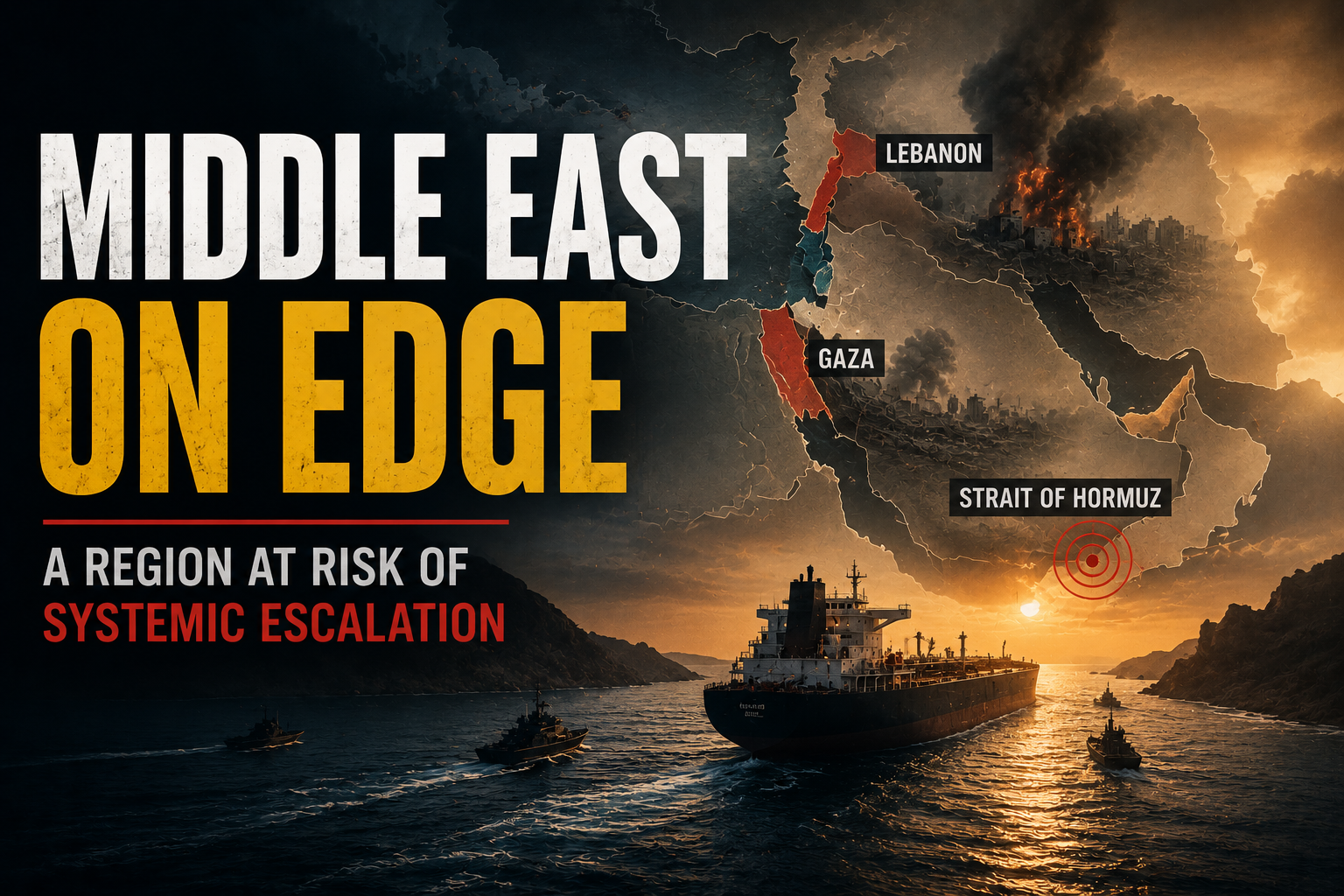
The Middle East in 2026 is no longer experiencing a series of parallel crises — it is experiencing a single interconnected strategic deterioration in which each pressure point amplifies the others, and in which the mechanisms that historically prevented escalation to regional war are under unprecedented strain
| The Short Answer: How Close Is the Middle East to Regional War?The Middle East in May 2026 is closer to a generalised regional conflict than at any point since the 1973 Yom Kippur War — and the escalation dynamics are more complex, more multi-actor, and less amenable to the diplomatic interventions that have historically contained crises in the region. Gaza remains in active conflict with no political resolution in sight. Lebanon has experienced direct Israeli-Hezbollah exchanges of the most intense kind since 2006. The Houthis continue to disrupt Red Sea shipping with Iranian-supplied capabilities. Iran’s nuclear programme has advanced to a point where multiple Western and regional intelligence assessments place it within weeks of weapons-grade uranium enrichment. And the United States, Israel’s primary patron, is engaged in direct military operations against Houthi infrastructure while simultaneously managing the Iran nuclear file. The question is not whether the region is at risk of escalation. It is whether the escalation that is already underway can be contained before it crosses thresholds from which return is impossible. |
The Middle East of 2026 does not present itself as a region with discrete, manageable crises. It presents as a single integrated strategic environment in which the actors, the incentives, and the conflict dynamics are interconnected in ways that make each crisis more dangerous because of the others. Gaza is not independent of Lebanon; Lebanon is not independent of Iran; Iran is not independent of the Red Sea; and the Red Sea is not independent of the Strait of Hormuz. Each pressure point generates pressures that flow through the system, amplifying risks at every other node.
This interconnection is not accidental. Iran’s axis of resistance — the strategic architecture linking the IRGC, Hezbollah, Hamas, the Houthis, and Iraqi Shia militias — was explicitly designed to create a multi-front deterrence posture in which no single adversary could address any one component without triggering responses from the others. The architecture has been severely tested by the events of 2023-2026: the October 7 attacks and their consequences have exposed both the power and the limits of the axis of resistance model. But the architecture has not been destroyed. And in its damaged but still-functional form, it represents a deterrence system whose failure modes are more dangerous than its operational modes.
| 21 million bpdVolume of oil and petroleum products transiting the Strait of Hormuz daily — approximately 21% of global oil consumption — making any sustained disruption to Hormuz transit the most consequential single chokepoint risk in the global energy systemThe Strait of Hormuz, at its narrowest point just 33 kilometres wide, is the exit point for the oil and gas production of Saudi Arabia, the UAE, Kuwait, Iraq, and Iran. It is also the chokepoint through which Iran has most credible leverage over the global economy. Iranian mining, shore-based missile systems, and naval assets give Tehran a serious capability to disrupt Hormuz transit — not to close the strait permanently, which would trigger overwhelming US military response, but to create sufficient uncertainty and insurance cost escalation to produce significant global energy price effects. The threat is not a weapon Iran wants to use; it is a deterrent it needs adversaries to believe it might. |
Section I: Gaza — The Conflict Without an Endpoint
The Gaza conflict that began with Hamas’s October 7, 2023 attack has entered its third year in a form that satisfies neither Israel’s stated war aims nor any of the external parties’ frameworks for resolution. Israel has degraded Hamas’s military capacity significantly, killed the majority of its senior military and political leadership, and dismantled much of the tunnel infrastructure that constituted Hamas’s strategic depth. It has not eliminated Hamas as a political and military organisation, has not produced the conditions for sustainable civilian governance in Gaza, and has not achieved the return of all hostages — the war objective with the most direct domestic political resonance in Israel.
The humanitarian catastrophe in Gaza — with over 52,000 Palestinians killed by May 2026 according to Gaza Health Ministry figures, more than 90% of the population displaced at some point during the conflict, and the majority of the territory’s infrastructure destroyed — has produced a level of international opprobrium that has constrained Israeli operational freedom in ways that were not anticipated in October 2023. The ICJ’s provisional measures orders, the ICC arrest warrants issued against Israeli and Hamas leaders, and the progressive erosion of European government support for Israeli military operations without humanitarian conditions have created a diplomatic environment that isolates Israel in multilateral forums even as the United States continues to provide military and diplomatic support.
The political obstacle to resolution is structural. Gaza requires a governing authority capable of providing security, services, and political legitimacy. No party currently in a position to provide governance meets all three conditions: the Palestinian Authority lacks the legitimacy and the capacity to govern Gaza in the aftermath of the conflict; Hamas retains residual organisational capacity and significant popular support in parts of Gaza despite military degradation; and the international community’s preferred governance frameworks have not translated into operational proposals that any party to the conflict is willing to accept. The conflict is grinding toward an outcome that no party wanted and that the international framework has no clear mechanism for managing.
| “Gaza in 2026 is not a conflict approaching resolution — it is a conflict that has entered a phase of managed destruction. Israel has achieved significant military objectives and cannot achieve the political objectives that would make those military gains durable. Hamas has been severely degraded and cannot be eliminated. The civilian population is bearing costs that no political outcome can justify retroactively. And the international community has demonstrated its limits in translating condemnation into either ceasefire or reconstruction. This is what strategic failure looks like when all parties share it.”— Dr. Ghaith al-OmariSenior Fellow, Washington Institute for Near East Policy; former adviser to the Palestinian negotiating team at Camp David |
Section II: Lebanon — The Fragile Ceasefire and Its Limits
The Lebanon ceasefire of November 2024 halted the most intense phase of Israeli-Hezbollah military confrontation since 2006 — but it did not resolve the underlying strategic tensions that produced it, and its implementation has been contested from the outset by all parties. Israeli forces remained in positions in southern Lebanon beyond the withdrawal timelines specified in the ceasefire agreement, citing Hezbollah’s failure to comply with requirements to withdraw its forces north of the Litani River under UN Security Council Resolution 1701. Hezbollah, significantly degraded by the 2024 campaign — which killed its secretary-general Hassan Nasrallah and much of the senior leadership — has been in a process of institutional reconstruction that is not yet complete.
The ceasefire’s fragility reflects a fundamental strategic unresolved question: whether Hezbollah can sustain its role as Iran’s most capable and most strategically positioned proxy without the leadership, the weapons stocks, and the military infrastructure that it possessed before the 2024 campaign. Iran has been supplying replacement weapons and has been supporting the reconstruction of Hezbollah’s command architecture — a process that Israeli intelligence is monitoring closely and that Israel has signalled it will not permit to reach the capability levels of the pre-2024 period. The gap between Iran’s determination to rebuild Hezbollah and Israel’s determination to prevent it is the primary driver of ceasefire fragility.
Lebanon’s domestic political situation compounds the security fragility. The country elected a new president in January 2025 — the first in over two years — and formed a government, but the structural conditions of Lebanese political dysfunction — sectarian power-sharing, Hezbollah’s hybrid political-military status, sovereign debt crisis, and the absence of a functioning state capable of enforcing ceasefire terms — remain unchanged. UNIFIL forces in southern Lebanon are monitoring a ceasefire whose terms neither party fully accepts, in a country without the institutional capacity to implement the security arrangements the ceasefire requires.
| 1HEZBOLLAH | Hezbollah’s Reconstruction — Iran’s Strategic InvestmentIran has been supplying Hezbollah with replacement munitions, missile systems, and command-and-control equipment through ground routes via Syria and through maritime delivery to Lebanese ports. The reconstruction is estimated to have restored a significant portion of Hezbollah’s pre-2024 rocket and missile inventory, though the precision-guided munition capability — which was more heavily targeted and is harder to replace — remains below pre-war levels. Israel’s intelligence assessment that Hezbollah is approaching operational restoration is the primary stated justification for continued Israeli military readiness posture in the north. |
| 2ISRAEL | Israel’s Northern Posture — Prevention Over CeasefireIsrael has been conducting ongoing strikes in Syria against weapons transfers to Hezbollah and has maintained a readiness posture in the north that treats the ceasefire as a pause rather than a settlement. The Israeli government’s position — that it will not permit Hezbollah to reconstitute the capability it possessed before October 2024 — is incompatible with Iran’s strategic objective of restoring Hezbollah to its pre-war role as the primary deterrent to Israeli military action against Iran’s nuclear programme. The incompatibility of these positions means that the ceasefire is subject to continuous pressure from both sides. |
| 3LEBANON | Lebanese State Capacity — The Missing Implementation PartnerThe ceasefire’s requirement for Lebanese Armed Forces (LAF) deployment in southern Lebanon and Hezbollah withdrawal north of the Litani faces the fundamental obstacle of Lebanese state fragility. The LAF lacks the equipment, the mandate, and the political backing within the Lebanese system to enforce compliance with ceasefire terms against Hezbollah. France, the US, and Saudi Arabia have provided financial and equipment support to the LAF, but the fundamental problem — that the Lebanese state does not have a monopoly on force in its own territory — cannot be resolved through equipment provision alone. |
| 4REGION | Regional Linkage — Lebanon as Iran’s Deterrence AnchorHezbollah’s strategic function within Iran’s axis of resistance architecture is to deter Israeli military action against Iran’s nuclear programme by threatening Israel’s northern population and critical infrastructure with rocket and missile fire. If Hezbollah’s deterrence capability is permanently reduced to a level that Israel no longer considers credible, the deterrent logic of Iran’s regional architecture is degraded — which increases rather than decreases the pressure on Iran to develop its own nuclear deterrent rapidly. The Lebanon file and the Iran nuclear file are therefore strategically linked in ways that make resolving either in isolation extremely difficult. |
Section III: The Strait of Hormuz — Economic Chokepoint as Strategic Variable
The Strait of Hormuz has not been closed, and Iran has not yet taken the step of directly interdicting commercial shipping in the Persian Gulf in a manner that would constitute a casus belli for US military response. But the threat is more operationally credible in May 2026 than at any point in the recent past — and the consequences of even partial disruption to Hormuz transit, in an energy market already stressed by conflict-related uncertainty, would be globally significant.
Iran’s Hormuz capability rests on a combination of shore-based anti-ship missiles, naval mines, submarine forces, and fast-attack craft that could not close the strait permanently against US military opposition but could impose severe costs on commercial shipping in a period of active confrontation. The economic effect of Hormuz disruption does not require physical closure — it requires only the credible threat of interdiction to produce insurance cost escalation, rerouting decisions, and energy price volatility that impose global costs without requiring Iran to fire a single missile.
The Houthi campaign in the Red Sea, which has redirected commercial shipping around the Cape of Good Hope at significantly higher cost and time since late 2023, demonstrates the effectiveness of this model of economic coercion at the level of a proxy actor. An Iranian decision to extend similar pressure to the Persian Gulf itself — whether in response to Israeli strikes on Iranian nuclear facilities, to US escalation of secondary sanctions, or to direct military confrontation — would produce an energy market disruption of significantly greater magnitude.
| The Escalation Ladder — Key Thresholds in the Regional ConfrontationIran nuclear threshold: Multiple intelligence assessments in 2025-26 place Iran within weeks of having sufficient 90%-enriched uranium for a nuclear device — not a deliverable weapon, but a threshold that changes the strategic calculus for both Israel and the US regarding military action.Israeli military option: Israel has conducted multiple strikes on Iranian nuclear-adjacent facilities and has maintained public and private communications asserting its right to act militarily against Iranian nuclear advancement. The US has sought to restrain Israeli action while maintaining ambiguity about its own military option.Hezbollah capability restoration: If Hezbollah reaches a pre-2024 capability level — particularly in precision-guided munitions — the Israeli assessment of the cost of conflict with Lebanon changes significantly, potentially triggering pre-emptive Israeli action before restoration is complete.Houthi escalation ceiling: The Houthis’ ability to expand their targeting envelope — from Red Sea commercial shipping to Persian Gulf energy infrastructure — represents a potential escalation that Iran could authorise in response to military pressure without directly committing Iranian forces. |
Frequently Asked Questions
| What is Iran’s axis of resistance and how does it operate?Iran’s axis of resistance is a strategic architecture linking the Islamic Revolutionary Guard Corps with a network of regional proxy and partner forces — Hezbollah in Lebanon, Hamas in Gaza, the Houthis in Yemen, and various Iraqi Shia militia groups. The architecture is designed to give Iran multi-front deterrence capability against Israel and the United States by creating threats in multiple theatres simultaneously, such that any military action against Iran triggers responses that impose costs on adversaries across the region. The axis suffered significant damage in 2024 through Israeli operations against Hamas and Hezbollah leadership, but has not been destroyed — Iran is actively rebuilding its components. |
| Could Iran close the Strait of Hormuz?Iran could significantly disrupt Strait of Hormuz transit in the short term — through mining, anti-ship missiles, and naval harassment — but could not close it permanently against determined US military opposition. The US Fifth Fleet, based in Bahrain, is specifically configured to defend Hormuz transit, and a sustained Iranian closure attempt would trigger military responses that Iran’s naval forces could not sustain. Iran’s Hormuz strategy is not closure; it is the threat of disruption sufficient to create insurance cost escalation and market uncertainty. That threat is credible, does not require active military confrontation, and produces significant economic effects without triggering the US military response that actual closure would invite. |
| What is the current status of Gaza ceasefire negotiations?As of May 2026, Gaza ceasefire negotiations mediated by Qatar, Egypt, and the United States have produced multiple temporary humanitarian pauses but no durable ceasefire agreement. The fundamental obstacle remains the gap between Israel’s insistence that any ceasefire cannot leave Hamas in a position to reconstitute military governance in Gaza, and Hamas’s insistence that it will not accept any arrangement that does not include a commitment to permanent cessation of hostilities and Israeli withdrawal. The hostage file complicates negotiations further — Hamas retains leverage from remaining hostages that it has used to extract concessions in temporary arrangements but has not converted into a comprehensive agreement. |
| What would trigger a broader regional war?The most credible triggers for a broader regional war in the current environment include: an Israeli military strike on Iranian nuclear facilities, which Iran has stated it would respond to with full-scale Hezbollah activation and direct Iranian military action; an Iranian decision to cross the nuclear threshold to a device-level capability, which would fundamentally alter the US and Israeli military calculus; a major Hezbollah attack on Israeli civilian or critical infrastructure, which could trigger a second Lebanon war; or a Houthi strike on Persian Gulf energy infrastructure, which could trigger direct US-Iran military confrontation. None of these triggers has been crossed as of May 2026, but the proximity to several of them is closer than at any recent point. |
Conclusion: The Edge — Managing Escalation When All the Tools Are Weaker
The Middle East in May 2026 is at the edge of systemic escalation in a situation where the tools historically available to manage such edges are weaker than they have been in generations. The United States, whose diplomatic and military power historically provided the primary escalation management function in the region, is managing simultaneous domestic political constraints, the demands of Ukraine support, and the requirements of Indo-Pacific competition — limiting the bandwidth and political capital available for Middle East crisis management. Regional diplomatic actors — Saudi Arabia, the UAE, Qatar, Egypt — have been active but are operating without the backing of a credible US military deterrent posture that has historically constrained Iranian escalation.
The interconnection of the Gaza, Lebanon, Hormuz, and Iran nuclear files means that movement on any one of them creates pressures that flow through all the others. A Gaza ceasefire that reduces pressure on Hamas creates space for Hezbollah reconstruction without an ongoing Gaza distraction. A Hezbollah capability restoration that crosses Israeli thresholds triggers strikes that activate Iranian responses that affect the nuclear file. An Israeli strike on Iran triggers Hormuz threats that affect the global economy. The system is tightly coupled — and tightly coupled systems, under stress, produce cascade failures.
The window for the diplomatic and de-escalatory interventions that might interrupt this cascade is narrow and narrowing. It has not yet closed. Whether it can be kept open requires a level of coordinated great-power engagement — involving the United States, China, Russia, and the key regional actors — that the current state of great-power relations makes extremely difficult to assemble. Difficult, but not impossible. And the cost of failing to assemble it is clear from the trajectory of the current environment.
The Middle East in 2026 is not approaching a crisis. It is in one — and the mechanisms that historically prevented escalation to regional war are weaker than at any point in the modern era.
Maritime Health Risks: The MV Hondius Hantavirus Outbreak and Its Implications


