


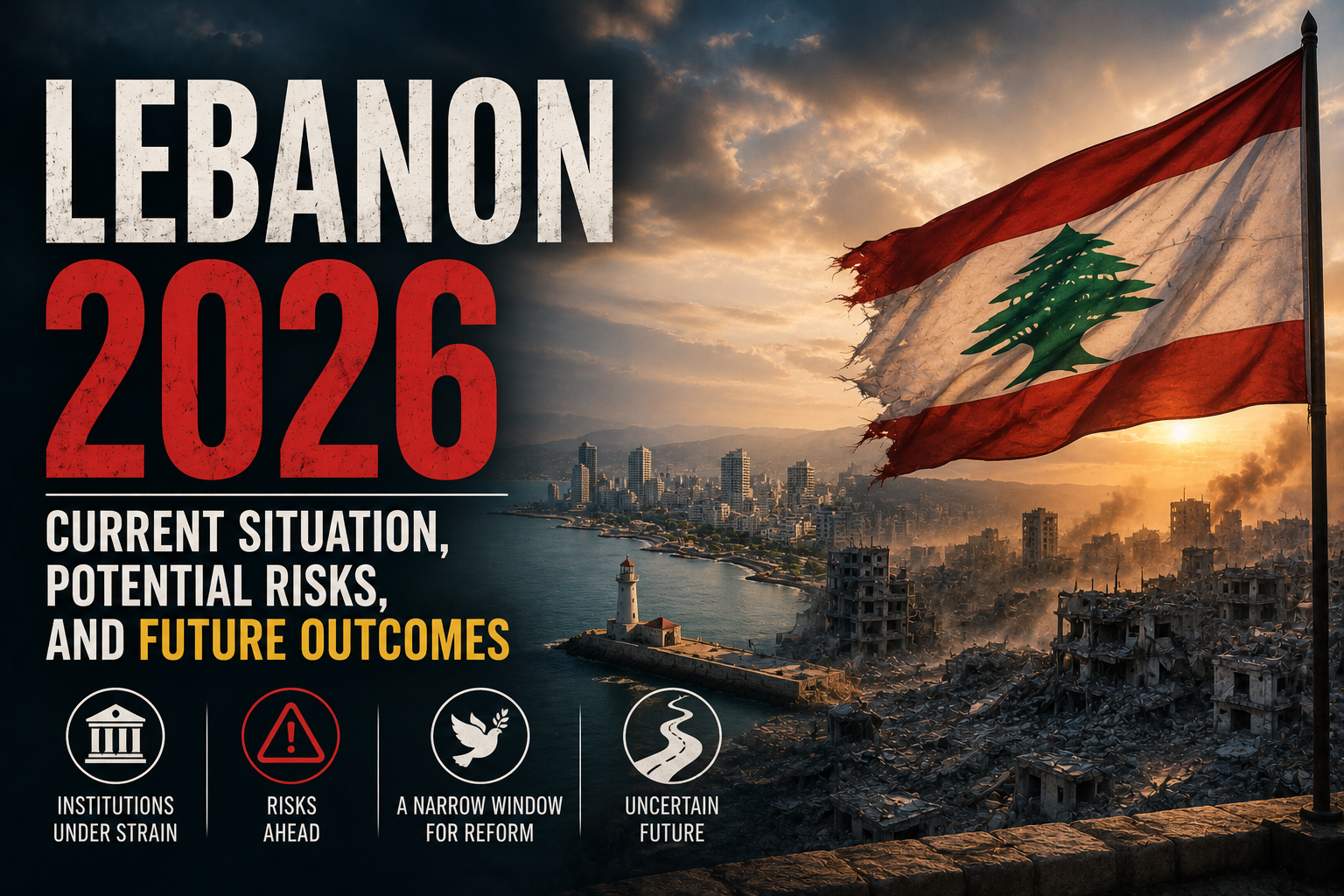
Lebanon is navigating the most consequential transition in its modern history — between the institutional collapse of the pre-2024 era, the devastation of the Hezbollah-Israel conflict, and the contested construction of a post-Hezbollah dominance political order. The window for genuine reform is narrow and the forces opposing it remain powerful
| The Short Answer: Where Does Lebanon Stand in May 2026?Lebanon in May 2026 is in an unstable transitional moment — better than its worst recent period, but far from stable. The ceasefire of November 2024 halted the most intensive phase of the Hezbollah-Israel conflict and created space for Lebanon’s first presidential election in over two years, forming a government under Prime Minister Nawaf Salam with an explicit reform mandate. But the structural conditions that produced Lebanon’s multiple simultaneous crises — the worst economic collapse in its modern history, the Beirut port explosion legacy, state institutional dysfunction, and Hezbollah’s parallel state — have not been addressed. Hezbollah is damaged but reconstructing. The Lebanese state is nominally functional but practically weak. The ceasefire is contested. And the regional environment — Gaza, Iran’s axis of resistance, Israeli readiness posture — means that Lebanon’s internal trajectory is not fully under Lebanese control. |
Lebanon’s situation in 2026 is the product of a decade-long accumulation of crises that arrived simultaneously and without the institutional capacity to manage any of them: the 2019 economic collapse, which wiped out the savings of the majority of the Lebanese middle class and produced the worst economic contraction in the country’s modern history; the August 2020 Beirut port explosion, which killed over 218 people, injured 7,000, and destroyed significant portions of the capital’s commercial and residential infrastructure; the COVID-19 pandemic, which compounded healthcare and economic stress in a system already under severe strain; the political paralysis produced by the sectarian power-sharing system’s inability to agree a president for over two years; and the 2024 Hezbollah-Israel conflict, which caused severe damage to southern Lebanon and the southern suburbs of Beirut and produced significant civilian displacement.
Against this backdrop, the election of Joseph Aoun as president in January 2025 and the formation of a government under Nawaf Salam — a judge and former ambassador to the UN with a reputation for independence from the traditional political establishment — represented the most significant positive political development in Lebanon in years. The Salam government has articulated an agenda of economic reform, institutional reconstruction, and assertion of Lebanese state sovereignty that, if implemented, would represent a meaningful break from the patterns that produced Lebanon’s crises. The obstacles to implementation are substantial and structural.
| 89%Share of the Lebanese population living below the poverty line at the peak of the economic crisis in 2021 — with the Lebanese lira having lost over 98% of its value against the dollar since 2019, wiping out private savings, public sector salaries, and pension values across the entire populationLebanon’s economic collapse is one of the most severe experienced by any non-conflict country in modern history. The World Bank characterised it as among the top three worst global economic crises since the mid-nineteenth century. The recovery, such as it exists, is partial and fragile: the banking sector remains non-functional for ordinary depositors, capital controls prevent the return of the estimated $6–8 billion in deposits frozen in Lebanese banks, and the exchange rate stabilisation achieved in 2023-24 rests on a structural fiscal adjustment that has not yet been sustained. |
Section I: The Economic Crisis — What Happened and Where Recovery Stands
Lebanon’s economic collapse was not a natural disaster or an external shock — it was the predictable consequence of a political economy model built on fundamental structural imbalances that were sustained for decades through capital inflows and creative accounting, and that collapsed catastrophically when those inflows stopped.
The model rested on three interconnected pillars: a fixed exchange rate between the Lebanese lira and the US dollar, maintained at 1,507 lira per dollar for over two decades; a financial system that attracted hard currency deposits from the Lebanese diaspora by offering above-market interest rates, then channelled those deposits to Banque du Liban and the Lebanese government to finance a public sector deficit and subsidise the peg; and a public sector whose employment, contracting, and subsidy systems distributed economic patronage along sectarian lines in exchange for political loyalty to the established parties. Each pillar supported the others, and each was unsustainable.
When the capital inflows that financed the peg slowed in 2019 — a consequence of declining diaspora remittances, regional capital outflows, and loss of confidence in the fiscal trajectory — the entire system collapsed rapidly. The lira lost 95% of its value, bank deposits became inaccessible, the fiscal deficit became unmanageable, and the social contract between the Lebanese state and the Lebanese population broke. The October 2019 uprising expressed a popular demand for systemic change that the political system proved unable to accommodate. The Beirut explosion of August 2020 deepened the crisis and destroyed whatever residual confidence in the state remained.
| “Lebanon’s economic collapse was not a crisis of competence — it was a crisis of system design. The political economy model that collapsed in 2019-20 was not an accident; it was the deliberate product of political choices made over decades to sustain a system of sectarian patronage at the cost of fiscal sustainability. Rebuilding Lebanon requires not just economic policy reform but a renegotiation of the political settlement that produced the economic model in the first place. That is a much harder problem.”— Dr. Ishac DiwanProfessor of Economics, Sciences Po Paris; former World Bank Country Director for Lebanon; lead author of multiple World Bank Lebanon economic assessments |
Section II: The Hezbollah Question — Damaged But Not Defeated
The 2024 conflict between Israel and Hezbollah — the most intense since the 2006 war, involving sustained Israeli airstrikes across southern Lebanon and the southern suburbs of Beirut, the targeted killing of Hezbollah’s senior leadership including Secretary-General Hassan Nasrallah, and significant damage to Hezbollah’s weapons infrastructure and command systems — has transformed Hezbollah’s position within Lebanon without resolving the fundamental question of its relationship to the Lebanese state.
Hezbollah entered the 2024 conflict as Lebanon’s most powerful political and military actor — with a weapons capability exceeding many state militaries, a parallel social services infrastructure that provided education, healthcare, and economic support to the Shia community, a political representation in the Lebanese parliament and government, and a deterrence function against Israeli military action that gave it a claim to legitimacy beyond sectarian politics. It exited the conflict significantly degraded: its secretary-general killed, much of its senior military and political leadership eliminated, its weapons stocks substantially depleted, and its social service infrastructure in southern Lebanon and the dahiye disrupted by physical destruction.
The reconstruction of Hezbollah is underway — Iran has been providing weapons, financing, and organisational support to rebuild the movement’s military capacity. But the reconstruction is occurring in a changed political environment. Lebanese political actors who previously accommodated Hezbollah’s parallel state under the implicit threat of its military capability are operating in a context where that capability, while still significant, is no longer overwhelming. The space for asserting Lebanese state sovereignty over southern Lebanon — through LAF deployment, through assertion of border security, through enforcement of UNSC Resolution 1701 — is larger than it has been since 2006. Whether the Salam government can use that space before Hezbollah’s reconstruction narrows it again is the central political question facing Lebanon.
| 1MILITARY | Hezbollah’s Military Reconstruction — Iran’s PriorityIran views Hezbollah as the most valuable component of its axis of resistance deterrence architecture — the force that can credibly threaten Israel’s north and impose costs on Israeli decision-making regarding Iran’s nuclear programme. The reconstruction of Hezbollah’s military capability is therefore a strategic priority for Iran, pursued through weapons transfers via Syria, financing for infrastructure repair in the dahiye, and support for the reconstitution of Hezbollah’s command structure under new leadership. Israel is monitoring this reconstruction and has signalled clearly that it will not permit restoration to pre-2024 capability levels — creating a dynamic in which Israeli strikes against reconstruction activities are periodic and expected. |
| 2POLITICS | Hezbollah’s Political Position — Constrained but PresentHezbollah retains significant political representation in the Lebanese parliament and its Shia constituent base remains largely intact — the social bond between Hezbollah and the Lebanese Shia community was not broken by the conflict, though it was tested. But the political environment has shifted: other Lebanese political forces are more willing to assert positions that challenge Hezbollah’s veto power over government formation, foreign policy, and security arrangements. The Salam government’s formation — which occurred without the paralysing accommodation of Hezbollah demands that characterised previous government formations — is the most visible indicator of this shift. |
| 3SOUTH | Southern Lebanon — LAF Deployment and the UNIFIL QuestionThe November 2024 ceasefire requires the deployment of Lebanese Armed Forces in southern Lebanon and Hezbollah’s withdrawal north of the Litani River. LAF deployment has proceeded, supported by French, US, and Saudi financial and equipment contributions, but is contested at the margins by Hezbollah’s continued presence in some areas. UNIFIL’s mandate and operational capacity has been under review, with questions about its ability to monitor ceasefire compliance in an environment where both Israel and Hezbollah challenge its operational freedom. The military equilibrium in the south is fragile and dependent on continued external support for the LAF. |
| 4DAHIYE | Reconstruction of Southern Suburbs — Social Reconstruction as Political LeverageIran and Hezbollah have been financing the reconstruction of the dahiye — the heavily Shia southern suburbs of Beirut that were extensively damaged in the 2024 conflict — in parallel with the Lebanese state’s own reconstruction efforts. This dual-track reconstruction dynamic reproduces the parallel state model that characterised pre-2024 Lebanon: the official Lebanese state, supported by international donors, provides some reconstruction; Hezbollah, supported by Iran, provides additional reconstruction tied to Hezbollah political loyalty. Breaking this model requires the Lebanese state to deliver reconstruction at a pace and quality that makes the Hezbollah alternative unnecessary — a demanding standard given current Lebanese institutional capacity. |
Section III: The Salam Government — Reform Window and Its Obstacles
Prime Minister Nawaf Salam’s government, formed in February 2025, represents the most reform-oriented Lebanese government since the Hariri era — with a programme that includes fiscal reform, banking sector restructuring, anti-corruption measures, and an explicit commitment to Lebanese state sovereignty over the entire Lebanese territory. The IMF has engaged constructively with the government on a potential programme, which would unlock significant international financial support conditional on reform implementation. Several Gulf states, including Saudi Arabia and the UAE, have signalled willingness to resume economic engagement with Lebanon under the Salam government after years of deliberate disengagement.
The obstacles to the reform agenda are structural and political. The fiscal reform required for an IMF programme involves measures — banking sector loss distribution, subsidy reform, tax system restructuring — that directly threaten the economic interests of the political establishment that has governed Lebanon for decades. That establishment has not disappeared; it retains significant parliamentary representation, institutional presence, and the ability to obstruct reform through legal, administrative, and political mechanisms that do not require forming a government. The banking sector, whose resolution is central to any sustainable recovery, has been the most effective opponent of loss distribution reform — using legal challenges, political pressure, and the threat of capital flight to prevent the allocation of losses to depositors and shareholders that a genuine restructuring would require.
The Hezbollah question intersects with the reform agenda in complex ways. A Lebanese state that successfully asserts sovereignty, builds effective institutions, and achieves economic recovery is a Lebanese state that no longer requires Hezbollah’s parallel social service infrastructure to provide what the official state cannot. This makes genuine state reconstruction a long-term challenge to Hezbollah’s domestic political model — which gives Hezbollah and its allies structural incentives to obstruct state reconstruction even as they nominally participate in it.
| Key Metrics for Lebanon’s Reform Trajectory in 2026IMF programme status: Discussions for an IMF programme remain ongoing but unconcluded — the banking sector loss distribution question and the fiscal reform pace have been the primary outstanding issues. An IMF programme would unlock approximately $3 billion in direct support and significantly larger amounts of associated international financing.LAF funding: The Lebanese Armed Forces, whose deployment in the south is central to the ceasefire architecture, requires approximately $1.2 billion annually in international support to maintain operational capacity. This support is currently being provided by the US, France, Saudi Arabia, and the EU — but on a short-term basis without the multi-year commitment the LAF requires for genuine institutional development.Reconstruction finance: International Conference for Lebanon (ICL) commitments of approximately $1 billion were made at the October 2024 Paris conference for immediate humanitarian and infrastructure reconstruction needs. Longer-term reconstruction finance — estimated at $10–15 billion — is conditional on IMF programme implementation and governance reforms that are not yet complete.Displaced persons return: Approximately 90,000 Lebanese displaced from southern Lebanon and the dahiye by the 2024 conflict have returned to their communities as of May 2026 — a partial return, with continued displacement in the most heavily damaged areas where reconstruction has not yet provided habitable conditions. |
Section IV: Future Scenarios — Three Trajectories for Lebanon
Lebanon’s future trajectory will be determined by the interaction of three variables: the pace and depth of state institutional reform under the Salam government; the trajectory of Hezbollah’s reconstruction and political repositioning; and the regional environment, particularly the Lebanon-Israel ceasefire stability and the Iran nuclear file. The combination of these variables produces three broad scenarios.
| AREFORM | Scenario A: Genuine Reform Trajectory (Possible, Requires Sustained Conditions)In this scenario, the Salam government implements sufficient fiscal and banking reform to conclude an IMF programme, unlocking international finance that enables meaningful reconstruction. LAF deployment in the south is sustained and progressively consolidates state authority. Hezbollah, constrained by its military degradation and the changed political environment, accepts a reduced domestic role — maintaining political representation without the parallel state infrastructure. Saudi Arabia, Qatar, and the Gulf states increase economic engagement. The reform coalition expands as economic recovery generates political dividends. This scenario requires: no return to major conflict in Lebanon; continued Israeli restraint on reconstruction activities; sustained Gulf financial engagement; and political leadership capable of maintaining reform momentum against establishment resistance. Probability: 20-25% over a 3-year horizon. |
| BSTALL | Scenario B: Reform Stall and Managed Fragility (Most Probable Near-Term)In this scenario, partial reforms are implemented sufficient to maintain international engagement without completing the structural transformations required for genuine recovery. The banking sector restructuring remains incomplete; fiscal reform advances at a pace that satisfies neither the IMF nor the Lebanese public; the LAF deployment stabilises the south without permanently resolving Hezbollah’s military presence. Lebanon remains in a condition of managed fragility — neither collapsing nor genuinely recovering — sustained by diaspora remittances, Gulf bilateral support, and international humanitarian finance. This scenario produces a Lebanon that is stable enough to avoid acute crisis but not functional enough to address the structural conditions that produced the crisis. Probability: 50-55% over a 3-year horizon. |
| CCONFLICT | Scenario C: Return to Conflict (Serious Risk)In this scenario, Israeli strikes against Hezbollah reconstruction activities escalate into a new military confrontation — either through Hezbollah response to Israeli strikes, through Hezbollah activation in response to Israeli military action against Iran, or through a miscalculation in the contested ceasefire environment of southern Lebanon. A new conflict would be devastating for Lebanon’s reform trajectory: it would halt reconstruction, freeze international financial engagement, reverse LAF deployment in the south, and potentially produce physical destruction on a scale that even exceeds the 2024 campaign. The Salam government’s reform mandate would not survive a return to major conflict. Probability: 25-30% over a 3-year horizon, concentrated in scenarios where the Iran nuclear file produces regional escalation. |
Frequently Asked Questions
| Who is Nawaf Salam and what does his government represent?Nawaf Salam is a Lebanese lawyer, judge, and diplomat who served as Lebanon’s ambassador to the United Nations from 2007 to 2017 and subsequently as a judge on the International Court of Justice. He was appointed prime minister in January 2025 following the election of Joseph Aoun as president — the first presidential election in over two years. Salam has no affiliation with Lebanon’s traditional sectarian political parties and has a reputation for independence, legal precision, and commitment to institutional reform. His government is the most explicitly reform-oriented Lebanese government in over two decades — though the gap between reform mandate and implementation capacity remains significant. |
| Is Lebanon’s economy recovering?Lebanon’s economy has stabilised from its worst phase — the lira has partially stabilised, some economic activity has resumed, and the Salam government has initiated reform processes with the IMF. But stabilisation is not recovery. The banking sector remains non-functional for ordinary depositors, with an estimated $6–8 billion in frozen deposits that cannot be accessed under current capital controls. Unemployment remains very high, emigration of educated Lebanese continues at significant rates, and the reconstruction needs from both the economic crisis and the 2024 conflict dwarf current financing capacity. Genuine economic recovery requires completing the banking sector restructuring, concluding an IMF programme, and maintaining political stability — none of which is secured. |
| What is the current status of Hezbollah in Lebanon?Hezbollah in May 2026 is significantly weaker militarily than before the 2024 conflict — its senior leadership including Nasrallah killed, its weapons stocks depleted, its infrastructure in southern Lebanon and the dahiye damaged. It remains, however, Lebanon’s most organised political and military actor, with significant parliamentary representation, a substantial social service infrastructure, and an ongoing reconstruction programme supported by Iran. Its relationship with the Lebanese state under the Salam government is contested — the government has asserted state sovereignty in ways previous governments did not, but Hezbollah retains the capacity to obstruct governance that it considers hostile to its interests. The trajectory is toward reduced but still significant Hezbollah presence in Lebanese political life. |
| What role does Saudi Arabia play in Lebanon’s recovery?Saudi Arabia was Lebanon’s most important external patron for much of the postwar period — providing financial support for the Lebanese state, hosting large Lebanese diaspora communities, and providing the political legitimacy for Sunni political leadership in Lebanon. Saudi Arabia’s deliberate disengagement from Lebanese affairs beginning around 2017 — in response to Hezbollah’s dominant position and what Riyadh assessed as Iranian control over Lebanese state decision-making — was a significant contributor to Lebanon’s political and economic isolation. The Salam government’s formation, the weakening of Hezbollah, and Lebanon’s new presidential leadership have created conditions for Saudi re-engagement that are being carefully cultivated — with significant financial implications if the engagement is sustained. |
| Could Lebanon return to civil war?A return to civil war on the scale of the 1975-1990 conflict is assessed as very unlikely — the Lebanese political system, however dysfunctional, has internalised the catastrophic costs of civil war in ways that create strong incentives against internal armed conflict between Lebanese factions. The more realistic risk is a return to external military conflict: a new Israel-Hezbollah war, triggered either by Hezbollah’s reconstruction reaching Israeli threshold levels or by regional escalation involving Iran. Such a conflict would be devastating for Lebanon but would likely remain an external conflict rather than a civil war, given the current domestic political configuration and Hezbollah’s weakened condition. |
Conclusion: The Narrow Window and the Cost of Missing It
Lebanon has a window in 2026 that it has not had in years — to implement the economic reforms that could produce genuine recovery, to consolidate state authority in the south while Hezbollah remains degraded, and to build the institutional foundations for a political system that does not depend on patronage, external patronage, or parallel armed forces to function. The window exists because the 2024 conflict altered the balance of forces in ways that have not yet been reversed, because the Salam government provides leadership with genuine reform credentials, and because the international community — Saudi Arabia, France, the United States, and international financial institutions — is prepared to provide financial and political support for reform that it was not prepared to provide under previous Lebanese governments.
The window is narrow. Hezbollah’s reconstruction is proceeding. The established political forces that benefit from the status quo are organising their resistance to reform. The regional environment — particularly the Iran nuclear file and the Gaza conflict’s unresolved political dimensions — could generate pressures that overwhelm Lebanon’s internal trajectory. And Lebanese state institutional capacity, after years of crisis, is not adequate to implement at the pace that the political window requires.
Whether Lebanon uses the window it has, or watches it close as previous windows have closed, will be determined not primarily by external factors but by Lebanese political choices — whether the reform coalition holds, whether the opposition to reform can be contained politically rather than accommodating, and whether the Lebanese public maintains pressure for the change that previous generations sought and did not achieve. The window exists. The outcome is not determined.
Lebanon in 2026 has a window it has not had in years. The question is whether its institutions, its leadership, and its politics are capable of using it — before the forces that closed every previous window succeed again.
Maritime Health Risks: The MV Hondius Hantavirus Outbreak and Its Implications


