


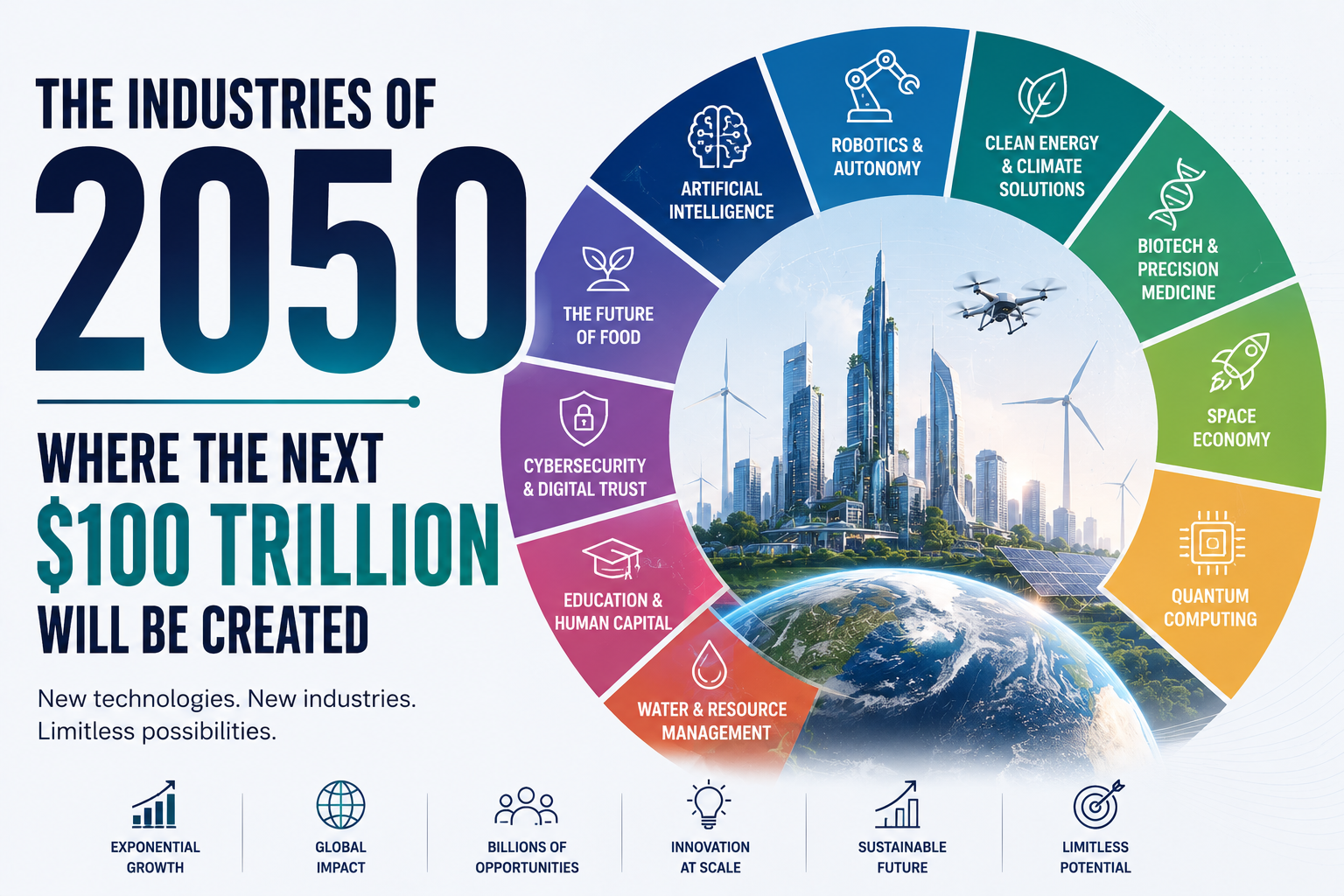
The Biggest Wealth Creation Opportunity in Human History
Every era has industries that define its prosperity.
The nineteenth century belonged to railways, steel, and manufacturing.
The twentieth century was shaped by oil, automobiles, aviation, telecommunications, and finance.
The early twenty-first century witnessed the rise of the internet, smartphones, cloud computing, and artificial intelligence.
By 2050, however, the global economy could look almost unrecognizable.
The world’s population is expected to approach 10 billion.
Artificial intelligence will automate millions of routine tasks.
Climate change will reshape infrastructure and energy systems.
Healthcare will become increasingly personalized.
Humanity may establish a permanent industrial presence in space.
Digital economies may rival physical ones.
The next wave of wealth creation will not come from a single breakthrough.
It will emerge from multiple industries converging at the same time.
The next $100 trillion in economic value is unlikely to be created by the companies that dominate today.
It will belong to those building the industries of tomorrow.
Artificial Intelligence: The World’s Largest Productivity Engine
Artificial intelligence is rapidly becoming the foundation of every industry.
Unlike previous technologies, AI is not creating a single market.
It is transforming every market.
Manufacturing.
Healthcare.
Education.
Agriculture.
Finance.
Law.
Engineering.
Entertainment.
Government.
AI will increasingly perform routine analysis, automate decision-making, optimize logistics, accelerate scientific research, and create entirely new products and services.
Future economic leaders will not simply develop AI.
They will build businesses around AI-native operations.
By 2050, AI may become as essential to economic activity as electricity became during the twentieth century.
Robotics and Autonomous Systems
Automation is entering a new phase.
Industrial robots are becoming more intelligent.
Service robots are entering healthcare, hospitality, logistics, and retail.
Autonomous vehicles are transforming transportation.
Autonomous drones are changing agriculture, emergency response, and infrastructure inspection.
Factories of the future may operate with minimal human intervention.
Warehouses may become almost entirely autonomous.
Construction sites could increasingly rely on robotic equipment.
Countries facing labor shortages will accelerate automation.
Robotics will become not merely an efficiency tool but an economic necessity.
Clean Energy and the Net-Zero Economy
The transition to cleaner energy represents one of the largest investment opportunities in modern history.
Solar.
Wind.
Advanced nuclear.
Hydrogen.
Battery storage.
Carbon capture.
Smart grids.
Energy efficiency.
The future energy economy extends far beyond electricity generation.
Entire industries are emerging around energy storage, grid management, sustainable transportation, and industrial decarbonization.
Countries that dominate clean energy technologies may become the industrial leaders of the twenty-first century.
Energy independence is increasingly becoming a strategic advantage.
Biotechnology and Precision Medicine
Healthcare is shifting from treatment toward prediction and prevention.
Advances in genomics, artificial intelligence, regenerative medicine, and biotechnology are transforming medicine.
Future healthcare may increasingly focus on personalized therapies tailored to individual genetic profiles.
Gene editing.
Synthetic biology.
Lab-grown organs.
Regenerative medicine.
Advanced diagnostics.
Longevity research.
These technologies could fundamentally change human health and life expectancy.
The biotechnology industry may become one of the defining economic sectors of the coming decades.
Space: The Next Industrial Frontier
Space is no longer the exclusive domain of governments.
Private investment is accelerating.
Satellite networks.
Space-based communications.
Earth observation.
Launch services.
Space manufacturing.
Asteroid resource exploration.
Lunar infrastructure.
Future economic activity may increasingly extend beyond Earth’s atmosphere.
The global space economy could become one of the fastest-growing sectors of the century.
Space will increasingly support industries on Earth while creating entirely new markets beyond it.
Quantum Computing
Classical computers transformed the digital economy.
Quantum computing could transform scientific discovery.
Problems that currently require years of computation may eventually be solved in minutes.
Drug discovery.
Financial modeling.
Climate simulation.
Advanced materials.
Optimization.
Cybersecurity.
Quantum technologies remain in their early stages.
But their long-term implications could rival those of the internet itself.
Countries investing early may gain enormous technological advantages.
The Future of Food
Feeding nearly 10 billion people requires agricultural transformation.
Climate change.
Water scarcity.
Urbanization.
Population growth.
Changing consumer preferences.
These pressures are accelerating innovation.
Vertical farming.
Precision agriculture.
Autonomous farming equipment.
Alternative proteins.
Cultivated meat.
AI-driven crop management.
Food biotechnology.
Agriculture is evolving into one of the world’s most technologically advanced industries.
Future farms may resemble data centers more than traditional fields.
Climate Adaptation: Building a Resilient World
The economic effects of climate change are creating entirely new industries.
Climate adaptation is becoming an investment category in its own right.
Flood protection.
Water management.
Climate-resilient infrastructure.
Disaster forecasting.
Wildfire technologies.
Heat-resistant construction.
Insurance innovation.
Cities will increasingly invest in resilience rather than simply recovery.
Climate adaptation may become as economically important as climate mitigation.
Protecting infrastructure could become one of the century’s largest construction markets.
Cybersecurity and Digital Trust
As economies become increasingly digital, cybersecurity becomes fundamental infrastructure.
Artificial intelligence creates new opportunities.
It also creates new threats.
Critical infrastructure.
Financial systems.
Healthcare networks.
Governments.
Businesses.
Personal identities.
Everything connected to the internet requires protection.
Cybersecurity is evolving from an information technology function into a national security priority.
Digital trust may become one of the most valuable economic assets.
The Creator Economy and Digital Experiences
The internet transformed information.
Artificial intelligence and immersive technologies may transform experience itself.
Virtual worlds.
Augmented reality.
Digital education.
Interactive entertainment.
Personal AI assistants.
Digital commerce.
Creator platforms.
Future consumers may spend increasing portions of their lives in hybrid digital-physical environments.
Economic value will increasingly be created through experiences rather than ownership.
Attention itself may become one of the world’s most valuable resources.
Water: The Resource Economy
Water is becoming one of the defining strategic resources of the twenty-first century.
Growing populations, climate change, and industrial demand are increasing pressure on freshwater supplies.
This challenge is creating new industries.
Desalination.
Water recycling.
Smart irrigation.
Leak detection.
Water purification.
Infrastructure modernization.
Countries capable of securing sustainable water supplies may gain important economic and geopolitical advantages.
Water technology could become one of the century’s fastest-growing industrial sectors.
Education and Human Capital
Technology changes quickly.
Skills become obsolete even faster.
Continuous learning is becoming essential.
Artificial intelligence tutors.
Personalized education.
Virtual classrooms.
Professional reskilling.
Lifelong learning platforms.
Education is shifting from a one-time experience to a lifelong service.
Countries investing in human capital may gain competitive advantages that extend across every industry.
Talent will increasingly determine economic success.
Why Geography Will Matter Less
The industries of 2050 will be less constrained by geography.
Artificial intelligence can operate anywhere.
Digital businesses scale globally.
Remote work expands access to talent.
Cloud computing reduces infrastructure barriers.
Capital increasingly flows toward innovation rather than location.
The most valuable companies of 2050 may be born in cities that today receive little international attention.
Innovation ecosystems will matter more than national borders.
Talent will become the world’s most important natural resource.
Frequently Asked Questions
Which industry could create the most economic value by 2050?
Artificial intelligence is likely to become the largest productivity driver because it enhances virtually every sector of the economy rather than operating as a standalone industry.
Will traditional industries disappear?
No. Manufacturing, finance, healthcare, agriculture, and energy will remain essential but will become increasingly technology-driven and digitally integrated.
Why is climate adaptation becoming an industry?
Governments and businesses must invest in infrastructure, water security, disaster resilience, and environmental protection as climate risks increase.
Could the space economy become commercially significant?
Yes. Satellite services, launch systems, communications, Earth observation, and future space manufacturing are expected to create substantial new markets.
Which skills will matter most by 2050?
Adaptability, digital literacy, AI collaboration, creativity, engineering, critical thinking, entrepreneurship, and lifelong learning will become increasingly valuable.
The Greatest Economic Transformation Yet
The industries of 2050 will not simply replace today’s economy.
They will redefine it.
Artificial intelligence will transform productivity.
Biotechnology will reshape healthcare.
Clean energy will power new industrial systems.
Robotics will change manufacturing.
Quantum computing will accelerate scientific discovery.
Climate adaptation will become essential infrastructure.
Space will evolve into an economic frontier.
Together, these industries could generate economic value on a scale rarely witnessed in history.
The next $100 trillion will not be created by following yesterday’s business models.
It will belong to those solving tomorrow’s problems.
History remembers every industrial revolution by the technologies it introduced.
The coming revolution may be remembered by something even more significant.
It will redefine how humanity works, produces, heals, learns, travels, and lives.
The race toward 2050 has already begun.
And the world’s next economic superpowers may be those building industries that barely exist today.


