


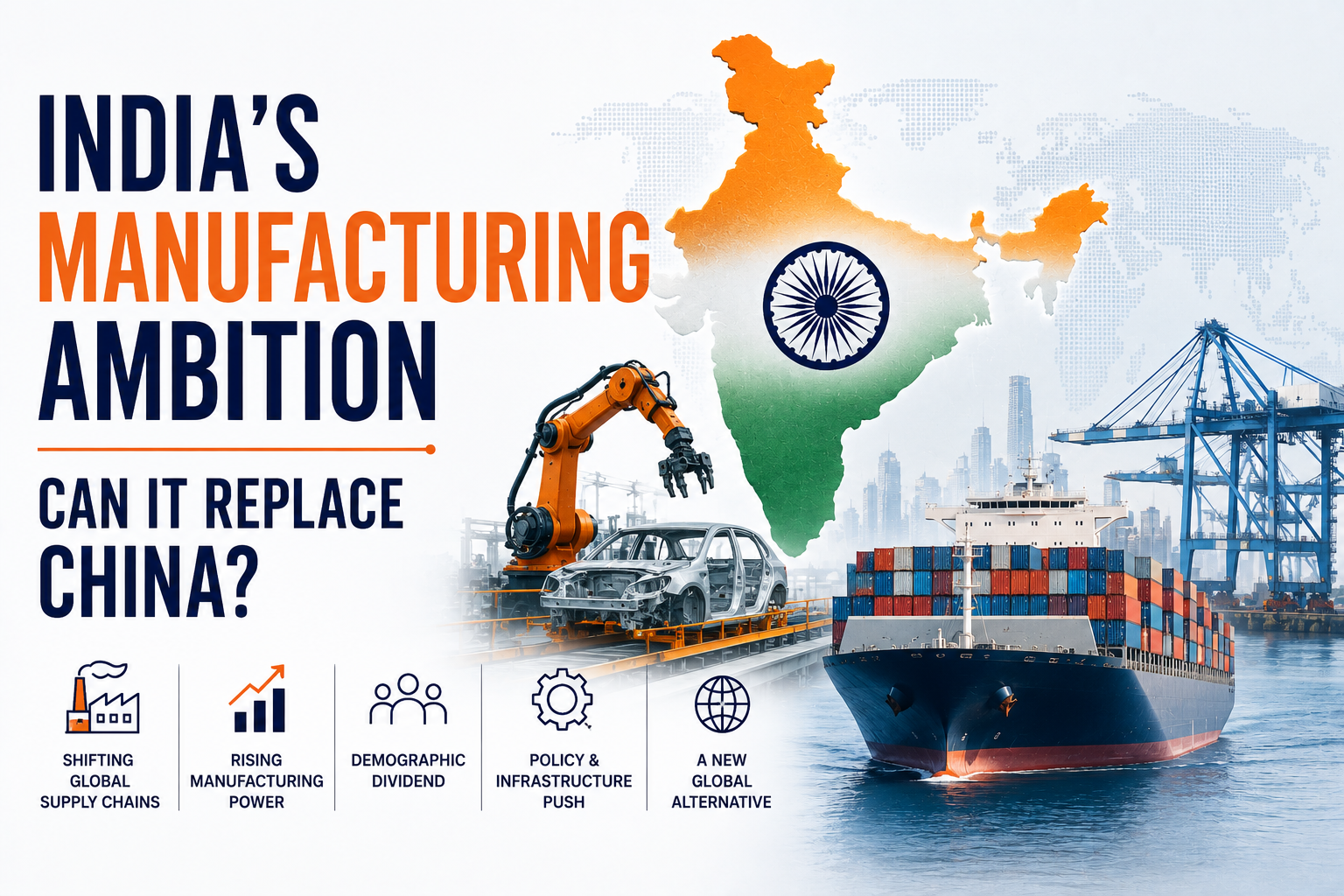
The Factory of the Future?
For more than three decades, one phrase has defined global manufacturing:
Made in China.
From smartphones and automobiles to clothing, electronics, machinery, and solar panels, China became the world’s factory by combining scale, infrastructure, skilled labor, and efficient supply chains.
Few countries in modern history have transformed manufacturing as successfully.
Today, however, the global industrial landscape is beginning to shift.
Rising labor costs in China, geopolitical tensions, supply chain disruptions, and the growing desire among multinational companies to diversify production have created an unprecedented opportunity for other manufacturing destinations.
At the center of that conversation is India.
With the world’s largest population, a rapidly expanding economy, improving infrastructure, and ambitious industrial policies, India is increasingly positioning itself as the next global manufacturing powerhouse.
The question is no longer whether India can manufacture more.
It is whether India can replace China.
The answer is both more complicated—and more interesting—than many headlines suggest.
Why the World Is Looking Beyond China
China’s manufacturing dominance remains extraordinary.
It produces everything from basic consumer goods to advanced electronics, electric vehicles, industrial machinery, and renewable energy technologies.
Its supplier ecosystem has few equals.
Yet several structural changes are encouraging companies to diversify.
Labor costs have steadily increased.
Trade tensions have intensified.
Export restrictions have expanded.
Supply chain disruptions exposed vulnerabilities during the pandemic.
The growing strategic rivalry between the United States and China has also prompted businesses to rethink excessive dependence on a single manufacturing base.
The result is not necessarily a departure from China.
It is a search for alternatives.
The Rise of the “China Plus One” Strategy
Rather than abandoning China altogether, multinational corporations are increasingly adopting what has become known as the China Plus One strategy.
The objective is straightforward.
Maintain operations in China while expanding production into other countries.
This approach reduces geopolitical risk, improves supply chain resilience, and creates greater operational flexibility.
India has emerged as one of the strongest beneficiaries of this trend.
Global manufacturers increasingly view the country not merely as an export base but also as one of the world’s largest consumer markets.
That combination is exceptionally rare.
India’s Competitive Advantages
India possesses several structural strengths that make it attractive for manufacturing.
A Young Workforce
India has one of the world’s youngest populations.
Millions of workers enter the labor force every year.
As aging populations reduce labor availability in several advanced economies, India’s demographic profile becomes increasingly valuable.
A Massive Domestic Market
Unlike many export-driven manufacturing economies, India offers scale at home.
A growing middle class is creating demand for automobiles, electronics, appliances, healthcare products, and consumer goods.
Manufacturers can serve both domestic and international markets simultaneously.
Improving Infrastructure
Over the past decade, India has invested heavily in highways, ports, airports, freight corridors, industrial parks, and digital infrastructure.
While significant gaps remain, logistics efficiency continues to improve.
Better connectivity reduces transportation costs and strengthens manufacturing competitiveness.
Digital Transformation
India’s digital public infrastructure has simplified payments, taxation, business registration, and financial inclusion.
Manufacturers increasingly benefit from digital governance systems that improve transparency and reduce administrative friction.
Digital transformation is becoming an important competitive advantage.
Manufacturing Sectors Driving Growth
India’s manufacturing ambitions extend well beyond traditional industries.
Several sectors are experiencing rapid expansion.
Electronics
Smartphone manufacturing has grown dramatically as global companies expand production in India.
The country is increasingly becoming an important assembly and export hub.
Automobiles and Electric Vehicles
India already possesses one of the world’s largest automobile industries.
Electric mobility is creating opportunities across batteries, components, charging infrastructure, and vehicle manufacturing.
Pharmaceuticals
India remains one of the world’s leading producers of generic medicines.
Future growth increasingly includes biotechnology, advanced pharmaceuticals, and medical devices.
Defense Manufacturing
Domestic defense production has become a strategic priority.
Expanding local manufacturing reduces import dependence while creating opportunities for exports.
Renewable Energy
Solar equipment, batteries, green hydrogen technologies, and clean energy components represent important future manufacturing sectors.
The global energy transition creates significant long-term opportunities.
The Challenges India Must Overcome
Replacing China requires more than ambition.
China’s manufacturing ecosystem was built over several decades.
Its advantages extend beyond labor costs.
Supplier networks.
Industrial clusters.
Deep logistics systems.
Efficient ports.
Large-scale engineering capabilities.
Advanced manufacturing expertise.
India still faces important challenges.
Land acquisition remains complex.
Regulatory processes can vary across states.
Power reliability continues improving but remains uneven in some regions.
Skill development must accelerate.
Manufacturing productivity needs further improvement.
Reducing logistics costs remains an important objective.
These are not insurmountable obstacles.
But addressing them consistently will determine whether India achieves its ambitions.
Can India Match China’s Scale?
Scale represents China’s greatest advantage.
Its manufacturing ecosystem allows companies to source thousands of components within relatively short distances.
Entire industrial cities specialize in specific products.
This creates extraordinary efficiency.
India is building similar ecosystems, but they remain in earlier stages.
Rather than replacing China immediately, India is more likely to complement it.
Different countries will increasingly specialize in different segments of global manufacturing.
The future is likely to be distributed rather than dominated by a single industrial superpower.
The Global Supply Chain Shift
The transformation of manufacturing is not driven solely by economics.
It is increasingly shaped by geopolitics.
Governments now view semiconductors, pharmaceuticals, batteries, telecommunications equipment, and critical minerals as matters of national security.
Supply chains are becoming strategic assets.
This shift favors countries capable of providing political stability, large markets, skilled labor, and reliable infrastructure.
India’s strategic position has become considerably stronger because of this changing environment.
The country is increasingly viewed as an essential partner in building resilient global supply chains.
Why Success Matters Beyond India
India’s manufacturing ambitions extend far beyond its own economy.
If successful, they could reshape global trade.
Reduce concentration risk.
Diversify production.
Create millions of jobs.
Strengthen supply chain resilience.
Accelerate industrial development across South Asia.
Provide businesses with greater manufacturing flexibility.
The emergence of another large-scale manufacturing hub would fundamentally change globalization itself.
Instead of relying overwhelmingly on one country, global production could become more balanced and geographically diversified.
Frequently Asked Questions
Can India replace China as the world’s manufacturing hub?
India has the potential to become one of the world’s leading manufacturing centers, but replacing China entirely is unlikely in the near future. The more probable outcome is a diversified global manufacturing system where India plays a much larger role alongside China and other emerging economies.
Why are companies expanding manufacturing in India?
Businesses are seeking supply chain diversification, access to India’s large domestic market, competitive labor availability, improving infrastructure, and reduced geopolitical risk.
Which industries could drive India’s manufacturing growth?
Electronics, semiconductors, automobiles, electric vehicles, pharmaceuticals, renewable energy equipment, defense manufacturing, textiles, and industrial machinery are among the sectors with strong long-term potential.
What remains India’s biggest challenge?
Building integrated supplier ecosystems, improving logistics efficiency, expanding skilled labor, simplifying regulations, and increasing manufacturing productivity remain key priorities.
Will China lose its manufacturing dominance?
China is expected to remain one of the world’s largest manufacturing powers for many years. The future is likely to involve manufacturing diversification rather than wholesale replacement.
The Future Is Not About Replacement—It’s About Diversification
The debate often asks the wrong question.
Can India replace China?
Perhaps the better question is:
Can the world continue relying so heavily on a single manufacturing hub?
Increasingly, the answer appears to be no.
The future of global manufacturing is unlikely to belong to one country alone.
It will belong to networks of resilient production spread across multiple regions.
India is exceptionally well positioned to become one of the pillars of that new industrial landscape.
Its demographics, market size, digital transformation, infrastructure investment, and geopolitical importance provide a foundation few countries can match.
Whether India becomes the world’s largest manufacturing economy remains uncertain.
Whether it becomes one of its most important manufacturing powers appears increasingly likely.
The next chapter of globalization will not be written by replacing one factory with another.
It will be written by building a more diversified, resilient, and interconnected manufacturing world.
And India is poised to be one of its principal architects.


