


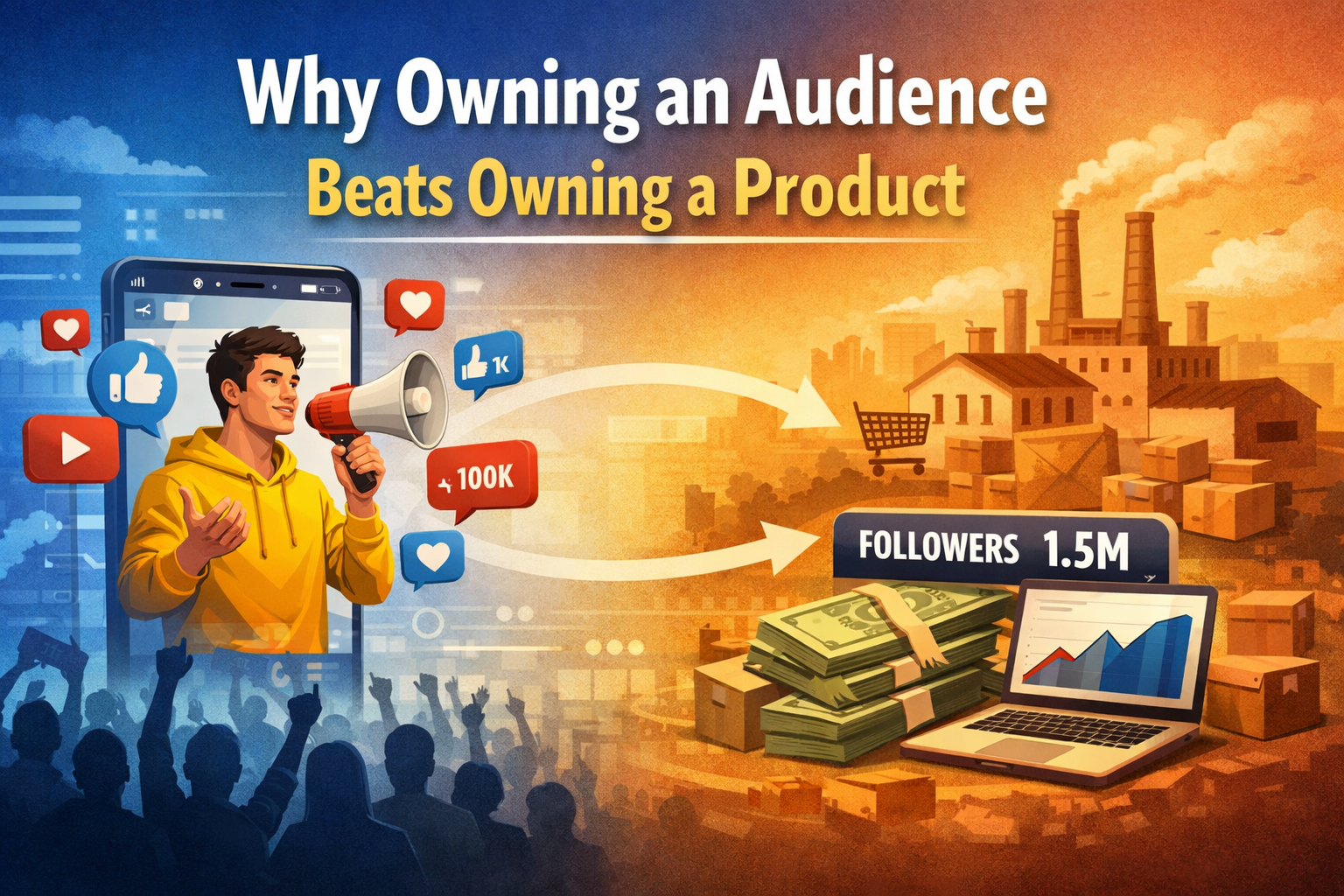
The traditional business model was largely dependent on the physical distribution of products to retail stores and fighting for shelf space to maximise their reach. Whoever could manufacture the most amount of inventory and get into all stores was the one who bloomed in the market. This trend slowly shifted to a fight for maximum amount of screen time on television advertisements and ultimately into a fight for the most viral social media accounts. As the popularity of social media apps like Instagram, TikTok and X grew, so did the businesses’ efforts to get the greatest number of views. As of early 2026, there are approximately 5.66 billion active social media users worldwide, spending over 2.5 hours daily across more than 7 different platforms.
Access to such a significant amount of reach with just a thirty-second video meant that the fight was no longer about manufacturing and supply chain, but rather about having the best social media marketing. This shift significantly lowered the initial capital required to reach a large audience, thereby greatly increasing the confidence and ability of young entrepreneurs to reach new heights by amassing an online audience who watches their content and views their products for free. Succeeding in the business world shifted from owning factories to owning attention.
Businesses fight for attention and not for shelf space. Companies hire the so-called Gen Z to create the most out-of-the-box and quirky videos for their social media handles. This is vastly different from the traditional concept of making advertisements which were rather formal and not controversial. Companies such as Ryanair, an Irish airline known for their cheap flights and cost-saving practices, has learnt to embrace its image and create memes on the very same topics to attract the attention of the younger generation. Their social media team creates short-form comedy sketches, comments on various viral videos and participates in heated online exchanges, all to gain popularity and the attention of the masses. It has been highly successful for the airline as they have managed to gain almost 2 million followers on their Instagram page and have since seen a large increase in passenger traffic. Ryanair is just one such example of a huge array of businesses that have reduced their customer acquisition cost and boosted sales by having an online presence.
This shift towards attention is part of a larger phenomenon often referred to as the “attention economy”, where human attention has become the most valuable and scarce resource. While products can be manufactured at scale and content can be produced endlessly, the time and attention of consumers remain limited. This creates an environment where businesses are no longer competing on the basis of who can produce more, but rather who can capture and retain attention more effectively. Algorithms on platforms are designed to reward engagement, which further amplifies content that resonates with audiences, giving businesses with strong audience understanding a disproportionate advantage. In such a landscape, the ability to consistently capture attention becomes a far more powerful asset than the ability to simply create a product. Companies that fail to adapt to this shift risk becoming invisible, regardless of the quality of what they offer.
Having an audience before launching a product into the market meant that one would not have to start from scratch and go door to door handing out free samples to gain popularity and depend on word of mouth. Thus, having a social media following prior to launching meant that the business had a readymade market for their products and they would not be spending heavily on ads to acquire customers. It would also enable the business owner to generate revenue from multiple sources — online courses, video monetisation and digital products, to name a few.
Another crucial advantage of owning an audience lies in the reduction of customer acquisition cost, often referred to as CAC in business terms. Traditional companies spend a significant portion of their budget on advertising campaigns, influencer collaborations and promotions just to reach potential customers. This makes scaling both expensive and uncertain. In contrast, a business with an established audience already possesses direct access to its consumers, allowing it to market products at little to no additional cost. This transforms distribution into a competitive moat. While products can often be replicated or improved upon by competitors, an engaged audience built over time is far more difficult to duplicate. This is why many modern businesses prioritise building distribution channels through content before even finalising their product offerings. In essence, controlling distribution through an audience provides a long-term strategic advantage that goes beyond any single product.
Modern customers are more sceptical of ads since the onset of AI-generated videos being used as ads. Having a business owner themselves marketing and showcasing the products online would instil confidence and trust in the buyer. It would add a personal touch to the act of purchasing the product, since the customer has been a part of the business and has viewed all aspects of it through the videos. It has also been observed that customers tend to buy products that are recommended by their favourite social media influencers. This trend of consumerism has led a lot of influencers to start their own businesses, and these brands often tend to outperform traditional ones even though they might sell similar or even weaker products. YouTuber MrBeast is one such example. He built a huge online community through his YouTube videos and eventually expanded into the food and beverage industry, even opening physical outlets for his burger brand.
This phenomenon is also deeply rooted in consumer psychology. Audiences develop what are known as parasocial relationships with creators, where repeated exposure to a person’s content creates a sense of familiarity and trust, even without direct interaction. Over time, this familiarity translates into credibility, making audiences far more receptive to recommendations. Unlike traditional advertisements, which are often perceived as intrusive or manipulative, content created by individuals feels authentic and relatable. As a result, when a creator introduces a product, it is seen less as a sales pitch and more as a personal endorsement. This shift in perception plays a significant role in driving higher conversion rates for audience-led businesses, further reinforcing the idea that trust, not just visibility, is a key driver of modern consumer behaviour.
As we move forward, the line between an influencer and an entrepreneur seems to be disappearing, as a significant proportion of influencers have started their own brands and a lot of entrepreneurs have started creating content online to try and boost their sales and gain a social media following. This shows us that having an audience has become infinitely more important than having large amounts of capital when starting a venture. With an audience, a person can create more relationships, stumble upon greater opportunities and most importantly raise funds. A large following not only gives the business owner more reach but also gives them credibility. Angel investors tend to prefer founders with audiences because it significantly reduces one of the biggest risks in early-stage investing, which is uncertain demand. A founder with a strong following does not need to question whether a product will work; they can validate their ideas in real time, take feedback and even implement customer suggestions before launching a product into the market. Amassing an audience acts as a powerful signal of credibility; if a founder manages to constantly attract and retain attention on various platforms, it demonstrates their understanding of consumer behaviour, branding and communication. For investors, this translates into a much more secure investment with a much lower burn rate and a higher probability of traction as compared to investing in a startup with no online presence.
Brands like Bluorng and Benne exemplify how modern businesses are increasingly built on audience and cultural relevance rather than just product design. Their growth is not driven solely by the quality of their product, but by the strong communities and identities they have cultivated online. By consistently engaging their audience through curated content, aesthetic positioning and daily vlogs, these brands create anticipation and a sense of belonging that translates directly into demand. This audience-first approach allows them to generate organic hype, reduce reliance on traditional advertising, and achieve high conversion rates during launches. In essence, their success demonstrates that in today’s market, it is not just about what you sell, but how deeply your audience connects with what you represent.
However, it is important to recognise that not all audiences are truly owned. Followers on platforms are essentially rented access, subject to algorithm changes and platform policies. A sudden shift in visibility rules can drastically reduce reach overnight, impacting businesses that rely solely on these platforms. This has led to an increasing emphasis on building owned channels such as email lists, private communities and direct customer databases. These channels allow businesses to maintain a direct line of communication with their audience, independent of external platforms. In the long run, the true value lies not just in building an audience, but in converting that audience into a community that can be reached and engaged with consistently.
The most effective business model going forward is not choosing between an audience or a product, it is to sequence them correctly. It is thereby necessary that one uses these platforms to create meaningful relationships with their customers, who will follow them even if these platforms cease to exist. We are heading towards an economy where visibility drives value, influence drives sales and having an audience drives success, but this does not mean that products will not matter; they would still need to excel at the traditional trust factors of quality and value for money.
Business Contributor

Amaan Siddique is a 22-year-old author and emerging voice in the real estate and entrepreneurship landscape. With a focused interest in market dynamics, business strategy, and the evolving nature of modern enterprise, his work reflects a blend of analytical thinking and practical insight.
He is the author of four Amazon bestselling books—RERA Simplified, Mumbai Housing Compass, Homebuyers Handbook, and Real Estate Dictionary. His writing is centred on demystifying real estate for a broader audience, translating regulatory frameworks and market complexities into clear, accessible narratives for both first-time buyers and informed investors.
Beyond real estate, Amaan’s interests extend to entrepreneurship and the structural shifts shaping contemporary business models. His perspective is grounded in a keen understanding of how industries are adapting to changing consumer behaviour and digital transformation. Through his writing, he seeks to contribute to more informed decision-making and a deeper public understanding of real estate as both an economic sector and a long-term asset class.
Also Read: The Fragmentation of the Internet


