


Why the Netherlands Works—Until It Doesn’t
In the competition for global talent, Netherlands occupies a distinctive position. It does not attract workers through size, cheap labour, or sprawling megacities. Instead, it draws talent through efficiency—of movement, administration, and daily life.
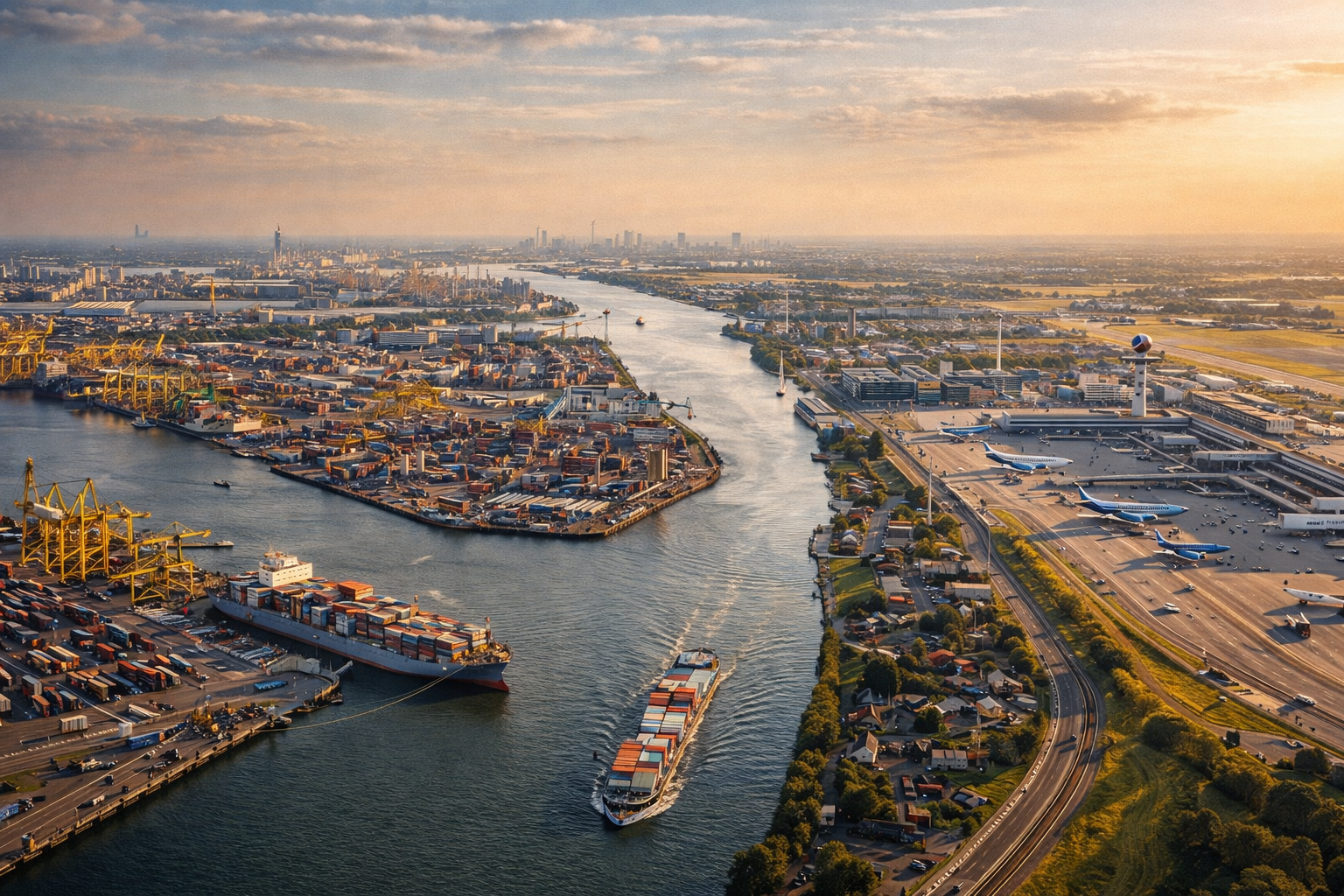
The Dutch model is logistics-first: built around ports, airports, waterways, and digital governance systems that reduce friction for businesses and workers alike. For much of the past two decades, this efficiency has made the Netherlands one of Europe’s most effective workforce magnets. Today, however, that same success is testing the country’s physical and political limits.
Infrastructure Built for Flow, Not Scale
Ports, Airports, and Inland Waterways
The Netherlands punches far above its weight in global trade because of its infrastructure density.
- One of the world’s most advanced seaports, serving as Europe’s primary maritime gateway
- A major international aviation hub supporting both passenger and cargo traffic
- An extensive inland waterways network linking ports to industrial and agricultural regions
This system allows goods—and workers—to move quickly across borders and within the country, reinforcing the Netherlands’ role as a European distribution and coordination hub.
Compact Geography, Low Commuting Friction
Geography amplifies infrastructure.
The Netherlands’ compact size means:
- Short commuting times even between cities
- National labour markets that function almost as a single urban zone
- Greater flexibility for workers to live outside major centres while remaining connected
For skilled migrants and professionals, this translates into quality-of-life efficiency—a powerful, often underestimated draw.
Digitised Government as an Economic Asset
One of the Netherlands’ most decisive advantages lies not in concrete or steel, but in software.
- Highly digitised public services
- Efficient tax, registration, and compliance systems
- Predictable regulatory processes for businesses and workers
For global firms and international professionals, administrative clarity reduces onboarding time and operational uncertainty. In a European context, this places the Netherlands among the easiest countries in which to start work and scale operations.
Who the Netherlands Attracts
The Dutch workforce pull is sector-specific and skill-heavy.
Key Workforce Groups
- Logistics and supply-chain professionals
- Technology and data specialists
- Finance and professional services workers
- Agri-tech and food-systems experts
- Knowledge workers supporting regional headquarters
The country’s role as a coordination and services hub—rather than a mass manufacturing base—shapes this profile.
A Hub for Regional, Not Just National, Careers
Many professionals use the Netherlands as:
- A base for European operations
- A headquarters location serving multiple markets
- A transit point in international careers
This reinforces the country’s attractiveness—but also accelerates demand for housing and urban services.
Constraints: When Efficiency Meets Capacity
Severe Housing Pressure
The Netherlands’ most acute constraint is housing.
- Chronic shortages in Amsterdam, Rotterdam, Utrecht, and The Hague
- Rising rents affecting both locals and migrants
- Limited land availability constraining rapid expansion
Housing scarcity has become the primary bottleneck in workforce absorption.
Political Pushback on Migration Volumes
As capacity tightens, politics follows.
- Growing resistance to high migration numbers
- Pressure on governments to limit inflows
- Public debate shifting from economic need to social capacity
This does not end the Netherlands’ appeal—but it narrows the margin for further growth.
Editorial Takeaway: Maximum Efficiency, Finite Space
The Netherlands attracts talent exceptionally well. Its infrastructure, governance, and geography allow workers and businesses to operate with minimal friction—often better than anywhere else in Europe.
Yet the model is approaching its natural limits. Unlike larger states, the Netherlands cannot endlessly scale housing, land, or political consensus. The result is a country that remains highly attractive—but increasingly selective by necessity.
In Europe’s workforce landscape, the Netherlands is not the biggest absorber. It is the most efficient one nearing capacity.


