


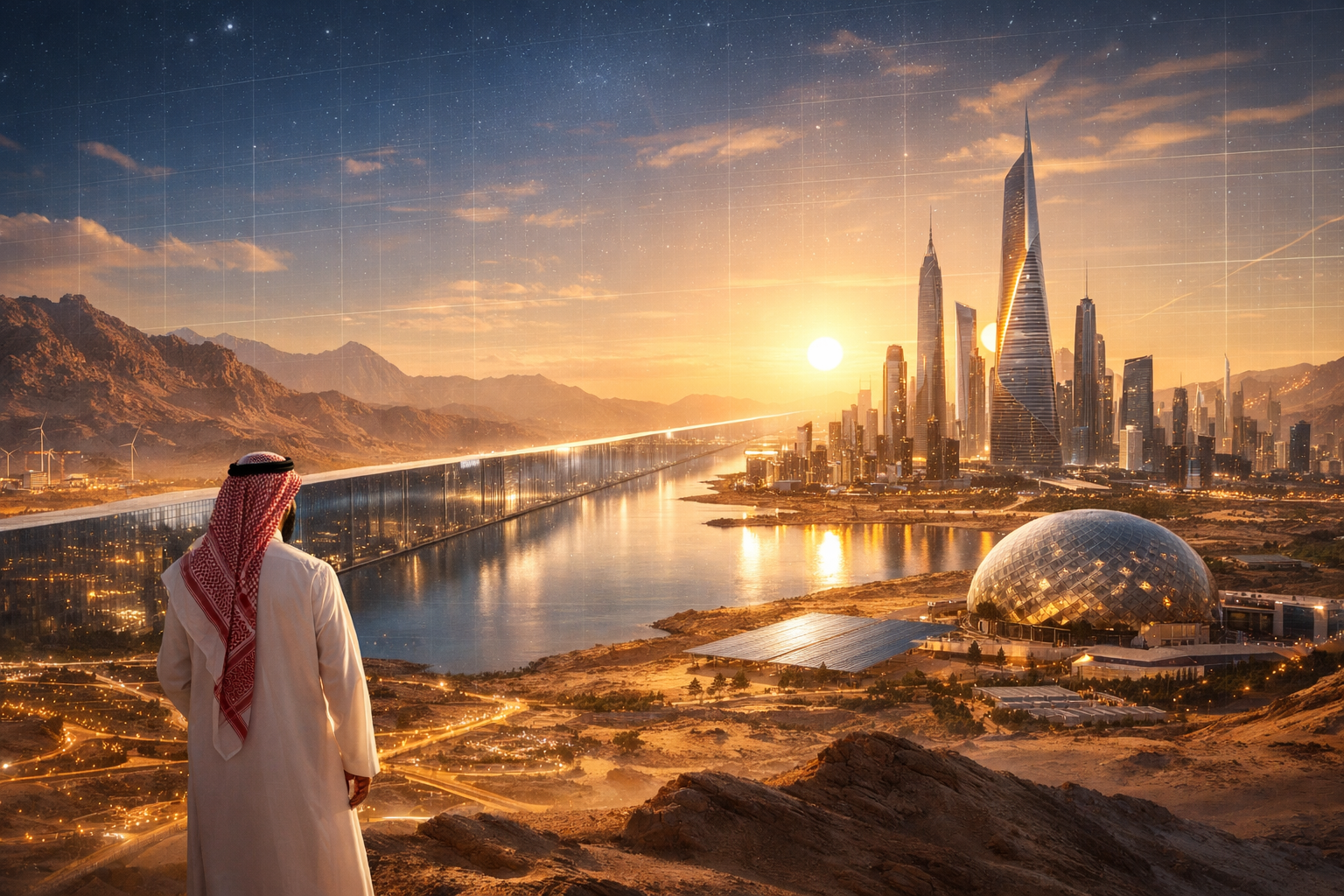
Riyadh is attempting one of the most ambitious economic transformations in modern history and the world is watching to see if it can succeed
Introduction: The Wager on Transformation
In 2016, Saudi Arabia unveiled Vision 2030 — an economic transformation blueprint announced by Crown Prince Mohammed bin Salman that set out to accomplish, in roughly fifteen years, what other countries have taken generations to achieve: the fundamental diversification of an economy built almost entirely on one commodity, in one of the world’s most challenging geographic and climatic environments, with limited existing non-oil industrial infrastructure and a large young population accustomed to state-subsidised employment and public services.
The ambition is genuinely extraordinary. Saudi Arabia aims to reduce oil’s share of GDP from over 40 percent to below 50 percent of total revenues while simultaneously building competitive tourism, entertainment, technology, financial services, logistics, and defence manufacturing sectors that barely existed at the programme’s launch. It involves the planned construction of entirely new cities — including NEOM, a $500 billion linear city development in the northwestern Tabuk region — that represent some of the largest infrastructure projects in human history. And it requires transforming the social contract between the Saudi state and its citizens, shifting from guaranteed public sector employment and subsidised services toward a market economy requiring private sector productivity and individual economic participation.
Section I: The Economic Imperative
Why Diversification Cannot Wait
Saudi Arabia’s oil dependency is not merely an economic structure — it is a political and social compact. Oil revenues fund the public services, government employment, and subsidies that constitute the material basis of the social contract between the House of Saud and Saudi citizens. As long as oil revenues remain high, this compact is sustainable. But several converging trends are creating urgency around diversification that was not present in previous decades.
The global energy transition — the accelerating shift from fossil fuels toward renewable energy driven by climate policy, technology cost reductions, and geopolitical supply diversification initiatives — threatens the long-term trajectory of oil demand. The International Energy Agency projects that oil demand in its net-zero scenario could be significantly lower by 2050 than current levels. Even in scenarios short of full net-zero, the diversification of energy supply and the electrification of transportation create headwinds for oil export revenues over a 20-30 year horizon that Saudi planners take seriously.
The Demographic Pressure
Saudi Arabia has a young and rapidly growing population, with approximately 60 percent of citizens under 30 and a labour force growing at rates that the public sector cannot sustainably absorb. Creating sufficient private sector employment — jobs that offer genuine economic opportunity rather than subsidised state employment — is one of the most acute economic policy challenges Vision 2030 must address. The programme explicitly targets significant increases in private sector employment and Saudi workforce participation, including a dramatic increase in female labour force participation that has already begun to materialise.
| ~60% of Saudi Arabia’s population is under 30 years old This demographic reality creates both urgency and opportunity for economic transformation. Providing productive employment for a rapidly growing young labour force requires private sector development at a scale and pace that cannot rely on traditional public sector absorption. It also means that the workforce available to support Vision 2030 industries is young, educated, and increasingly globally oriented. |
| “Saudi Arabia’s demographic structure is both its greatest challenge and its greatest asset for Vision 2030. A young, educated population with rising aspirations creates pressure for economic transformation — but it also provides the human capital to drive it, if the enabling environment for private sector activity can be built quickly enough.” — Dr. Karen Young Senior Fellow and Director, Program on Economics and Energy, Middle East Institute |
Section II: The Megaproject Dimension
NEOM and the New Cities
The most globally visible element of Vision 2030 is NEOM — a planned development zone in the Tabuk region of northwestern Saudi Arabia encompassing multiple sub-projects, the most prominent of which is The Line: a planned linear city 170 kilometres long, 200 metres wide, and 500 metres tall, designed to house 9 million people in a car-free, AI-managed urban environment. The total planned investment in NEOM is approximately $500 billion, making it one of the largest construction projects in human history.
NEOM has attracted both significant international interest and substantial scepticism. Questions about its technical feasibility, its ability to attract the residents and businesses necessary to make it economically viable, and the timeline and cost estimates for its construction have been raised by economists, urban planners, and infrastructure experts. The Saudi government has presented NEOM as a demonstration project for new urban and economic models — a laboratory for technologies and governance approaches that could be scaled more broadly — rather than simply a real estate development.
Tourism, Entertainment, and the Social Transformation
Vision 2030 encompasses a substantial social transformation alongside its economic agenda. The introduction of mixed-gender entertainment venues, the opening of cinemas (banned since 1979), the hosting of international music concerts and sporting events, the development of tourism infrastructure at sites like Al-Ula’s ancient Nabataean city of Hegra, and the granting of tourist visas to international visitors for the first time represent a genuine reshaping of Saudi social life that has proceeded at remarkable speed.
Female labour force participation has increased significantly — from approximately 17 percent in 2017 to over 30 percent by 2023 — driven by Vision 2030 targets and facilitated by regulatory changes enabling women to work in a broader range of sectors. The lifting of the ban on women driving in 2018 was both practically significant and symbolically indicative of the pace and direction of social change.
Section III: Saudi Arabia as a Global Investment Hub
Vision 2030’s ambition extends to positioning Saudi Arabia as a significant global financial and investment centre. The Public Investment Fund — Saudi Arabia’s sovereign wealth fund, managed by Crown Prince Mohammed bin Salman as chair — has grown from approximately $150 billion in 2016 to over $700 billion by 2024, with investments spanning global technology companies, entertainment, sports, real estate, and infrastructure. The PIF’s investment activity has made Saudi Arabia a significant capital allocator in global markets, with the geopolitical influence that large-scale capital deployment provides.
Saudi Arabia has also positioned itself as a diplomatic bridge between East and West — maintaining relationships with the United States, China, Russia, and the Gulf states simultaneously, using its economic weight and strategic location to maintain influence with multiple great powers. The 2023 Beijing-brokered normalisation of diplomatic relations with Iran, ending a seven-year rupture, was both a geopolitical development and a signal of Saudi Arabia’s confidence in conducting an independent foreign policy that does not depend on alignment with any single external power.
Conclusion: The Scale of the Wager
Vision 2030 is the most ambitious economic transformation programme currently underway anywhere in the world. Whether it succeeds — whether Saudi Arabia can build competitive private sector industries at sufficient scale and speed to sustain a young and growing population as oil’s long-term trajectory declines — is a question with implications extending well beyond Saudi borders. A successful transformation would validate the proposition that resource-dependent economies can make the transition to diversified market economies through deliberate state-led strategy. A failure would raise serious questions about the stability of a state that has staked its social contract on a transformation that did not deliver.
The early indicators are mixed — significant social and institutional progress, genuine development of the tourism and entertainment sectors, but persistent questions about whether the non-oil private sector is growing at the pace and scale required, and whether the megaproject ambitions can translate from architectural renderings to functioning cities. The wager is genuine, the stakes are high, and the outcome over the next decade will be one of the most consequential economic stories in the world.
Nayla Al Khaja: Building Emirati Cinema and the Future of Storytelling in the Gulf


