


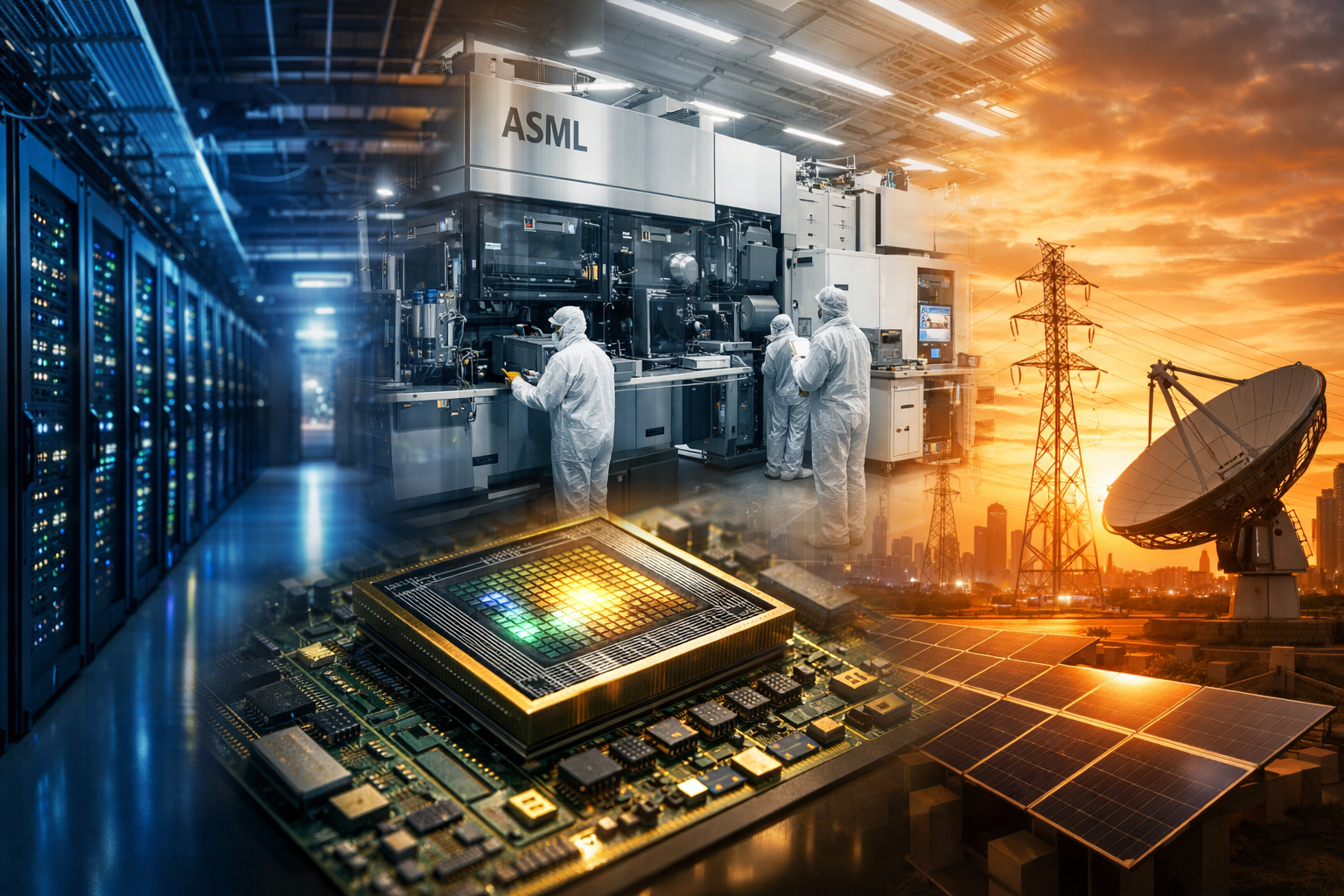
The competition to dominate artificial intelligence is the defining investment race of our era and the winners will shape economic power for decades
The Short Answer: Why the AI Race Is the New Industrial Revolution
In 1900, the countries and companies that controlled steel, railways, and electricity determined the economic order of the twentieth century. In 2026, the equivalent competition is for artificial intelligence — the infrastructure, the models, the data, and the talent on which the next economy will run. The scale of investment now flowing into AI development and deployment is without precedent in the history of technology: estimates of cumulative global AI investment over the 2024-2030 period range from $1 trillion to several times that figure, depending on how broadly AI-related infrastructure spending is defined.
The race is not merely about which company builds the most capable AI model. It is about who controls the computing infrastructure on which AI runs, who owns the data that trains the next generation of systems, who manufactures the chips that power it all, and which country sets the standards and governance frameworks that determine on whose terms AI is developed and deployed. Control AI — at any of these levels — and you exercise influence over economic power in the twenty-first century that is comparable to controlling oil in the twentieth.
| $200B+ Capital expenditure committed by major tech companies for AI infrastructure in 2025 alone Microsoft, Google, Meta, Amazon, and other major technology companies committed approximately $200 billion in AI-related capital expenditure in 2025 — primarily data centres, networking, and custom AI chips. This figure is expected to increase significantly in 2026-2027 as AI infrastructure scaling continues. |
Section 1: The Key Players
The Frontier Model Companies
At the most visible level of the AI race sit the companies building the most capable foundation models — the AI systems that, through training on vast quantities of data with enormous computational resources, develop general-purpose capabilities that can be applied across virtually any domain. OpenAI, Google DeepMind, Anthropic, Meta AI, and xAI (Elon Musk’s venture) are the primary American competitors at this frontier, with Chinese companies — Baidu, Alibaba, Tencent, Huawei, and DeepSeek — competing in parallel on a partly parallel technology trajectory shaped by US semiconductor export controls.
The Chipmakers
Nvidia has achieved a position in the AI compute market that represents one of the most extraordinary corporate transformations in business history — moving from a niche graphics chip company to the supplier of the infrastructure on which virtually all frontier AI training runs. The H100 and successor GPU architectures, combined with the CUDA software ecosystem that makes Nvidia chips the path of least resistance for AI developers, have given the company a market position of extraordinary strength. AMD, Intel, and a range of specialised AI chip startups are competing to offer alternatives, while Google (TPUs) and Amazon (Trainium) develop custom silicon for their own AI workloads.
The Cloud Giants
Amazon Web Services, Microsoft Azure, and Google Cloud are the primary distribution infrastructure for AI capabilities — the platforms through which enterprises access frontier AI models via API, through which AI startups access the compute they need for training, and through which AI capabilities are integrated into business applications at scale. Their combined capital expenditure commitments represent the largest single driver of AI infrastructure investment, and their competitive dynamics — each investing heavily to ensure that AI advances make their platforms more rather than less central to enterprise computing — are a primary force driving the overall pace of AI scaling.
| “The cloud platforms are the real kingmakers in the AI economy. They control the distribution infrastructure, the enterprise relationships, and the capital for AI investment at a scale that even the frontier model companies cannot match independently. The question of which cloud platform AI runs on is as important as the question of which AI system is most capable.” — Benedict Evans Independent technology analyst; former Andreessen Horowitz partner |
Section 2: Where the Money Is Going
Data Centres and Compute Infrastructure
The largest single component of AI investment is compute infrastructure — the data centres housing the GPU clusters on which AI training and inference runs. Training a frontier AI model requires thousands of high-end GPUs running continuously for weeks or months; inference — running the trained model to serve queries — requires substantial compute at scale across all usage. The data centre building programmes of major technology companies represent investments measured in tens of billions per year, and they are driving a secondary investment wave in power generation, cooling technology, and grid infrastructure adequate to support their enormous energy requirements.
AI Models and Research
Investment in frontier model development — the research, engineering, and compute required to build and train the most capable AI systems — represents a smaller but strategically central component of overall AI investment. OpenAI, Google DeepMind, Anthropic, and their Chinese counterparts collectively employ thousands of researchers and engineers working on model architecture, training methodology, safety, and capability evaluation. The pace of model capability improvement is directly related to both the research quality and the compute budgets of these organisations.
Enterprise AI Applications
The largest component of AI investment by number of projects, if not by absolute capital, is the deployment of AI capabilities in enterprise applications — the integration of AI models into software systems used by businesses across every sector. The market for enterprise AI applications — AI-enhanced ERP, CRM, HR, finance, and operations systems — is growing rapidly and is expected to be the primary driver of AI-related revenue growth over the medium term, as the value created by AI capability is captured through productivity improvements and new product capabilities across the entire economy.
Section 3: Winners vs Losers
Early Movers and Their Advantages
The AI race has clear early leaders, and early leadership in technology platform markets tends to compound through network effects, data advantages, and ecosystem lock-in. Microsoft’s deep integration of OpenAI’s capabilities into its productivity software — through Copilot embedded in Office, Teams, and Azure — has given it a distribution advantage for AI capabilities that reaches hundreds of millions of enterprise users. Google’s ownership of the world’s largest search engine, the world’s most used productivity suite, and one of the leading AI research organisations gives it a structural position that competitors find very difficult to challenge simultaneously across all three dimensions.
The Laggard Risk
Companies that are late to AI integration — in any sector — face a compounding competitive disadvantage as AI-enhanced competitors achieve productivity, quality, and cost advantages that are difficult to close through accelerated adoption. The historical pattern of major technology platform transitions — personal computing, the internet, mobile — suggests that the gap between early adopters and late movers in AI integration may be more persistent than previous transitions because AI improvement compounds: more users generate more data, better data trains better models, better models attract more users.
Section 4: The Geopolitical Dimension
US vs China — The Technology Cold War
The US-China AI competition has become one of the primary axes of geopolitical rivalry, with both governments treating AI leadership as a national security priority and investing accordingly. The United States maintains advantages in frontier model development, semiconductor design, and the concentration of AI research talent in its leading universities and technology companies. China has responded with state-directed investment in AI at extraordinary scale, combined with aggressive domestic semiconductor development aimed at reducing dependence on US-controlled chip supply chains.
The American export controls on advanced AI chips — Nvidia’s H100 and successor architectures — have created a constraint on China’s ability to train frontier models at scale that Chinese AI developers are working to engineer around through improved algorithmic efficiency and domestic chip development. The January 2025 release of DeepSeek’s R1, which demonstrated capabilities competitive with frontier American models at a fraction of reported training costs, provided the first major public evidence that the computational constraint imposed by export controls may be less decisive than American policymakers had assumed.
| “The AI race is not a sprint — it is a decade-long marathon in which early leads can be overcome and late entrants can leapfrog. China’s investments in AI talent, data, and infrastructure mean that assuming a durable American advantage is strategically dangerous. The competition is more contested than export control optimism suggests.” — Graham Allison Professor of Government, Harvard Kennedy School; author of ‘Destined for War: Can America and China Escape Thucydides’s Trap?’ |
The Rest of the Field
The AI race is not purely bilateral. The European Union, the United Kingdom, Canada, India, Israel, and several other countries are investing significantly in AI capabilities, primarily through academic research, startup ecosystems, and national AI strategies. Europe’s comparative advantage lies in regulation — the EU AI Act is the world’s first comprehensive AI governance framework, and the ability to set global AI regulatory standards is itself a form of economic and geopolitical influence. The question of whether regulatory leadership can translate into commercial and capability leadership is one of the central strategic questions for European AI policy.
Frequently Asked Questions
| How much money is being invested in AI globally? Total global AI investment including infrastructure, model development, and enterprise applications is estimated at $200-300 billion annually in 2025-2026, with cumulative investment over the decade expected to exceed $1 trillion. US government and private sector commitments, including the Stargate project, alone represent hundreds of billions of dollars. |
| Which AI companies are most likely to win the AI race? The most structurally advantaged companies are those with simultaneous strengths in compute infrastructure, frontier model capability, and enterprise distribution — currently Microsoft/OpenAI, Google DeepMind/Alphabet, and Amazon/AWS. However, AI capability transitions have historically produced surprise entrants, and Chinese competitors are formidable in specific domains. |
| Can China compete with the US in AI despite chip export controls? The evidence from DeepSeek and other Chinese AI developments suggests China can develop highly capable AI systems despite semiconductor constraints, through algorithmic efficiency improvements and domestic chip development. The controls slow certain types of scaling but do not prevent AI development from advancing on Chinese-controlled computational resources. |
| How does AI investment affect the broader economy? AI investment is driving significant secondary economic effects: extraordinary demand for power generation and grid infrastructure, rapid growth in data centre construction, surging demand for AI-adjacent skills in the labour market, and productivity improvements across every AI-adopting sector that are beginning to show up in corporate financial results. |
| Is AI investment a bubble? This is actively debated among economists and investors. The bullish case is that AI productivity gains will generate economic value that justifies current infrastructure investment. The sceptical case is that infrastructure investment is running well ahead of demonstrated commercial application at current scale. The resolution depends on how rapidly AI adoption translates into measurable productivity growth across the broader economy. |
Conclusion
Control AI — its infrastructure, its models, its data, and its governance — and you control economic power in the twenty-first century. This is not hyperbole. It is the conclusion that every major government and every major technology company has reached simultaneously, which is why the race is being run at the current scale and pace.
The AI investment race is the defining economic competition of our era — more consequential than the internet race of the 1990s, more structurally transformative than any single technology platform transition in modern history. Its outcome will determine which companies are the economic engines of the next several decades, which countries maintain technological relevance, and on whose terms the most powerful technology in history is developed, deployed, and governed. The race is well underway. The finish line is nowhere in sight. And the stakes could hardly be higher.
North Korea’s New Missile Doctrine


