


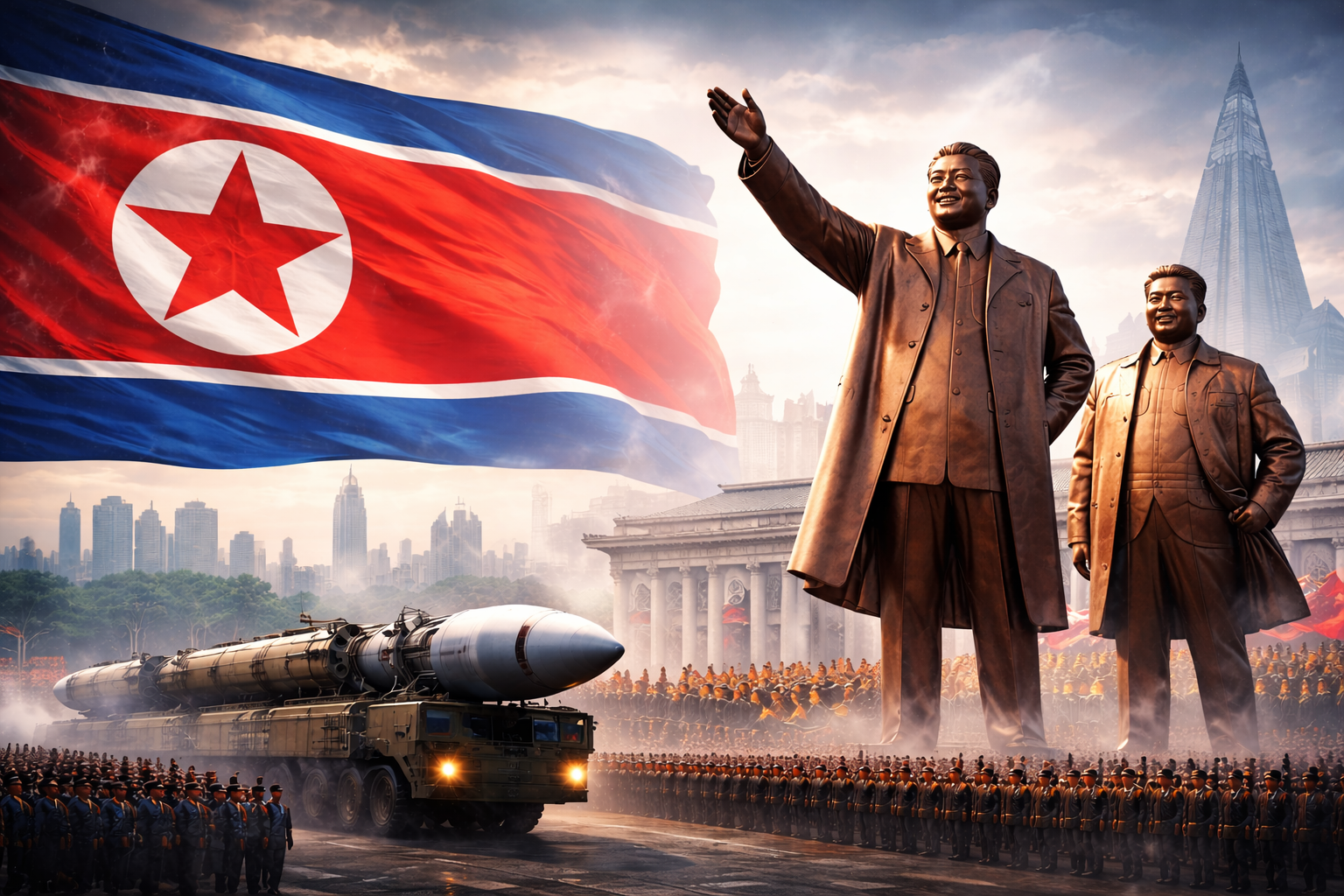
North Korea is officially a socialist republic. In practice, it is the world’s most enduring hereditary dictatorship.
Three generations of the Kim family have ruled the country since its founding in 1948. Kim Il Sung established the state; his son Kim Jong Il consolidated it; and his grandson, Kim Jong Un, has reshaped it. The prospect of a fourth Kim generation succeeding him—once speculative—has entered the realm of plausible political planning.
The question is not whether North Korea resembles a monarchy. It does. The more consequential question is whether dynastic succession remains viable in a system facing economic stagnation, international isolation, and an increasingly complex security environment.
The logic of hereditary rule
Dynastic succession in North Korea is often misunderstood as a cultural anomaly or ideological contradiction. In reality, it is a rational adaptation to the regime’s core challenge: ensuring elite cohesion in the absence of institutional legitimacy.
Unlike communist systems that relied on party structures or collective leadership, North Korea fused ideology with bloodline. The Kim family was elevated not merely as leaders, but as the embodiment of the state itself. Loyalty to the regime became loyalty to the family.
This fusion solved a fundamental problem. In a system with no elections, no succession rules, and no legal constraints on power, heredity offers predictability. It reduces elite competition, limits factionalism, and provides a clear line of continuity.
From this perspective, dynastic succession is not a weakness of the system—it is one of its stabilising mechanisms.
Kim Jong Un’s consolidation of power
When Kim Jong Un assumed power in 2011, he was young, inexperienced, and widely underestimated. Many analysts predicted instability or elite manipulation. Instead, he moved swiftly and ruthlessly to consolidate authority.
Potential rivals were eliminated, most notably his uncle Jang Song Thaek, once considered the regime’s second-most powerful figure. Senior military officers were reshuffled or purged. Decision-making authority was recentralised around the leader.
At the same time, Kim Jong Un invested heavily in symbolic legitimacy. He revived imagery associated with his grandfather Kim Il Sung, frequently invoking the state’s revolutionary origins. Monuments were refurbished, anniversaries amplified, and propaganda recalibrated to present Kim Jong Un as the rightful inheritor of a sacred lineage.
This consolidation has created the conditions under which succession planning—once taboo—can be signalled.
The emergence of the fourth generation
In recent years, Kim Jong Un’s children have appeared intermittently in state media, a departure from past practice. Most notably, his daughter has been shown accompanying him at military events, including missile launches.
Such appearances are not accidental. In North Korea’s political language, visibility equals legitimacy. Introducing a child into the public narrative serves multiple purposes: it normalises the idea of succession, familiarises elites with the next generation, and reinforces the permanence of dynastic rule.
Yet symbolism alone does not guarantee smooth transition. A fourth-generation succession would present challenges unprecedented even by North Korean standards.
The problem of age and authority
The most immediate obstacle is age. Any potential fourth-generation successor is currently a child. That reality introduces a period of vulnerability.
A child ruler would require a regency—formal or informal—comprised of senior party, military, and security figures. Such arrangements are inherently risky. They create opportunities for factionalism, power struggles, and policy drift.
North Korea’s history offers little precedent for collective leadership. Authority has always been personal and centralised. Delegating power, even temporarily, runs counter to the system’s design.
The regime would need to ensure absolute unity among elites during any interregnum—a tall order in a system built on surveillance, fear, and rivalry.
Elite incentives and regime survival
Despite these risks, the regime’s elite may still favour dynastic succession over alternatives.
For senior officials, generals, and security chiefs, continuity offers protection. A known bloodline reduces uncertainty about policy direction and personal survival. A revolutionary or reformist successor would introduce unpredictability—and potential accountability.
In this sense, dynastic succession is less about popular legitimacy than elite reassurance. It signals that the rules of the game will not change.
North Korea’s elites have lived through famine, sanctions, and international isolation. Their primary objective is not reform, but survival. A fourth Kim, however young, may be seen as the safest custodian of the status quo.
The role of ideology and myth
North Korea’s ideological framework is uniquely suited to hereditary rule. The Kim family is portrayed not merely as leaders, but as benevolent guardians whose wisdom transcends generations.
This mythology is deeply embedded in education, media, and daily life. It allows succession to be framed not as political inheritance, but as historical destiny.
Such narratives are powerful—especially in a society with limited access to alternative information. While economic hardship erodes material legitimacy, ideological continuity can still command obedience.
That said, ideology alone cannot manage modern pressures indefinitely.
External pressures and internal constraints
A fourth-generation succession would unfold in a far more complex environment than previous transitions.
North Korea faces sustained economic stagnation, demographic challenges, and technological leakage despite isolation. Information control, while formidable, is less absolute than in the past. Markets operate semi-legally, and exposure to the outside world—however limited—has grown.
Externally, the regime confronts a hardened security environment, with little prospect of sanctions relief or diplomatic normalisation in the near term. Nuclear weapons provide deterrence, but also entrench isolation.
A child successor would inherit these pressures without the personal authority accumulated over decades by Kim Il Sung or Kim Jong Il.
Is the system adaptable enough?
The key question is not whether a fourth Kim can rule—but whether the system can adapt to sustain such a transition.
North Korea has demonstrated remarkable resilience. It has survived famine, leadership deaths, economic collapse, and diplomatic isolation. Each time, the regime adjusted without fundamentally reforming.
That adaptability suggests that succession mechanisms—however opaque—exist and can function under stress. But resilience is not immunity. Each generational transition increases uncertainty and raises the stakes.
The fourth succession, if it occurs, would test the limits of dynastic governance in a modern authoritarian state.
Conclusion
Can a fourth Kim generation rule North Korea? The answer is neither unequivocally yes nor dismissively no.
Dynastic succession remains the regime’s preferred option because it minimises uncertainty for elites and reinforces ideological continuity. The groundwork is being laid deliberately and symbolically.
Yet the risks are real. A child ruler, a potential regency, and mounting internal and external pressures introduce vulnerabilities unseen in previous transitions.
If a fourth Kim does rule, it will not be because the system is confident—but because it fears the alternatives even more. In Pyongyang, heredity has become the least dangerous form of change.
North Korea and the Kim Dynasty: The Dictator’s Paradox Explained
- El Niño 2026: The Climate Phenomenon Reshaping Weather, Food Security and the Global Economy
- Rahul Gandhi’s Political Evolution: From Reluctant Heir to a More Assertive Challenger to the BJP
- India’s Middle East Strategy Explained: Energy, Alliances and the Battle for Strategic Autonomy
- The Rise of Private Military Technology Companies: Who Is Building the Future of Warfare?
- Riyadh Under Attack: Why Saudi Security Matters to the Entire World


