


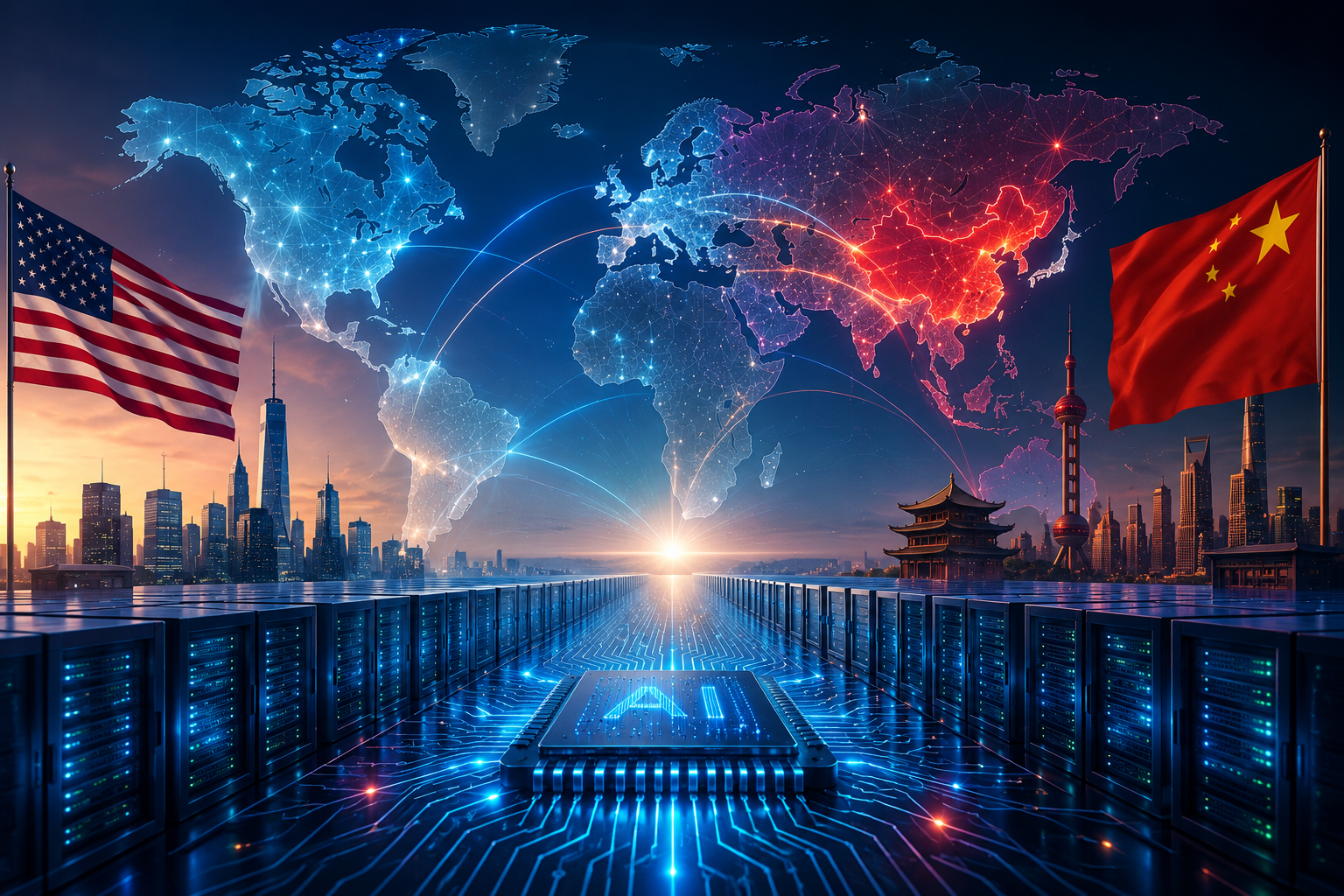
The New Race for Technological Power
The next great geopolitical competition may not be fought over territory.
It may be fought over algorithms, chips, electricity, data and computing power.
Artificial intelligence is rapidly becoming a strategic technology with implications for economic growth, military capability, national security and global influence.
The countries that lead in AI could gain advantages across almost every major sector of the economy—from manufacturing and healthcare to finance, defense and scientific research.
But there is an important misconception about the AI race.
There is no single scoreboard.
One country may lead in frontier models.
Another may dominate manufacturing.
Another may possess the world’s most advanced semiconductor technology.
Another may have the cheapest electricity and fastest-growing data-center capacity.
And another may have the world’s most important chipmaking infrastructure.
The AI arms race is therefore better understood as a competition across an entire technological ecosystem.
And as of 2026, one conclusion is becoming increasingly clear:
The United States remains the overall leader—but China is closing the gap rapidly.
The United States: Still the Overall Leader
The United States currently possesses the strongest combination of AI companies, capital, computing infrastructure, semiconductor design, cloud platforms, research institutions and entrepreneurial talent.
Stanford’s 2026 AI Index estimates that U.S. private AI investment reached $285.9 billion in 2025, more than 23 times China’s reported private investment. The United States also produced 59 notable AI models in 2025, compared with 35 from China.
The world’s most powerful AI companies are also heavily concentrated in the United States.
OpenAI.
Google.
Anthropic.
Meta.
Microsoft.
Amazon.
xAI.
These companies possess enormous computing resources and access to global capital markets.
But America’s advantage goes beyond software.
The United States hosts 5,427 data centers, more than ten times any other country, according to Stanford’s 2026 AI Index.
That infrastructure matters because AI leadership increasingly depends on access to compute.
The United States therefore begins the next phase of the AI race with an extraordinary advantage.
But it is not an unassailable one.
China: The Fastest Challenger
China is no longer simply trying to catch up.
In several areas, it is already competing at the frontier.
Stanford’s latest assessment says the performance gap between leading U.S. and Chinese AI models has effectively closed, with the two countries repeatedly trading the lead since early 2025. As of March 2026, Stanford estimated that Anthropic’s leading model held only a 2.7% advantage over its Chinese counterpart on the relevant comparison.
China has another major advantage:
Scale.
China leads the world in AI publication volume, citations and patent grants, while also possessing an enormous industrial base and one of the world’s largest manufacturing ecosystems.
That combination could become particularly important as AI moves beyond chatbots.
The next phase of AI will involve robots.
Factories.
Autonomous vehicles.
Industrial systems.
Military applications.
Smart infrastructure.
China’s enormous manufacturing sector gives it an unusually large real-world laboratory for deploying AI.
A recent U.S.-China Economic and Security Review Commission report also warned that China’s systematic use of industrial and operational data could provide a strategic advantage in AI, particularly in robotics and embodied AI.
China’s Secret Weapon May Be Industrial AI
The United States has built an extraordinary lead in frontier AI models.
China may have a different strength.
It can put AI into the physical economy at enormous scale.
China is already a manufacturing superpower.
It is also the world’s largest market for industrial robotics.
That creates a powerful feedback loop.
Factories generate data.
Data improves AI.
AI improves robots.
Robots improve manufacturing.
Manufacturing generates more data.
This could make China’s AI advantage increasingly difficult to measure through chatbot benchmarks alone.
The future competition may therefore shift from:
Who has the smartest AI model?
to:
Who can deploy AI most effectively across the real economy?
China could be particularly competitive in that race.
Taiwan: The Most Important Country That Doesn’t Dominate the Rankings
There is another player that cannot be ignored.
Taiwan.
Taiwan does not have the world’s largest AI startup ecosystem.
It does not produce the largest number of frontier AI models.
But it occupies one of the most strategically important positions in the entire AI supply chain.
TSMC.
The Taiwanese semiconductor manufacturer produces the majority of the world’s leading-edge AI chips.
Stanford notes that one Taiwanese foundry fabricates almost every leading AI chip, making the global AI hardware ecosystem heavily dependent on Taiwan.
This creates a geopolitical paradox.
America may dominate AI software.
China may be closing the model gap.
But much of the physical infrastructure enabling the AI revolution still depends on semiconductor manufacturing concentrated in Taiwan.
That makes Taiwan one of the most strategically important territories in the AI era.
Nvidia: America’s Advantage Depends on a Global Supply Chain
The AI chip story also illustrates why the race cannot be reduced to national borders.
Nvidia is an American company.
Its processors are among the most important technologies driving AI computing.
But Nvidia does not manufacture all of its leading chips itself.
The global semiconductor ecosystem stretches across the United States, Taiwan, South Korea, Japan, the Netherlands and other manufacturing centers.
The AI race is therefore simultaneously a competition and a supply chain.
Control one layer and you gain leverage.
Control multiple layers and you gain strategic power.
South Korea: The Semiconductor Powerhouse
South Korea occupies another critical position.
Its semiconductor giants are central to the production of advanced memory technologies required by AI systems.
The country also stands out in AI innovation.
Stanford’s 2026 AI Index identifies South Korea as the global leader in AI patents per capita.
South Korea’s strategic importance could increase as AI systems demand ever larger quantities of high-performance memory.
The country’s combination of semiconductor manufacturing, industrial capacity and technology companies gives it an important position in the AI economy.
It may not win the AI race alone.
But the race cannot be won without it.
Japan and the European Union: The Infrastructure Players
Japan and Europe are unlikely to dominate the frontier-model race in the same way as the United States.
But that does not make them irrelevant.
Japan possesses major strengths in robotics, advanced manufacturing, materials and industrial technology.
Europe retains significant advantages in research, industrial engineering, telecommunications, regulation and advanced semiconductor equipment.
The Netherlands is home to ASML, whose extreme ultraviolet lithography machines are essential to producing the world’s most advanced chips.
This illustrates another important reality:
AI power is distributed across the supply chain.
A country does not need to build the world’s best chatbot to possess enormous strategic leverage.
It may control the machines that manufacture the chips running that chatbot.
The Netherlands: A Tiny Country With Enormous Leverage
Few examples better demonstrate the new geography of technological power than the Netherlands.
ASML’s advanced lithography systems are essential to the production of cutting-edge semiconductors.
That gives a relatively small European country an influence over the AI ecosystem far greater than its population or geographic size would suggest.
In the AI era, strategic power increasingly comes from technological bottlenecks.
A country controlling a critical component can possess extraordinary geopolitical leverage.
The Middle East Is Building an AI Strategy
The next group of contenders is more surprising.
Saudi Arabia, the United Arab Emirates and Qatar are investing heavily in AI infrastructure, data centers, cloud computing and digital transformation.
Their advantage is different.
Energy and capital.
AI requires enormous quantities of electricity.
The countries of the Gulf possess abundant energy resources and substantial financial capital.
That combination could make them important AI infrastructure hubs.
The emerging strategy is straightforward:
Convert energy wealth into compute capacity.
Convert compute capacity into AI capability.
Convert AI capability into economic diversification and geopolitical influence.
The Gulf states may not invent the next frontier model.
They do not necessarily need to.
They could become some of the world’s most important places for running AI at scale.
India: The Sleeping Giant?
India may be one of the most interesting long-term contenders.
Its strengths are different again.
A huge technology workforce.
A massive domestic market.
A rapidly expanding digital economy.
A large pool of engineers.
Strong software capabilities.
A growing startup ecosystem.
And increasingly ambitious semiconductor and AI infrastructure plans.
India’s biggest opportunity may not be to defeat the United States or China in frontier-model development.
It could be to become one of the world’s most important AI deployment markets.
Healthcare.
Financial services.
Manufacturing.
Agriculture.
Education.
Government.
Logistics.
India has enormous opportunities to apply AI across a vast and diverse economy.
If Indian companies can convert that scale into globally competitive AI products, India could become one of the defining AI powers of the 2030s.
The Real Race Is About Compute
AI models attract headlines.
Compute determines what can actually be built.
Stanford estimates that global AI compute capacity grew 3.3 times per year since 2022, reaching the equivalent of 17.1 million H100 GPUs. Nvidia accounts for more than 60% of total compute, with Google and Amazon supplying much of the remainder.
This creates a new definition of technological power.
A country needs:
Chips
↓
Data centers
↓
Electricity
↓
Networks
↓
Capital
↓
AI researchers
↓
Models
↓
Industrial deployment
The strongest countries will increasingly be those capable of controlling or reliably accessing the entire chain.
Electricity Is Becoming a Strategic Weapon
The AI race is also becoming an energy race.
Data centers already consume enormous amounts of electricity, and demand is accelerating.
The International Energy Agency expects global data-center electricity consumption to more than double by 2030, with AI as a major driver.
This creates an unexpected strategic advantage for countries with abundant electricity.
The AI superpower of the future may need not only the best scientists.
It may need the biggest power grid.
That is one reason the United States, China and Gulf states are investing heavily in AI infrastructure.
It is also why nuclear power, natural gas, renewables and grid infrastructure are increasingly becoming part of the AI geopolitical conversation.
Data Could Become China’s Strategic Advantage
The AI race has created an unusual debate about data.
The United States has enormous quantities of high-quality commercial data.
China has something different:
A vast industrial economy combined with extensive state-supported data collection.
A recent U.S. government advisory report argues that China’s national data strategy could give it an advantage in AI by turning industrial and operational data into a strategic resource.
This could matter enormously for embodied AI.
A robot operating in a factory requires different data from a chatbot.
An autonomous vehicle needs real-world environmental data.
An industrial AI system needs manufacturing data.
China’s physical economy could therefore become one of its most important AI assets.
Open-Source AI Is Changing the Race
Another major shift is the rise of open-weight AI models.
Chinese companies have increasingly used open approaches to distribute capable models globally.
That creates a strategic advantage.
A model does not need to be the absolute best to become influential.
If it is cheap, customizable and accessible, millions of developers can build on it.
The competition therefore has two dimensions:
Performance
and
Distribution.
The United States remains exceptionally strong in frontier models.
China is increasingly strong in affordable, open and deployable AI.
The winner may ultimately be determined by which approach generates the largest ecosystem.
The AI Arms Race Is Not Just About Technology
There is another dimension.
Military power.
AI can improve:
Intelligence analysis.
Autonomous systems.
Cyber operations.
Logistics.
Target recognition.
Simulation.
Decision support.
Electronic warfare.
The integration of AI into military systems could fundamentally change the balance of power.
But it also creates risks.
Faster decision-making can increase the danger of miscalculation.
Autonomous systems can compress response times.
AI-generated information can create uncertainty.
Cyberattacks can spread rapidly.
The AI arms race therefore has a direct relationship with strategic stability.
Who Is Actually Winning?
There is no single winner.
But a ranking of strengths looks increasingly clear.
1. United States — Overall Leader
The United States leads in frontier models, private investment, AI startups, data centers and access to enormous computing infrastructure.
2. China — Fastest Challenger
China is closing the model gap, leads in AI research output and patents, and possesses enormous advantages in manufacturing, robotics, data and state-backed infrastructure.
3. Taiwan — Critical Hardware Power
Taiwan’s semiconductor manufacturing position makes it indispensable to the global AI ecosystem.
4. South Korea — Semiconductor and Memory Power
South Korea combines advanced semiconductor manufacturing with strong AI innovation and industrial capability.
5. Netherlands/Japan/Europe — Strategic Technology Suppliers
Advanced semiconductor equipment, robotics, materials, research and industrial technologies give these economies influence far beyond their share of AI headlines.
6. Gulf States — Emerging Compute Powers
Energy, capital and ambitious national strategies could allow Gulf states to become major AI infrastructure hubs.
7. India — Long-Term Growth Power
India’s combination of talent, market scale and digital infrastructure gives it one of the strongest long-term opportunities to become a major AI economy.
The Most Important Battle May Be Between Two Different Models
Ultimately, the AI race could become a competition between two systems.
The American model is largely driven by:
Private capital + universities + startups + hyperscalers + global talent.
The Chinese model combines:
State direction + industrial scale + domestic data + manufacturing + national infrastructure.
Both have strengths.
Both have weaknesses.
The American system is exceptionally good at frontier innovation.
The Chinese system is exceptionally good at industrial-scale deployment.
The next decade will reveal which model can translate technological breakthroughs into lasting economic and geopolitical power.
The Winner May Not Be the Country With the Best AI
This is the most important point.
AI leadership is not one competition.
It is five.
Who designs the best chips?
Who builds the largest compute infrastructure?
Who develops the strongest models?
Who deploys AI across the economy fastest?
Who turns AI into military and geopolitical power?
Different countries can win different races.
The United States may lead the overall ecosystem.
China may dominate industrial AI.
Taiwan may remain indispensable to chip manufacturing.
South Korea may dominate critical memory technologies.
The Gulf may become a major compute hub.
India may become the world’s largest AI deployment laboratory.
Europe may control critical technologies and standards.
That means the AI era may not produce a single technological superpower.
It may produce a network of interdependent AI powers.
Frequently Asked Questions
Is the United States still winning the AI race?
Yes, if AI leadership is measured across private investment, frontier models, data-center infrastructure and startup activity. However, China’s model performance has rapidly converged, making the race increasingly competitive.
Is China ahead of the United States in AI?
China leads in several indicators, including research publications, citations, patent output and industrial robotics. The United States remains ahead in private investment, frontier-model production and data-center capacity.
Why is Taiwan so important to AI?
Taiwan hosts the world’s most important advanced semiconductor manufacturing ecosystem. TSMC produces the majority of leading-edge AI chips, making Taiwan a critical part of the global AI supply chain.
Could India become an AI superpower?
India has the talent, market scale and digital infrastructure to become a major AI power. Its greatest opportunity may lie in deploying AI across its enormous domestic economy and developing globally competitive AI companies.
Will AI create a new Cold War?
The competition already has characteristics of a technological Cold War, particularly around semiconductors, computing infrastructure, data, export controls and military applications. But unlike the original Cold War, the global AI supply chain remains deeply interconnected.
The AI Race Has Only Just Begun
The first phase of the AI revolution was about models.
The second is about infrastructure.
The third may be about deployment.
And the fourth could be about geopolitical power.
The United States currently holds the strongest overall position.
China is closing the gap.
Taiwan remains indispensable.
South Korea controls critical semiconductor capabilities.
Europe and Japan retain strategic technological advantages.
The Gulf is turning energy wealth into computing power.
India is building the foundations of a major AI economy.
The result is a world where artificial intelligence is no longer simply a technology story.
It is an industrial strategy.
An energy strategy.
A national security strategy.
And increasingly, a geopolitical strategy.
The countries that win the AI era will not necessarily be those that invent the most impressive chatbot.
They will be the countries capable of building the entire ecosystem around intelligence.
Chips. Compute. Energy. Data. Talent. Capital. Infrastructure. Deployment.
The AI arms race is therefore not a race to build one machine.
It is a race to build the technological foundation of the next world order.
And that race is only beginning.


